
died c. 300·Feast February 7
St. Chrysolius
Armenian Missionary and Martyr of Flanders
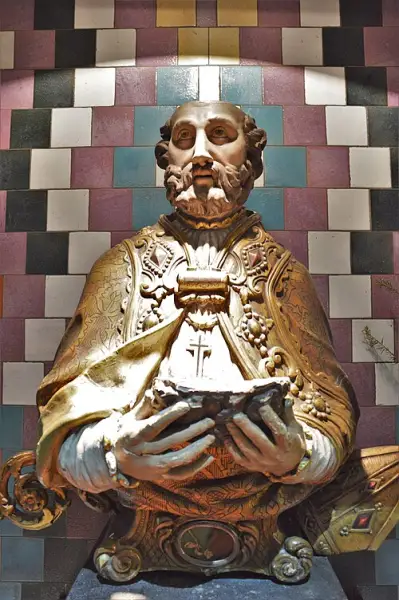
Overview
Chrysolius, known in French as Chrysole or Chryseuil, is honoured as the patron saint of Komen, or Comines, a town now divided between Belgium and France, and his bones received veneration at the Bruges basilica of St Donatian. Tradition holds that he came from Armenia and made his escape to Rome in the years when Diocletian was hounding the Christians. There the pope, Marcellus I, welcomed him and dispatched him to northeastern Gaul, where at Verlengehem he began his preaching. His legend then makes him a spiritual student of Saint Denis and a companion of Saint Piatus in the evangelization of the region of Cambrai and Tournai. Chrysolius became a bishop, and in the course of his mission he was halted by Roman soldiers and sentenced to lose his head, and the blade sliced away the crown of his skull. The legend relates that this severed fragment shattered into three parts as it fell, and at each spot where a portion landed a spring of wonder-working water burst from the earth. Chrysolius gathered up the crown of his head, made his way to Komen by the crossing of the Deûle that has carried his name ever since, and died there. People trusted the waters of those three springs to heal complaints of the throat and the eyes. He is commemorated on 7 February and depicted alongside Saints Hubert, Benedict, and Bernard in the rosette of the church of Saint-Vaast at Wambrechies.
The Complete Life
An Armenian Fleeing Persecution
Chrysolius, whose name appears in French sources as Chrysole and Chryseuil, belongs to that generation of missionaries whom the persecutions of Diocletian scattered across the Roman world. According to tradition he was a native of Armenia, the first kingdom to embrace Christianity as a state religion and, in these same years, a land of fierce suffering for the faith. Fleeing the persecution of Christians by Diocletian, he made his way west to Rome, the centre of the empire whose edicts had driven him from home. The city that had ordered the persecution also gave the refugee his commission: he was received there by Pope Marcellus I, the pontiff whose own brief and troubled reign fell within the same era of trial, and by him he was sent to northeast Gaul. The choice of destination was not accidental. The church of Rome was then actively extending its mission into the northern provinces, and priests from the eastern churches, already formed in confession and exile, were natural agents of that work. In Gaul he evangelized at Verlengehem, a village of the Flemish plain near the river Deûle, and from that modest beginning grew the whole later legend of the Armenian bishop-martyr of Flanders. So remote a figure, an Armenian preaching by a Flemish river at the turn of the fourth century, can be recovered only through tradition, but the tradition was strong enough to give his name to churches, springs, and a ford that are still identified today.
§ Life
Disciple of Denis and Bishop of the Mission
The legend of Chrysolius gives his missionary formation a distinguished lineage. He is said to have become a spiritual student of Saint Denis, the apostle of Paris and the most celebrated martyr-bishop of Gaul, whose own martyrdom on Montmartre had made him the model of the northern mission. Under this patronage Chrysolius was sent out with Saint Piatus of Tournai to carry the faith into the countryside about Cambrai and Tournai, the stretch of land between the Scheldt and the Sambre that was then the northern frontier of Gallic Christianity. The pairing is significant: the mission of the region was remembered as a shared work of several founders, and Chrysolius belongs in that company rather than as a solitary wanderer. He then became a bishop, a rank the older martyrologies, including André du Saussay's Martyrologium gallicanum of 1637, were careful to claim for him, though modern scholarship notes that the historical bishoprics of this region date only from the sixth century. Whatever the historical reality behind the title, the tradition remembers him as a shepherd with authority to confirm and ordain, a missionary equipped not merely to preach but to build. His vocation thus joined the two strands of the early Gallic church: the martyr-confessor who had fled persecution in his own land, and the organizing bishop who left behind converts, churches, and a cult watered by the springs of his own blood.
§ Life
The Beheading and the Three Springs
The passion of Chrysolius is told with the startling imagery characteristic of the Flemish martyrological tradition. In the course of his mission Roman soldiers halted him and a sentence of beheading was passed. The stroke fell short of its purpose, cutting away only the crown of his head, and the legend then relates the severed piece broke into three smaller pieces as it fell. Where each fragment touched the ground, a miraculous spring gushed out, so that the violence done to the missionary's head became the source of three living waters. The symbolism is transparent and theologically exact: from the wounded head flows the water of life, and the disfigurement of the preacher becomes the font of healing for the country that rejected him. Those spring waters enjoyed a reputation for healing complaints of throat and eye, a twofold grace that reads like a commentary on his ministry, for the throat of the preacher and the eyes of the newly enlightened are both consecrated in his blood. The cult of such springs belongs to the deep religious geography of the Low Countries, where wells and fords were holy long before the Gospel arrived, and the Christian legend simply baptized them: the holiness of the water was referred henceforth to the martyr whose skull had made it flow. Pilgrims came to the springs as they came to the ford of the Deûle, and the cures reported there kept the name of the Armenian alive in Flanders for fifteen centuries.
§ Veneration
The Walk to Komen
The last journey of Chrysolius is the most extraordinary passage of his legend. Having recovered the top of his cranium, he did not die where he had been struck but rose and walked on to Komen, the town on the Deûle that would take his patronage for its own. To reach it he crossed the Deûle by the ford that has carried his name ever since, a crossing still marked in the local topography of the region, and there at Komen he died. The image of the wounded bishop walking with the piece of his own skull, mile after mile across the flat Flemish country until he reached the place appointed for his rest, is hagiography of a deliberate kind: it establishes, in the idiom of legend, that the saint himself chose Komen, walking there by a miracle so that his body, and therefore his patronage, would remain in that town. The same motif of the walking martyr is found elsewhere in the passions of the Low Countries, where the place of burial determines the place of pilgrimage, and the walk after death is the saint's signature upon the landscape. His relics were later venerated in the basilica of St Donatian at Bruges, the great Carolingian collegiate church of the counts of Flanders, which gave the martyr of the Deûle a shrine among the most prestigious in the county. His death is placed around the year 300, at the height of the Diocletianic persecution that had first driven him from Armenia, so that the fugitive of that persecution became in the end one of its farthest-flung victims.
§ Life
Patron of Komen and Comines
The legacy of Chrysolius is written into the towns and churches of the Franco-Belgian border. He is the patron saint of Komen, or Comines, a town now divided between Belgium and France, and his cult spread through the surrounding plain: his bones were honoured in the Bruges basilica of St Donatian, while the façade rosette of the Saint-Vaast church at Wambrechies shows him alongside Saints Hubert, Benedict, and Bernard, a notable company for a local missionary. The springs of his passion long drew those seeking relief for ailments of the throat and eyes, and the ford of the Deûle still bears his name, so that geography itself preaches him. His chief monument, the church of Saint-Chrysole at Komen, rose again in neo-Byzantine style between the years 1922 and 1929, its forerunner having perished in the First World War, a rebuilding that made the martyr's church itself a kind of resurrection, rising from the ruins of the same Flanders he had evangelized. He is commemorated in the Roman Catholic Church on 7 February. Modern students of the period observe that the historical bishoprics of the Cambrai-Tournai region date only from the sixth century, and so treat the Armenian bishop as legend rather than record; but the cult has its own kind of truth, preserving the memory of an early evangelization of the north, and the people of Komen have kept their heavenly patron through war, flood, and every change of border.
§ Veneration
Timeline
- 300
Condemned to decapitation by Roman soldiers, he died at Komen, according to his legend walking there with the crown of his skull after the blade fell
§ Life
- 1922
The church of Saint-Chrysole at Komen was rebuilt in neo-Byzantine style through 1929, after its World War I destruction
§ Veneration
The Record
- Patron of
- Patron of Komen/Comines
- Symbols
- Fragmented skull·Miraculous springs·Bishop's regalia
- Canonization
- Pre-congregation; venerated in the Roman Catholic Church as patron of Komen/Comines.
Prayer
Bibliography
Show 4 sources
- William Smith and Henry Wace, A Dictionary of Christian Biography, Literature, Sects and Doctrines, 1877, vol. I s.v. "Chrysolius"
- Casteleyn, Maryse. (February 9, 2008). "Saint Chrysole a donné son nom à plus d'un lieu à Wambrechies". La Voix du Nord.
- André du Saussay, Martyrologium gallicanum (Paris 1637), noted in Smith and Wace
- The Cyclopedia of Biblical, Theological, and Ecclesiastical Literature. (James Strong and John McClintock, eds.) Harper and Brothers; NY; 1880
Profile text adapted from the Wikipedia article, licensed CC BY-SA 4.0.
Pray with this saint every day
Save St. Chrysolius to your favorites, read the full profile, and get feast-day reminders in the Saints app.
Get the Saints AppFree on the App Store for iPhone and iPad