
1867 – 1922·Feast Sunday before the Exaltation of the Holy Cross (7–13 September)
St. Chrysostomos of Smyrna
Hieromartyr and Metropolitan of Smyrna
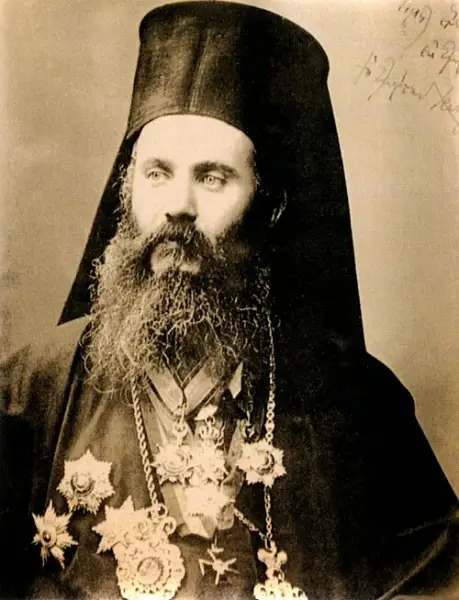
Overview
Chrysostomos Kalafatis, honored as Saint Chrysostomos of Smyrna, served as Greek Orthodox metropolitan bishop of Smyrna (modern İzmir) across two terms, 1910 to 1914 and 1919 until his martyrdom in 1922. His birth was at Triglia in Bithynia on 8 January 1867, among the eight children of Nikolaos and Kalliopi Kalafatis. Sent to the Theological School of Halki at seventeen, he graduated into service as archdeacon to Konstantinos Valiadis, Metropolitan of Mytilene, and later worked as a chancellor. In 1902 he became Metropolitan of Drama in northeastern Greece, but his loud nationalism led the Ottoman government to demand his dismissal in 1907, and he retired to Triglia until his elevation to Smyrna in 1910. Ottoman pressure displaced him in 1914; when the Hellenic Army landed in 1919 he was restored to his see and supported the Greek campaign in Asia Minor, though he quarreled bitterly with High Commissioner Stergiadis over the treatment of local Turks and the politics poured into sermons. When the Greek army collapsed in August 1922 he refused offers of escape and stayed with his flock. After Turkish forces entered the city he was seized at the cathedral, dismissed by the commander Nureddin Pasha, and murdered by a mob — beaten, mutilated, and dragged into a lane of the Iki Cheshmeli district, dying on 9 or 10 September 1922, days before the Great Fire of Smyrna. The Church of Greece numbered him among the saints in 1992.
The Complete Life
A Child of Triglia
Chrysostomos Kalafatis was born on 8 January 1867 in Triglia, a Greek town on the southern shore of the Sea of Marmara in the Bursa district of the Ottoman Empire — today the Turkish town of Tirilye. Nikolaos and Kalliopi Lemonidos Kalafatis raised eight children, of whom he was one, in a family of the ordinary Greek professional and mercantile class from which the Ottoman millet drew its priests and teachers. His formation was the standard one for a gifted boy of that world: the Theological School of Halki, the Greek Orthodox academy on the island of Halki (Heybeliada) near Constantinople, which he entered at the age of seventeen. Halki trained the episcopate of the Ecumenical Patriarchate in scripture, patristics, and Church history, and it was there, in the years after the tanzimat reforms and amid the rising national consciousness of the Greeks of the empire, that a country boy from Bithynia was turned into a hierarch. He would carry the nationalism of that generation into every office he held — a conviction, not yet a fault, that would shape his career and finally cost him his life.
§ Early life
From Archdeacon to Metropolitan
Graduating from Halki, Kalafatis served as archdeacon to Konstantinos Valiadis, the Metropolitan of Mytilene, and then held the post of chancellor — the administrative apprenticeship through which the Patriarchate tested its future bishops. In 1902 he was elected Metropolitan of Drama, a largely Greek and Bulgarian town in northeastern Greece then still under Ottoman rule. There his patriotism showed itself plainly. He preached and acted as a champion of Hellenism in a province contested between Greek and Bulgarian national movements, and his profile rose so high that the Sublime Porte itself — the Ottoman central government — asked for his removal in 1907. He gave up the see and went home to Triglia, spending three years in something close to exile from episcopal life. The setback did not end him: in 1910 he was translated to one of the greatest thrones of the Greek East, the metropolis of Smyrna, the prosperous port of Asia Minor with its huge Greek population. It was a promotion to the very center of the coming storm, and he occupied it as a national bishop in an age when nationality and confession had become one cause.
§ Early life
Shepherd of Smyrna in the Greek Years
Kalafatis governed Smyrna from 1910 until the Ottoman authorities displaced him in 1914, and the pattern of Drama repeated itself: a hierarch at odds with the state, too conspicuous for his politics to be tolerated. His return came with the Greek Army's landing in May 1919 at the opening of the Greco-Turkish War, when he was reinstated as metropolitan and, by Greek accounts, aided the campaign. Yet the occupation years placed him in conflict not with Turks but with his own side's proconsul. Aristeidis Stergiadis, the High Commissioner appointed by Prime Minister Venizelos, enforced strict order in the Greek zone, punished discrimination and abuse against local Turks, and objected to the political preaching of the metropolitan — sermons Stergiadis judged inflammatory. The American consul George Horton recorded the commissioner publicly cutting short a cathedral service when Chrysostomos drifted into politics, telling him he had asked for none of it. To the metropolitan, Stergiadis behaved with what looked like perverse defeatism; to the commissioner, the bishop was pouring oil on a fire. Chrysostomos remained an ardent Venizelist even while denouncing Venizelos's choice of Stergiadis, and in 1922, with the Turkish army advancing, he wrote the former prime minister the letter that survives as his testament: Hellenism in Asia Minor, he warned, was descending into hell.
§ Smyrna
The Lynching of September 1922
When the Hellenic Army broke in August 1922 and began its retreat from Anatolia, Chrysostomos was offered a way out of Smyrna and refused it, choosing to remain with his flock. Soon after the Turkish army entered the city, an officer and two soldiers took him from his office in the cathedral and brought him before the commander-in-chief, Nureddin Pasha, who told him his office as metropolitan was no longer acknowledged, that Mustafa Kemal declined to see him, and that he was to appoint a deputy and step aside. What followed was described by several witnesses. A captain in the crowd outside seized the bishop by his beard, accused him of blessing those guilty of atrocities during the Greek occupation, and forced him to hail Mustafa Kemal; the mob closed in, beat him, tore out his beard, and — in the account of French soldiers ordered not to intervene — stabbed him, gouged his eyes, and cut off his nose and ears. Dragged, by some accounts behind a vehicle, into a back street of the Iki Cheshmeli quarter, he died within hours, on 9 or 10 September 1922, days before the Great Fire destroyed the city. Mustafa Kemal, informed of the killing, is recorded as saying it should never have happened.
§ Lynching
A Saint of the Church of Greece
On 4 November 1992 the Holy Synod of the Church of Greece formally declared Chrysostomos of Smyrna a martyr and a saint of the Orthodox Church — a new-hieromartyr of the twentieth century, slain, in the Church's judgment, in hatred of the faith and of his office. His glorification came at a moment when the Orthodox churches were systematically reckoning with the martyrs of the Ottoman Greek catastrophe: the destruction of the Christian communities of Asia Minor in 1922 and the exchange of populations that followed. A bishop murdered by a crowd in the street, within days of the burning of his own cathedral city, took his place in that calendar almost as its emblem. His feast is kept on the Sunday before the Exaltation of the Holy Cross, a movable date falling between 7 and 13 September, close to the anniversary of his death and of the fire. Venerated in the Eastern Orthodox Church, he is commemorated as a hieromartyr — a bishop-martyr — and his icon, following the tradition of such saints, shows him in episcopal vestments holding a staff or a Gospel book.
§ Lynching
Memory of the Martyred Metropolitan
Chrysostomos's death became one of the fixed images of the Smyrna catastrophe of 1922, told and retold in Greek memory and in the Western accounts of the city's end. George Horton, the American consul who was in Smyrna until 13 September 1922 and wrote the classic contemporary indictment of the burning of the city, devoted pages to the metropolitan's murder; French soldiers who witnessed the lynching under orders not to intervene left an account of comparable force; and the memoir of the Turkish general Fahrettin Altay preserves the scene from the other side, including the report that Mustafa Kemal received the news with regret. His family survived him: he was mourned by nephews, among them Ioannis Elefteriades, who witnessed his uncle's arrest and execution and escaped as a refugee to Lebanon — where his grandson Michel Elefteriades is today a prominent Greek-Lebanese artist and producer. For the Greeks of Asia Minor and their descendants, the metropolitan who would not board the ship remains the shepherd who died with his people, an icon both of their church and of their catastrophe.
§ Family Survivors
Timeline
- 8 Jan 1867
Born at Triglia in Bithynia on 8 January, one of eight children of Nikolaos and Kalliopi Kalafatis
§ Early life
- 1902
Becomes Metropolitan of Drama in northeastern Greece after service as archdeacon at Mytilene
§ Early life
- 1907
The Sublime Porte demands his removal over his vocal nationalism; he withdraws to Triglia
§ Early life
- 1910
Installed as Metropolitan of Smyrna
§ Early life
- 1914
Displaced from his see under Ottoman pressure
§ Smyrna
- 1919
Restored to Smyrna when the Hellenic Army occupies the city at the start of the Greco-Turkish War
§ Smyrna
- 1922
Writes to Eleftherios Venizelos as Turkish forces approach, warning that Hellenism in Asia Minor is descending into hell
§ Smyrna
- 1922
Declines evacuation after the Greek defeat in August and remains in the city
§ Lynching
- 9 Sep 1922
Seized at the cathedral, repudiated by Nureddin Pasha, and lynched by a Turkish mob outside the Government House
§ Lynching
- 4 Nov 1992
Declared a saint and martyr of the Orthodox Church by Greece's Holy Synod on 4 November
§ Lynching
In Their Own Words
Hellenism in Asia Minor, the Greek State and the entire Greek Nation are descending now into Hell
The Record
- Patron of
- The Greeks of Asia Minor and their descendants·Persecuted Christian clergy
- Symbols
- Episcopal vestments·Pastoral staff·Gospel book
- Canonization
- Declared a martyr and saint by the Holy Synod of the Church of Greece on 4 November 1992
Prayer
Bibliography
Show 6 sources
- Akcam, Taner, A Shameful Act: The Armenian Genocide and the Question of Turkish Responsibility. Metropolitan Books (2006)
- Milton, Giles (2008). Paradise Lost: Smyrna 1922: The Destruction of Islam's City of Tolerance. London: Sceptre; Hodder & Stoughton Ltd. ISBN 978-0-340-96234-3.
- Horton, George (1926). The Blight of Asia: An Account of the Systematic Extermination of Christian Populations by Mohammedans and of the Culpability of Certain Great Powers; with the True Story of the Burning of Smyrna. Indianapolis: Bobbs-Merrill.
- Llewellyn Smith, Michael (1998). Ionian Vision: Greece in Asia Minor, 1919–1922. London: C. Hurst & Co. Publishers. ISBN 9781850653684.
- Altay, Fahrettin (1970). Görüb Geçirdiklerim — 10 Yıl Savaş 1912–1922 ve Sonrası. İstanbul: İnsel Yayınları, pp. 359–361.
- Mansel, Philip (2010). Levant: Splendour and Catastrophe on the Mediterranean. London: John Murray. ISBN 9780719567070.
Profile text adapted from the Wikipedia article, licensed CC BY-SA 4.0.
Pray with this saint every day
Save St. Chrysostomos of Smyrna to your favorites, read the full profile, and get feast-day reminders in the Saints app.
Get the Saints AppFree on the App Store for iPhone and iPad