
c. 516 – c. 549·Feast September 9
St. Ciarán of Clonmacnoise
Young Abbot and Founder of Clonmacnoise
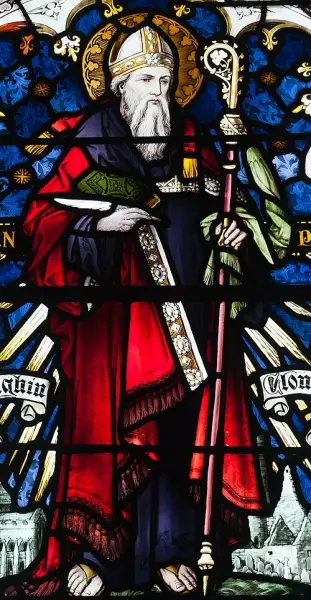
Overview
Ciarán of Clonmacnoise — born, it is said, Ciarán mac an tSaeir, "the carpenter's son" — counts among the Twelve Apostles of Ireland and the first abbot of Clonmacnoise, the great monastery on the Shannon. Born around 516 in County Roscommon, the son of a carpenter and chariot maker, he worked as a cattle herder as a boy. He studied at Clonard under St. Finian and in time became a teacher there himself; Columba of Iona praised him as a lamp of wisdom. Around 534 he left Clonard for Inishmore, the largest of the Aran islands, where he studied under Enda, who ordained him priest and directed him to found a church and monastery at Ireland's center. He later spent time with Senan on Scattery Island, and in 544 finally settled at Clonmacnoise, founding the monastery with ten companions. As abbot he labored on the first buildings himself, but died of plague about seven months later, still in his early thirties. The house he planted outlived him by a thousand years, becoming one of the most important centers of learning and religious life in Ireland, famed for its scribes and its school. He is called Ciarán the Younger to distinguish him from the elder Ciarán of Saigir; his many name-forms include Ceran, Kieran, Kyran, Queran, and Queranus, and he is a patron of Connacht.
The Complete Life
The Carpenter's Son of Roscommon
Ciarán was born in about 516 in County Roscommon, in the kingdom of Connacht, and the tradition has preserved one fact about his origins with unusual firmness: his supposed birth name, Ciarán mac an tSaeir, means "son of the carpenter," and his father worked as a carpenter and maker of chariots. In the Ireland of the sixth century this was a modest station — the craft of a skilled freeman, not of a noble — and it set Ciarán apart from the royal and aristocratic saints who fill the early Irish calendars. As a boy he herded cattle, the ordinary work of the young in a pastoral society, and the contrast between the herdsman of Roscommon and the abbot he became was remembered precisely because it was unusual. His name traveled under many spellings — Ceran, Kieran, Kyran, Queran, Queranus — and he is distinguished from an older namesake, Ciarán of Saigir, bishop of Osraige, as Ciarán the Younger. It was a humble beginning for the man who would be counted among the Twelve Apostles of Ireland, the circle of Finian's students who seeded the Irish church with monasteries.
§ Life
Student of Finian and Enda
Ciarán's formation ran through the two greatest schools of sixth-century Ireland. The first was Clonard, where he studied under Finian and where, in time, he himself became a teacher; Columba of Iona, who knew that generation of students, praised him, in the words Columba's saying preserved, as a lamp of wisdom. Around 534 he left Clonard for Inishmore, the great island of Aran off the Galway coast, to study under Enda — the monk under whom several of the Twelve served their apprenticeship. There Enda ordained him priest and gave him the counsel that determined his life: to go and found a church and monastery at Ireland's very center. The advice was strategic as well as spiritual — a foundation at the heart of the island could serve all provinces — and Ciarán spent the years afterward moving toward it: about 541 he travelled to Senan on Scattery Island in the Shannon estuary, another of the great monasteries of the age, before at last, in 544, finding the site Enda's words had pointed to. Finian's school at Clonard supplied a whole generation of founders, and the Twelve Apostles of Ireland — that circle of his students sent out to plant the great houses — counted Ciarán among their number from the earliest lists. His name reached the calendars under many spellings, Ceran, Kieran, Kyran, Queran, and Queranus among them.
§ Life
Seven Months at Clonmacnoise
In 544 Ciarán settled at Clonmacnoise, on the east bank of the Shannon where it crosses the central plain of Ireland, and founded a monastery there with ten companions. The place was close to the boundary of several provinces — a meeting ground of Connacht, Meath, and Munster — and it grew into one of the most important centers of learning and religious life in Ireland, a school, a scriptorium, and a burial place of kings. The founding abbot lived to see almost none of it. He worked with his own hands on the first buildings of the monastery, and about seven months after the foundation he died in a plague, still in his early thirties. The Irish church saw in that brief life a parable: the oldest stories about him turn on the envy of the other saints, who — Columba alone excepted — are said to have prayed that he would die young, since a man so gifted threatened to outshine them all; and he is said to have instructed his monks that his bones were to stay lying on the hillside, his spirit to be kept in preference to any relics. The monastery was his monument instead.
§ Life
The Dun Cow and Half-Matthew
The legends of Ciarán are among the best-loved in Irish hagiography, and two concern books. The first fixes the name of one of Ireland's oldest and most treasured literary manuscripts: the Lebor na hUidre — the Book of the Dun Cow — written out by a Clonmacnoise scribe in 1106. When Ciarán went to study at Clonard, the story runs, the cow went along as his fee, and its milk fed the whole abbey; after the saint's death, the hide of that cow became the parchment on which the great book was written — the monastery's holiest beast made the vehicle of its learning. The second story belongs to his student days: he lent his copy of the Gospel of Matthew to a fellow student, Ninnidh, and when Finian examined the class Ciarán knew only the Gospel's opening half. The others mocked him with the nickname Ciarán half-Matthew, and Finian silenced them with a prophecy — not half-Matthew but half-Ireland, since half the country would fall to him and they would share the remainder. A third tale gives him a fox for a servant, bearing the boy's school-work to his teacher until, grown, it made a meal of his satchel: the animals, like the books, serve the saint.
§ Legends
Death in a Plague
Ciarán's last half-year was the whole of his abbacy. He had found the site in 544, raised the first buildings with his ten companions, and then, roughly seven months into the work, contracted the plague then moving through Ireland and died, in about 549, aged in his early thirties. His last recorded instruction to his monks, in the legend already old when written down, was that they should not gather his bones into a shrine but leave them on the hillside — an instruction the community's later history quietly overrode, for his shrine became a treasure house dispersed bit by bit through the Middle Ages; the Clonmacnoise Crozier, however, survives, and is kept in the National Museum of Ireland. The figure who dies at thirty-three, having founded nothing greater in Ireland, invited the comparison his medieval biographers inevitably drew, and the church that venerated him kept his feast on 9 September, at the edge of autumn, when the Shannon valley he chose begins to empty toward winter. The boy herder from Roscommon was buried in the ground of the most famous school of the Gael.
§ Life
A Thousand Years on the Shannon
Clonmacnoise became one of the most important centers of learning and religious life in Ireland, and its longevity was extraordinary: it weathered the plundering of the Viking raids and the wars of the Anglo-Norman age, and was destroyed only in 1552, in the Dissolution of the Monasteries under Henry VIII — a working monastery for a full thousand years after its founder's death. Unusually for a great Irish house, the title of abbot, which carried the title Comarba of Saint Ciarán, was not hereditary, a fact the tradition connects with the humble origins of the founder himself. The ruins still stand above the Shannon and remain a center of civic and religious activity, among the most visited of Ireland's ancient sites. Ciarán's cult spread wide: he is a patron of Connacht, has a strong connection with Campbeltown in Argyll, once Ceann Loch Chille Chiarain, the head of the loch at Ciarán's kirk, near which pilgrims still visit a cave linked with him off Island Davaar — and the Celtic scholar Charles Plummer even suggested that he, rather than Ciarán of Saigir, lies behind Cornwall's Saint Piran. Venerated in both the Roman Catholic and the Orthodox Churches, he is one of the Twelve Apostles of Ireland.
§ Legacy
Timeline
- 516
Born in County Roscommon, Connacht, to a carpenter and chariot maker, and works as a cattle herder as a boy
§ Life
- 534
Leaves Clonard for Inishmore, studies under Enda of Aran, is ordained a priest, and is advised to build a church in central Ireland
§ Life
- 541
Travels to Senan on Scattery Island
§ Life
- 544
Settles at Clonmacnoise and founds its monastery with ten companions, becoming its first abbot
§ Life
- 549
Dies of a plague about seven months after founding the monastery, in his early thirties
§ Life
- 1106
A Clonmacnoise scribe compiles the Book of the Dun Cow, whose parchment a legend traces to Ciarán's cow
§ Legends
- 1552
The monastery of Clonmacnoise is destroyed during the Dissolution of the Monasteries
§ Legacy
In Their Own Words
He was a lamp, blazing with the light of wisdom.
Not Ciarán half-Matthew, but Ciarán half-Ireland, for he will have half the country and the rest of us will have the other half.
The Record
- Major works
- Foundation of the monastery of Clonmacnoise (544)
- Patron of
- Connacht
- Symbols
- Carpenter's tools, for the son of a carpenter·Book of the Gospels
- Canonization
- Pre-congregation; venerated from early times in the Roman Catholic and Orthodox Churches
Prayer
Bibliography
Show 7 sources
- Healy, John (1908), "Abbey and School of Clonmacnoise", The Catholic Encyclopedia, vol. IV. New York: Robert Appleton Company.
- Scherman, Katharine (1981), The Flowering of Ireland: Saints, Scholars, and Kings. Boston: Little, Brown. ISBN 978-0-316-77284-6.
- Farmer, David Hugh (1997), The Oxford Dictionary of Saints, 4th ed. Oxford University Press, p. 102.
- Gratton-Flood, W. H. (1907), "The Twelve Apostles of Erin", The Catholic Encyclopedia, vol. I. New York: Robert Appleton Company.
- Monahan, John (1886), Records Relating to the Dioceses of Ardagh and Clonmacnoise. Dublin: M. H. Gill and Son.
- "St. Ciaran of Clonmacnois", Orthodox Church in America.
- Challoner, Richard (1761), A Memorial of Ancient British Piety: or, a British Martyrology, p. 127. London: W. Needham.
Profile text adapted from the Wikipedia article, licensed CC BY-SA 4.0.
Pray with this saint every day
Save St. Ciarán of Clonmacnoise to your favorites, read the full profile, and get feast-day reminders in the Saints app.
Get the Saints AppFree on the App Store for iPhone and iPad