
5th century – c. 530·Feast March 5
St. Ciarán of Saigir
The Elder — First Bishop of Ossory
Overview
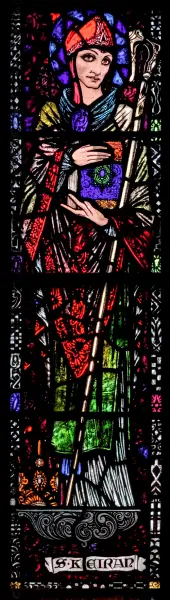
Ciarán of Saigir — Ciarán mac Luaigne, the Elder, so named to set him apart from Ciarán of Clonmacnoise — enjoys the reputation of being Ireland's first native-born saint, and was bishop of Saighir (Seir-Kieran) in Upper Ossory, remaining patron of its successor see, the diocese of Ossory. The martyrologies and the Irish genealogies make the father Lugna, a noble of the Dál Birn, Osraige's ruling house, and the mother Liadán, of the Corcu Loígde; before his conception his mother dreamed that a star fell into her mouth, and the druids told her the son she bore would be famous to the world's end. Cape Clear Island off County Cork is regarded as his birthplace, and he is said to have built a church there. Tradition holds that, already a Christian, he left Ireland to prepare for the Church, studying at Tours and Rome, and that on his return he settled as a hermit at Saighir near the Slieve Bloom Mountains, where disciples gathered and a great monastery grew around his cell — the chosen burial place of the Kings of Osraige. The Lives picture him in animal skins, a western John the Baptist dwelling in the wilderness before Patrick, with wild animals as his first pupils. Modern scholars dispute his dates across more than two centuries. He shares his feast of 5 March with his mother Liadán and his successor Carthach the Elder, and is often identified with Cornwall's Saint Piran.
The Complete Life
A Star Falling into a Mouth
The sources for Ciarán of Saigir are four medieval Lives — two in Latin and two in Irish, all of uncertain date and all written primarily to edify, so that, as the modern editors concede, it is unclear how far they represent real events. What they preserve about his birth is a genealogy and a portent. The martyrologies, above all the Félire Óengusso, and the Irish genealogies name his father Lugna (or Laighne), a nobleman of the Dál Birn, the ruling kin of Osraige, and his mother Liadán of the Corcu Loígde. Before Liadán conceived, she dreamed of a star dropping into her mouth; the dream she related to the druids, versed in such matters, and their answer was that the son she carried would win renown and holiness to the very ends of the earth. Cape Clear Island, lying off County Cork to the southwest, is held to be his birthplace, and the tradition relates that a church of his building stood there — with church ruins and a well of considerable age still to be seen on the island, along with a site associated with his youth. The dream of the star became, in effect, the motto of his cult.
§ Family background and early career
Formation at Tours and Rome
Ciarán's biography is, in the words of the scholarship, full of obscurities — but one thread runs through every account. Already a Christian, and a man of royal Osraige blood, he resolved to prepare himself for service of the Church, and to do so he left Ireland: he secured his education at Tours, the city of Martin, and at Rome. If the tradition is taken literally, this places him among the very first Irishmen to study for the priesthood abroad, a generation or more before the great age of Irish monastic scholarship, and it explains the odd episcopal character of his later career — he is a bishop of the old continental type rather than an abbot of the Irish type. The common claim is that his departure from Ireland preceded St. Patrick's coming, and the whole shape of his legend rests on that priority: he is counted the first saint born in Ireland, and in some accounts he met Patrick in Italy and made his allegiance to him there, though it is no less possible that Patrick, on arriving, consecrated him among his twelve helpers. His mother Liadán herself later came to Saighir with a company of women devoted to the service of God and of her son's community — a household saint as well as a national one.
§ Family background and early career
The Monastery in the Woods of Upper Ossory
On his return from Rome, Ciarán built himself a small cell in the woods of Upper Ossory and settled there as a hermit, at Saighir — also called Seir Kieran or simply Seir — near the Slieve Bloom Mountains. Disciples were drawn to the hermit, and a large monastery grew up around the cell; the house became the chief church of the Osraige, a base for evangelization that grew, on the accounts, into a populous and wealthy industrial community, as well as the chosen burial place of the Kings of Osraige — the dynasty of his own father's kin. One account ties the foundation to Patrick: sent to precede him, Ciarán was directed to build his monastery at the site of a well, and when he asked how the well might be found, he received from Patrick a small bell that stayed silent until brought to the spot. The site was eventually eclipsed by the later monastery of St. Canice at nearby Aghaboe, but for centuries Seir Kieran remained the spiritual capital of Ossory, and Ciarán its first bishop — the see that survives today as the diocese of Ossory, of which he is still the patron.
§ Foundation of Saighir
The Wild John the Baptist of Ireland
All four of the Lives agree on one image of Ciarán: a holy man clothed in skins, whose first pupils were the animals of the forest. The fox, the badger, and the wolf are said to have worked with the monks, cutting wood and building huts; when the fox stole the saint's shoes, Ciarán ordered the badger to retrieve him, and the badger returned with the thief bound from head to tail, whereupon the saint told the fox to repent as a monk would and go back to his tasks. The tradition has seen in this figure a western John the Baptist — a man in skins dwelling in the wilderness, a forerunner of Patrick as John was of Christ — and some modern writers have heard in the name Ciarán an echo of the older Celtic god Cernunnos, the horned tamer of wild beasts, though this remains speculation. The animal stories are not decoration: the monks remembered the beasts as the first brothers of the little monastery, the helpers of its building. Alongside them stand miracles of a more sober kind — a well he blessed that tasted of wine or honey — and the scholia of the Martyrology of Oengus credit him with foretelling the sanctity of Conall and Fachtna of Rosscarbery.
§ Miracles
Old Age and the Question of Dates
Ciarán's death came, as far as the tradition records, at an advanced age and from natural causes — an ending notable in itself among Irish saints, so many of whom are given martyrdoms or plagues. The date is genuinely uncertain, given as about 530, and the dispute over his lifetime is one of the oldest quarrels in Irish hagiography. The traditional Irish sources, his vitae and the Félire Óengusso, place his missionary work before Patrick but assign no dates; if that is right he was born near the end of the fourth century and evangelized in the fifth, a chronology accepted by Plummer, Hogan, and Kenny. According to W. O'Halloran, the Annals of Inisfallen have him born at Cape Clear in 352. Others — Baring-Gould, Sharpe, Ó Riain, Sperber — push his life into the fifth or even the sixth century; Lanigan and Leslie Stephen set him in the fifth, resting on stories that place him alongside Ciarán of Clonmacnoise and both Brendans, and Lanigan even suggested he was among Finnian of Clonard's first students and a bishop before about 544. The feast of 5 March is his in common with his mother, St. Liadán, and with his disciple and successor St. Carthach the Elder.
§ Pre-Patrician Arrival
Patron of Ossory, Ireland's First-Born Saint
The ruins of Ciarán's monastery, long the burial place of the Kings of Osraige, still stand at Seir Kieran, and other sites keep his memory — a monastic foundation near Errill, and the ruined church and ancient well upon Cape Clear, island of his birth and youthful retreat. His cult is kept on 5 March in Ireland and beyond, in England, Brittany, Wales, and Scotland, and his name carries institutional weight: St. Kieran's College in Kilkenny, founded in 1782 and the oldest Roman Catholic secondary school in Ireland, is named for him, as the diocese of Ossory takes him for its patron. He is traditionally identified with Saint Piran, the patron of Cornwall, Wales, and Brittany — an identification the scholar Pádraig Ó Riain has dismissed as groundless, but which the Cornish keep all the same, and which Plummer complicated by proposing instead the younger Ciarán of Clonmacnoise. He is often listed among the Twelve Apostles of Ireland, though the Martyrology of Oengus does not enumerate him as such, and his association with Finnian's students may be a persistent confusion. Even the popular culture of the internet has found him: a 2018 song, "Mr. Fox Felt Really Bad," retells the tale of the fox who stole his shoe.
§ Legacy
Timeline
- 352
W. O'Halloran reports that the Annals of Inisfallen place his birth at Cape Clear in Cork this year
§ Pre-Patrician Arrival
- 530
Dies at an advanced age from natural causes, in about this year, though his dates remain disputed
§ Miracles
- 1782
St. Kieran's College, the oldest Roman Catholic secondary school in Ireland, is founded and named for him
§ Legacy
In Their Own Words
it had the taste of wine or honey for everyone who drank it got drunk as well as filled
The Record
- Major works
- Foundation of the monastery and see of Saighir (Seir-Kieran)·A church on Cape Clear Island, by tradition
- Patron of
- Diocese of Ossory·Kingdom of Ossory·St. Kieran's College, Kilkenny
- Symbols
- Animal skins, as a "Western John the Baptist"·A little bell, given in the Patrick tradition
- Canonization
- Pre-congregation; bishop of Saighir, venerated in the Catholic, Orthodox and certain Protestant churches
Prayer
Bibliography
Show 7 sources
- Plummer, Charles (ed. and trans.), Bethada Náem nÉrenn (Lives of the Irish Saints), two Lives of St. Ciaran of Saigir. Available through CELT.
- O'Grady, Standish Hayes (ed. and tr.), "Life of S. Kieran of Saighir", in Silva Gadelica. 1892.
- Gratton-Flood, W. H. (1907), "The Twelve Apostles of Erin", The Catholic Encyclopedia, vol. I. New York: Robert Appleton Company.
- Johnston, Elva, "Munster, saints of (act. c. 450–c. 700)", Oxford Dictionary of National Biography. Oxford University Press, 2004.
- Ó Riain, Pádraig, "Ciarán of Saigir", in Seán Duffy (ed.), Medieval Ireland: An Encyclopedia. Routledge, 2005, p. 142.
- Farmer, David Hugh (1997), The Oxford Dictionary of Saints, 4th ed. Oxford University Press, pp. 102–103.
- Graves, Rev. James (1857), The History, Architecture, and Antiquities of the Cathedral Church of St. Canice, Kilkenny. Dublin: Hodges, Smith, & Co., p. 22.
Profile text adapted from the Wikipedia article, licensed CC BY-SA 4.0.
Pray with this saint every day
Save St. Ciarán of Saigir to your favorites, read the full profile, and get feast-day reminders in the Saints app.
Get the Saints AppFree on the App Store for iPhone and iPad