
1194-1253·Feast August 11
St. Clare of Assisi
Virgin, Foundress of the Poor Clares
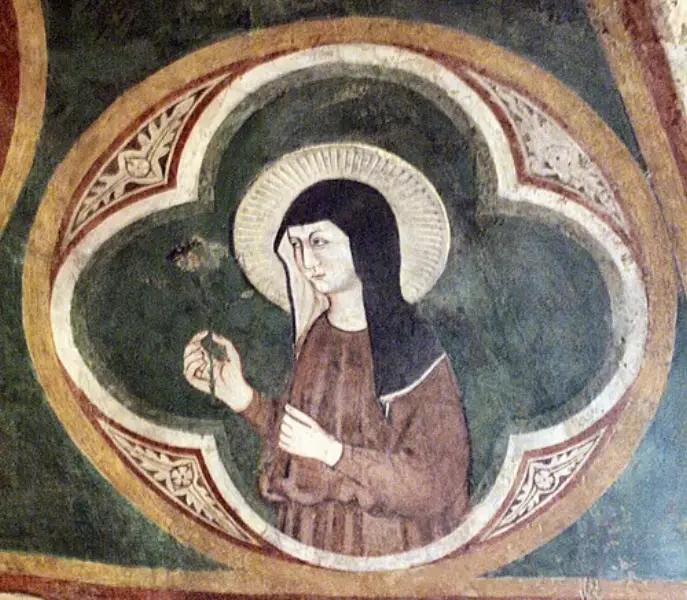
Overview
Chiara Offreduccio, eldest daughter of the noble Favarone di Sciffi and the devout Ortolana, grew up in an Assisi palace in the late twelfth century. At twelve she stalled her parents' marriage plans; a few years later, hearing Francis preach in San Giorgio, she found the shape her longing had waited for. On Palm Sunday evening, 1212, she slipped from her father's house to the Porziuncula, where Francis sheared her hair and exchanged her rich gown for a plain veil. Family pressure failed to drag her back — she bared her cropped head at the altar and they relented. Settled at last beside the repaired church of San Damiano, she gathered women into what became the Order of Poor Ladies, living barefoot, silent, meatless, owning nothing. Francis made her abbess in 1216, a charge she bore with the title of servant, saving the hardest work for herself and nursing Francis in his last illness. Against popes and the Lateran rules she defended her Privilege of Poverty, telling Gregory IX she would never accept release from following Christ. Twice, in 1240 and 1241, Saracen raiders were turned from San Damiano as she prayed before the Blessed Sacrament. Her own Rule, the earliest monastic rule we know to be written by a woman, was approved the day before she died, on 11 August 1253.
The Complete Life
Early Life
Chiara Offreduccio was born at Assisi in 1194, the eldest daughter of Favarone di Sciffi, a knight of the noble Offreduccio line, and of Ortolana, a pious woman who late in life herself entered her daughter's monastery. The household was a palace, and Chiara's upbringing was that of a marriageable noble girl in a town of faction and feuding. Something in her resisted it from the first: at twelve, when her parents arranged a match for her, she stalled the negotiations until they dropped the plan. She is said to have practiced secret austerities and given food and money away long before she had a word for what she was doing. What she lacked was a form; and the form arrived when a ragged merchant's son named Francis began preaching in the church of San Giorgio in the years after his own conversion, calling the people of Assisi to literal, rejoicing poverty after the naked Christ.
§ Early life
Conversion and Vocation
On the evening of Palm Sunday 1212 — the liturgy had rung with the Passion — Chiara slipped out of her father's house by a door used for the dead, crossed the town, and came to the Porziuncula, the ruined chapel Francis had repaired. There, in the presence of the brothers, Francis sheared her hair and exchanged her rich gown for a rough tunic and veil. She was eighteen. The family came after her at once; first to the Benedictine house at Bastia where she had been placed, then to Sant'Angelo in Panzo on the slopes of Subasio where she had moved her sister Catherine — whom Francis also received, renaming her Agnes. At Sant'Angelo the relatives laid hands on the girl, and Clare, baring her shorn head at the altar, showed them what could not be undone. They left. Within weeks she was settled at San Damiano, the chapel whose crucifix had first spoken to Francis, and women began to gather to her.
§ Life in the convent
Mission and Ministry
The community at San Damiano became the Order of Poor Ladies, later the Poor Clares: the second half of the Franciscan movement, enclosed where the brothers were itinerant. Francis gave the sisters no endowment and no property, and in 1215, when the Fourth Lateran Council required new communities to adopt an approved rule with stable revenues, he made Clare abbess — a title she held from 1216 while calling herself the servant of the sisters, taking the hardest work for herself, washing the feet of the lay sisters, and nursing the sick, including Francis himself in his last illness at San Damiano in 1225-26. Under her the house grew to some fifty women, and new foundations spread through Italy and beyond, Agnes going to the first of them at Monticelli near Florence. Clare ruled by letter as well as by example; her correspondence with Agnes of Prague, in which she writes of Christ as the mirror of eternity, is a major document of early Franciscan theology.
§ Life in the convent
Spirituality and Teaching
The core of Clare's spirituality was the Privilege of Poverty: that her community should possess nothing, absolutely and in perpetuity. She defended it against a series of popes. Innocent III had granted the privilege in principle in 1216; Honorius III and Gregory IX pressed her toward a more conventional Benedictine stability with revenues, and Gregory, visiting San Damiano, tried to persuade her in person to accept some property. She answered that she needed absolution from her sins, never release from following Christ, and he gave her the absolution and a form of words instead. She obtained from Innocent IV in 1247 a rule with the privilege embodied, and then spent her last years rewriting it: her own Rule, the earliest monastic rule known to be composed by a woman, binds the community to corporate as well as individual poverty. Her writings are few but substantial — four letters to Agnes of Prague, a Testament, a Rule, and a blessing — and they present a life of gazing on the mirror that is Christ, poor and crucified.
§ Life in the convent
Trial and Final Years
Clare's last decades were a long trial of the body. Illness confined her to San Damiano for the better part of twenty-nine years, and the later years brought attacks on the community's poverty from within the order as well as from the papacy. Twice the outside world broke in: in 1240 and again in 1241, bands of Saracen mercenaries in the army of Frederick II reached the valley and threatened the convent. According to her Testament, Clare, too sick to walk, had herself carried to the gate with the pyx containing the Blessed Sacrament and pleaded with the corporate Christ for his handmaids; the raiders withdrew. She spent her last days dictating her Rule and Testament and winning the papal approval she had sought for a lifetime, which Innocent IV confirmed on 9 August 1253, two days before she died. She died at San Damiano on 11 August 1253, commending her soul, in the words attributed to her, to the God who had created it.
§ Late life
Canonization
Clare was canonized with unusual speed. The process opened within weeks of her death at the order of Innocent IV, who had visited her; Alexander IV, the former Cardinal Rainaldo who had been her friend and protector at Assisi, canonized her at Anagni on 26 September 1255, a little over two years later. Her body was translated to a church built for her at Assisi in 1260. In 1258 the office of her feast, kept on 12 August and then on 11 August, spread through the Church; in the modern calendar her memoria is celebrated on 11 August, and in 1969 it was moved there from the 12th, correcting the date to that of her death. In 1958 Pope Pius XII named her patroness of television, on the strength of the tradition that on a Christmas night too ill to rise she had seen and heard the office at the basilica of Saint Francis as if present.
§ Legacy
Legacy
The Poor Clares are Clare's monument: a worldwide enclosed order of several federations and thousands of sisters, still living under a rule descended from the one she dictated, and still, where possible, without endowments. Within Franciscanism she is the co-foundress, the one who did for women what Francis did for men and who preserved his ideal of absolute poverty longer and more literally than the friars themselves managed. Her Rule's status as the first known monastic rule written by a woman has made her a figure of far more than devotional interest, and her letters to Agnes of Prague are read as spiritual classics. She is invoked for eye disease and, since 1958, as patroness of television; her incorrupt body lies at the Basilica of Santa Chiara in Assisi, and Assisi's two saints remain inseparable in the Church's memory. Her patronage of television has given her an unexpected modern presence, and artists have never tired of the image of the abbess holding the pyx against the Saracen raiders.
§ Introduction
Timeline
- 16 Jul 1194
Born in Assisi, eldest daughter of Favarone Sciffi, Count of Sasso-Rosso, and his wife Ortolana
§ Introduction
- 20 Mar 1212
Leaves her father's house on Palm Sunday evening and receives the haircut and plain robe from Francis at the Porziuncula
§ Early life
- 1212
Her sister Catarina, taking the name Agnes, joins her sixteen days later; the sisters settle at San Damiano
§ Early life
- 1215
The Fourth Lateran Council decrees that unapproved new communities must adopt an established rule, beginning her long fight for strict poverty
§ Life in the convent
- 1216
Reluctantly accepts the office of abbess of San Damiano at Francis's instruction
§ Life in the convent
- Sep 1240
A Saracen army attacking San Damiano is driven off as Clare prays before Christ in the Blessed Sacrament
§ Late life
- Jun 1241
A second Saracen assault on Assisi is likewise repelled through her prayer before the Blessed Sacrament
§ Late life
- 9 Aug 1253
Pope Innocent IV's bull Solet confirms her Rule as the governing rule of her Order of Poor Ladies, two days before her death
§ Death
- 11 Aug 1253
Dies at San Damiano aged 59, reportedly blessing God for having created her; buried at the chapel of San Giorgio
§ Late life
- 26 Sep 1255
Canonized as Saint Clare of Assisi by Pope Alexander IV in Rome
§ Death
- 3 Oct 1260
Her remains are translated from the Church of Saint George to the newly completed Basilica of Saint Clare in Assisi
§ Legacy
- 1263
Pope Urban IV renames the Order of Poor Ladies as the Order of Saint Clare in her honor
§ Death
- 1872
Her relics are moved to a newly built shrine in the crypt of the Basilica of Saint Clare
§ Legacy
- 1958
Pope Pius XII names her patroness saint of television
§ Legacy
In Their Own Words
Holy Father, never and in no way do I wish to be dispensed from following Christ!
Blessed be You, my God, for having created me.
I Clare, servant of Christ, little plant of our holy father Francis.
The Record
- Major works
- Rule of Life (Form of Life) of the Poor Ladies·Four Letters to Agnes of Prague·Testament
- Patron of
- Television (named patroness by Pope Pius XII in 1958, after her Christmas vision of the Mass from her sickbed)·The Order of Saint Clare (Poor Clares)
- Symbols
- Monstrance or pyx·Habit of the Poor Ladies·Palm (from her Palm Sunday flight)
- Canonization
- Canonized by Pope Alexander IV on 26 September 1255, two years after her death
Prayer
Bibliography
Show 12 sources
- 1 2 Grau, Engelbert (1992). "Saint Clare's privilegium Paupertatis Its History and Significance". Greyfriars Review . 6 (3): 327.
- ↑ Natali, Costanzo; Donno, Cristina. "Santa Chiara d'Assisi: La sua vita" (in Italian). Conferenza Italiana Ministri Provinciali Cappuccini . Retrieved 26 November 2018 .
- 1 2 3 Robinson, Paschal (1908). "St. Clare of Assisi." The Catholic Encyclopedia . 4. New York: Robert Appleton Company.
- ↑ Bartoli 1993 , p. 34–35.
- ↑ Botkin, Gene (26 April 2023). "Do Nuns Shave Their Heads?" . theosischristian . Retrieved 26 April 2023 .
- 1 2 3 4 5 Grau, Engelbert (1992). "Saint Clare's Privilegium Paupertatis Its History and Significance". Greyfriars Review . 6 (3): 328.
- 1 2 3 Pirlo, Paolo O. (1997). "St. Clare". My First Book of Saints . Sons of Holy Mary Immaculate. pp. 178– 179. ISBN 971-91595-4-5 .
- 1 2 3 Foley, Leonard, (revised by McCloskey, Pat). "Saint Clare of Assisi" , Saint of the Day , Franciscan Media.
- ↑ Alberzoni, Maria Pia. Clare of Assisi and the Poor Sisters in the Thirteenth Century . St. Bonaventure, New York: Franciscan Institute, 2004.
- ↑ Bartoli 1993 , p. 92ff.
- ↑ Bartoli 1993 , p. 95.
- ↑ Bartoli 1993 , p. 96.
Profile text adapted from the Wikipedia article, licensed CC BY-SA 4.0.
Pray with this saint every day
Save St. Clare of Assisi to your favorites, read the full profile, and get feast-day reminders in the Saints app.
Get the Saints AppFree on the App Store for iPhone and iPad