
1268 – 1308·Feast August 17
St. Clare of Montefalco
Augustinian abbess who carried Christ's cross in her heart
Overview
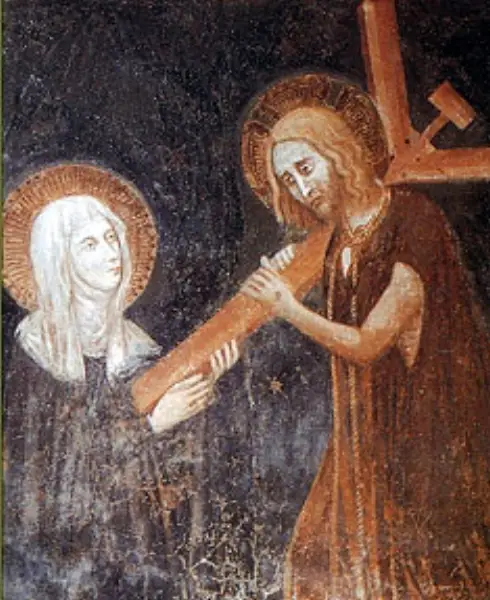
Clare of Montefalco, also called Clare of the Cross, was an Augustinian nun and abbess whose life spanned the whole sweep of Umbrian religious fervor in the late thirteenth century. Born in 1268 in Montefalco to the wealthy Vengente family, she entered religious life as a small child, joining the Franciscan Third Order community her elder sister Joan directed in a hermitage their father had built. In 1290 the group embraced the Rule of St. Augustine as a formal monastery, with Joan as its first abbess; when Joan died the following year, Clare, initially hesitant, was elected to succeed her and governed the community for sixteen years. Her fame rests on a vision of 1294, during which Christ appeared to her as a young man bearing a cross and declared her heart a fitting resting place for it. She spoke thereafter of carrying Christ within her, and when the nuns examined her body after her death on August 18, 1308, they reported finding a crucifix, scourge, and instruments of the Passion formed in her heart. Disputed at first, the findings survived an official inquiry, and Leo XIII canonized her in 1881.
The Complete Life
A Child of the Hermitage
Clare grew up in a household where holiness was a family undertaking. Her father Damiano, a wealthy citizen of Montefalco, had built a hermitage within the town itself, and there Clare's older sister Joan and Joan's friend Andreola lived as Franciscan tertiaries of the Secular Third Order of St. Francis. When the Bishop of Spoleto authorized Joan to accept additional sisters in 1274, Clare — then only six years old — joined the community, took up residence in the hermitage, and put on the Franciscan habit. What began as a household of three thus became, with the arrival of the child Clare and others, a genuine religious household. Growth continued, and by 1278 the sisters had outgrown their quarters: a larger hermitage was raised at a greater distance from the town to house the expanding community. Clare's formation, then, was entirely domestic and entirely Franciscan — she never knew the world outside this family of women, and her spiritual instincts were shaped from earliest childhood by the common life, the Franciscan penitential tradition, and the example of her own sister's leadership.
§ Life
From Franciscan Tertiary to Augustinian Abbess
In 1290 Clare and Joan, with their companions, resolved to advance from the Secular Third Order to monastic life in its stricter form. Because the Regular Third Order of St. Francis did not yet exist, they applied to the Bishop of Spoleto, who solved the canonical question by founding a monastery for them beside the church of Sant'Illuminata in Montefalco under the Rule of St. Augustine. Clare bound herself by the three religious vows and took her place among the Augustinian sisters; Joan was chosen as the house's founding superior, and the hermitage their father had built and funded was set apart as a monastery. The sisters' new canonical status lasted barely two years for Joan, who died on November 22, 1291. Clare was then elected abbess in her place. Her own instinct was to refuse: she was at first reluctant to accept so heavy an office, and yielded only when the Bishop of Spoleto himself intervened to require it. Thus at twenty-three she found herself superior of the house she had entered as a child, and she would hold that office for the remaining sixteen years of her life.
§ Life
The Cross in Her Heart
The year 1294 marked the turning point of Clare's interior life. At Epiphany, having unburdened her conscience in a public confession before all her sisters, she fell into an ecstasy that held her for several weeks. Unable to eat through that whole period, she survived on sugar water that the sisters fed her, and she recounted a vision in which she saw herself standing in judgment before God. Her official vita preserves its content: Christ came to her as a beautiful young man clothed in white, shouldering a cross, and told her that he was looking for somewhere to lay it down, and that he judged her heart a fitting place for it. From that experience forward, Clare spoke often of carrying Christ within her heart — so habitually that when, in her last sickness, a sister placed a crucifix at the head of her bed, she protested that she already had Christ with her. All her remaining years were marked by pain, yet she went on serving her sisters as their superior, teacher, mother, and spiritual directress, while her reputation for holiness and wisdom drew visitors to the Monastery of the Holy Cross.
§ Life
A Church for the Town
Clare's governance of her community combined spiritual authority with practical shrewdness. She guarded the monastery's communal harmony and kept firm hold of its daily domestic management, and the wisdom that attracted pilgrims to her door never dissolved into negligence toward the nuns under her care. Her most visible work was architectural. In 1303 she built a church at Montefalco intended to serve a double purpose: a chapel for her own community and a parish church for the townspeople. On June 24 the Bishop of Spoleto pronounced his blessing over the foundation stone, and the building was dedicated to the Holy Cross — Santa Croce — a fitting patronal choice for a woman who claimed Christ's cross as the dwelling of her inmost being. That modest church survives in altered form: its remnants make up the frescoed Chapel of Santa Croce now joined to the larger church of Santa Chiara in Montefalco. Sixteen years as abbess, one new church, and a community securely governed: these were the outward fruits of an apostolate that was otherwise hidden, exercised in confession, counsel, and the unglamorous stewardship of a small Umbrian monastery.
§ Life
A Holy Death
Clare's death approached with the same deliberateness that marked her life. On August 15, 1308, the solemnity of the Assumption, she asked to receive Extreme Unction, the church's final anointing. The next day she had her brother summoned to the monastery, so that her kin might stand about her. On August 17 she made her last confession. By the next day her illness had rendered her bedridden, yet hours before the end a sudden surge of strength came upon her — a phenomenon often noted in the deaths of the saints. She died at about forty years of age in a seated position, encircled by her fellow sisters, her chaplain, and her brother. The community she had governed for sixteen years did not treat her passing as an ordinary death. Convinced that God had favored her, the nuns embalmed her body with herbs and spices — a common practice for notable persons that allowed the corpse to be kept for public veneration — and observed that it showed no signs of natural decay. Sister Francesca of Foligno then opened the body, and in the cavity of Clare's heart found the crucifix that fixed her fame.
§ After Clare's death
Inquiry and Confirmation
The findings within Clare's body were extraordinary: a thumb-sized crucifix whose white body bore a livid reddish wound in the right side, a scourge and crown of thorns formed of whitish nerve fibers, and three dark nails of fibrous tissue; in her gallbladder, three stones the sisters took for a figure of the Holy Trinity. The monastery's physician, Master Simone of Spello, declined to dissect the organ as unworthy work, so Sister Francesca opened it herself. Miracles of healing, especially of injuries to the extremities, began to be reported at the heart, and these reports drove the canonization inquiries of 1318 and 1319. Skepticism came quickly: ecclesiastical and governmental authorities doubted the claimed cross and stones. A commission of physicians, jurists, and theologians investigated and rejected any thought that trickery or artifice lay behind the signs, and the vicar sent to Montefalco intent on punishing fraud ended by verifying the signs with his own examination and accepting their authenticity. The formal process then moved at the pace of centuries: Clement XII beatified Clare in Rome in 1828, and Pope Leo XIII enrolled her among the saints in Saint Peter's Basilica on the Immaculate Conception feast of December 8, 1881, reckoning her an Augustinian rather than a Franciscan.
§ Canonization
The Heart on Display
Clare's remains remain the center of her cult at Montefalco. In the crypt of the Basilica of Saint Clare, her statue stands within a glass sarcophagus; her bones are visible at its rear, though only to the nuns who have access to that space. Her heart, the vessel of the astonishing crucifix, is displayed separately in the same crypt for the veneration of pilgrims. The little church she raised in 1303 endures as the Chapel of Santa Croce within the larger basilica that bears her name, and the town she served has never ceased to claim her. Her patronage traveled far beyond Umbria: Montefalco honors her as its own, and she is invoked as well at Caniogan and in Pasig City in the Philippines, where Augustinian devotion carried her memory across the world. In the Church's memory she stands as proof of the substance behind her own saying — that Christ had chosen her heart for his rest. The nuns who opened that heart in 1308 believed they were only confirming what their abbess had told them all her life, and the inquiries that followed left the claim, however mysterious, standing unrefuted.
§ After Clare's death
Timeline
- 1268
Clare is born in Montefalco in Umbria, daughter of the wealthy couple Damiano and Lacopa Vengente.
§ Life
- 1274
At six years old, Clare joins the Franciscan Third Order and moves into the hermitage directed by her sister Joan.
§ Life
- 1278
The growing community builds a larger hermitage farther from the town.
§ Life
- 1290
The Bishop of Spoleto founds a monastery under the Rule of St. Augustine; Clare makes vows of poverty, chastity, and obedience, and Joan is elected first abbess.
§ Life
- 22 Nov 1291
Joan, the community's first abbess, dies; Clare is elected to succeed her, accepting the office after the Bishop of Spoleto intervenes.
§ Life
- 1294
During Epiphany, after a general confession, Clare falls into an ecstasy lasting weeks and sees Christ seeking a place to set down his cross.
§ Life
- 24 Jun 1303
Clare's new church is dedicated to the Holy Cross after the Bishop of Spoleto blesses its first stone; it serves both nuns and townspeople.
§ Life
- 18 Aug 1308
After receiving Extreme Unction on August 15 and making final confession, Clare dies aged about forty, seated among her sisters.
§ Life
- 1318
Reports of miracles at Clare's heart help initiate the first of two canonization inquiries.
§ Importance of these findings
- 1319
A commission of physicians, jurists, and theologians rules out fabrication, and the inquisitorial vicar becomes convinced of the signs' authenticity.
§ Nuns' controversy
- 13 Apr 1737
Pope Clement XII beatifies Clare in Rome.
§ Canonization
- 8 Dec 1881
On the feast of the Immaculate Conception, Pope Leo XIII canonizes Clare at Saint Peter's Basilica, recognizing her as an Augustinian.
§ Canonization
In Their Own Words
tiny aperture in the right side which is a livid reddish color
The Record
- Major works
- Monastery of the Holy Cross, Montefalco·Church of the Holy Cross (Santa Croce), Montefalco
- Patron of
- Montefalco·Caniogan·Pasig City, Philippines
- Symbols
- Cross
- Canonization
- Beatified 1828 in Rome by Pope Clement XII; canonized December 8, 1881 in Rome by Pope Leo XIII
Prayer
Bibliography
Show 6 sources
- Park, Katharine (2006). Secrets of Women: Gender, Generation, and the Origins of Human Dissection. Princeton University Press, p. 47.
- Park, Katharine (2006). Secrets of Women: Gender, Generation, and the Origins of Human Dissection. Princeton University Press, p. 39.
- Buckley, Jonathan; Mark Ellingham; Tim Jepson. Tuscany & Umbria: The Rough Guide. London: Penguin, 2000, p. 516.
- Lochrie, Karma (1991). Margery Kempe and Translations of the Flesh. University of Pennsylvania Press, p. 13.
- Weil, Tom. The Cemetery Book: Graveyards, Catacombs and Other Travel Haunts around the World. New York: Hippocrene, 1992, p. 319.
- Bornstein, Daniel Ethan; Roberto Rusconi; Margery J. Schneider. Women and Religion in Medieval and Renaissance Italy. University of Chicago Press, 1996.
Profile text adapted from the Wikipedia article, licensed CC BY-SA 4.0.
Pray with this saint every day
Save St. Clare of Montefalco to your favorites, read the full profile, and get feast-day reminders in the Saints app.
Get the Saints AppFree on the App Store for iPhone and iPad