
1641 – 1682·Feast February 15
St. Claude La Colombière
Jesuit confessor of Margaret Mary Alacoque
Overview
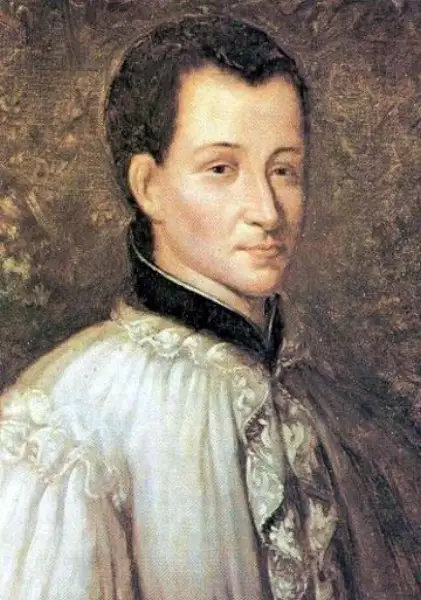
Claude La Colombière was a French Jesuit priest whose quiet fidelity placed him at the center of one of the great devotional movements of modern Catholicism. Born on February 2, 1641, at Saint-Symphorien-d'Ozon in the Dauphiné, the third child of a notary, he was educated at Vienne and at the Jesuit school in Lyon before entering the Society's novitiate at Avignon in 1658, at seventeen. Ordained in 1669 after studies in Paris, he won a reputation as a preacher of unusual clarity and soundness. In 1675, after a decisive experience of the Spiritual Exercises, he professed his final vows and was named rector of the Jesuit house at Paray-le-Monial, where he became spiritual director to the Visitation nuns — and thereby the confessor of Margaret Mary Alacoque, whose visions of the Sacred Heart he discerned, defended, and preached to the world. Sent to England in 1676 as preacher to the Duchess of York, he was imprisoned in 1678 under the anti-Catholic hysteria of the Popish Plot and expelled in 1679 with his health broken. He died at Paray-le-Monial on February 15, 1682, aged forty-one, and was canonized by Pope John Paul II in 1992.
The Complete Life
From the Dauphiné to the Novitiate
Claude La Colombière was born on February 2, 1641, in the town of Saint-Symphorien-d'Ozon, in the ancient Province of Dauphiné, the third child of Bertrand La Colombière, a notary, and his wife Margaret Coindat. The family soon relocated to nearby Vienne, where the boy began his education before moving on to the Jesuit school at Lyon for his secondary studies. The pattern of his life was thus fixed early: town by town along the Rhone corridor, in schools and churches run by the Society of Jesus. In 1658, at the age of seventeen, he presented himself at the novitiate of the Society in Avignon. His own notes preserve a striking honesty about that step, for he recorded that he did it despite what he called a terrible aversion for the life he was embracing — an admission that makes the following twenty-four years of exact fidelity the more remarkable. He completed the two-year novitiate, pursued higher studies in the same city, and after profession spent five years of regency teaching grammar and literature there, forming in the classroom the clarity of mind that would later mark his preaching.
§ Early life
Preacher and Vowed Religious
Paris claimed him in 1666, when Colombière was sent to study theology at the College de Clermont; there he was also assigned as tutor to the children of Jean-Baptiste Colbert, the royal minister of finances, an introduction to the world of the court that would later carry him to England. Ordained a priest in 1669, he taught first at his old school in Lyon and then joined the Jesuit community's preaching team, where hearers noted the clarity and soundness of his sermons. The decisive grace of his Jesuit life came in 1674. After fifteen years in the Society he undertook his tertianship, the final probation of the Jesuit course, and the Exercises of St. Ignatius led him to bind himself by a private vow, undertaken as the surest road to perfect fidelity: he would keep the Society's Rule and Constitutions without lapse, holding himself guilty of sin in any breach. His companions bore witness that the pledge was honored with remarkable exactness. On February 2, 1675, he professed the Fourth Vow of the Society, binding himself irrevocably to the service of the Church in obedience to the pope, and his superiors then assigned him to Paray-le-Monial.
§ Jesuit ministry
Paray-le-Monial and the Sacred Heart
The rectorship of a small Jesuit house in the remote Burgundian town of Paray-le-Monial would have seemed an unremarkable posting, except for one thing: adjoining the church stood the Monastery of the Visitation Sisters, among whose nuns was Margaret Mary Alacoque. The very oddity of posting so promising a preacher to so tucked-away a town has prompted the guess that the superiors had Margaret Mary specifically in view. Alacoque was in distress. Christ, she believed, had granted her a sequence of private revelations summoning her to spread devotion to his Sacred Heart, and the other sisters' disbelief left her anxious and alone. When Colombière arrived and began hearing the community's confessions, she recognized at last a priest in whom she could confide, and she opened her heart to him. After speaking with her repeatedly and praying at length over her case, he judged her visions genuine and cast in his lot with her cause — supporter and zealous apostle of the devotion that the Church would come to know as the devotion to the Sacred Heart. She later wrote that his talent lay in leading souls to God by the Gospel path of love and mercy.
§ The Sacred Heart
Prison, Exile, and Paray
In 1676 Colombière crossed to England as preacher to Mary of Modena, Duchess of York and wife of the future James II, taking up residence at the Court of St. James's. Even amid courtly duties he kept every religious observance of his rule, and he preached and heard confessions in England as vigorously as in France, while still guiding Alacoque by letter through the difficulties that beset her. The work broke him. Between his unflagging labors and the damp English air, his strength gave way, and a lung ailment seemed likely to finish his work. In November 1678, with his recall to France still pending, he was abruptly seized, denounced as a party to the Popish Plot fabricated by Titus Oates, and thrown into the King's Bench Prison, where over twenty Jesuits died in the anti-Catholic hysteria that followed. He escaped death thanks to his standing at the royal court and the protection of Louis XIV, but in 1679 he was expelled from England, his health ruined by imprisonment. His final two years went to Lyon, where he guided the Society's novices, and to Paray-le-Monial, to which he had gone back hoping to recover his strength. He died there on February 15, 1682, aged forty-one.
§ England
Confidence in God
Colombière left behind a substantial body of writing, gathered after his death under the title Oeuvres du R.P. Claude La Colombière, published at Avignon in 1832 and at Paris in 1864. Its principal components are Pious Reflections, Meditations on the Passion, and the Retreat and Spiritual Letters through which his counsel passed to souls far beyond his confessional. Pope Francis, in his encyclical on the Sacred Heart, pointed to the hallmark of this corpus: an absolute confidence in God, eloquently expressed in the priest's own words — that he was so convinced God keeps watch over those who hope in him. That confidence was not temperamental optimism but discipline learned in the Spiritual Exercises and sealed in the personal vow of 1674, by which he bound himself under penalty of sin to keep the Society's Rule and Constitutions perfectly. His companions' testimony that the vow was kept with great exactitude tells the story of his interior life better than any single event. From the aversion he confessed at seventeen to the prison writings of 1678, his spirituality was one of fidelity maintained against feeling — love expressed as perseverance, and hope as the refusal to doubt God's watchful care.
§ Death and veneration
Honored at Paray and in Rome
Devotion to Colombière grew with the devotion to the Sacred Heart that he had championed. He was beatified by Pope Pius XI on June 16, 1929, and the cause for his canonization was formally opened on November 14, 1934. On May 31, 1992, Pope John Paul II canonized him in Saint Peter's Basilica, enrolling among the saints the priest whose discernment had made the revelations of Paray-le-Monial part of the Church's universal life. His relics are preserved in the Jesuit Church at Paray-le-Monial, the town of his decisive ministry and of his death, where pilgrims of the Sacred Heart continue to visit his shrine. The Church keeps his feast on February 15, the anniversary of his death in 1682. In him the Society of Jesus honors a religious whose observance of his rule was certified by those who lived beside him, and the wider Church honors the confessor whose yes to a weeping Visitation nun in a provincial monastery opened one of the great channels of modern Catholic spirituality. He was canonized as a confessor — the title the infobox tradition gives him — a saint of fidelity rather than of spectacle.
§ Death and veneration
Timeline
- 2 Feb 1641
Claude La Colombière is born at Saint-Symphorien-d'Ozon in the Dauphiné, the third child of a notary and his wife Margaret Coindat.
§ Early life
- 1658
At seventeen, though he himself recorded a dread of the step, he enters the Jesuit novitiate at Avignon.
§ Early life
- 1666
He is sent to Paris to study theology at the College de Clermont and serves as tutor to the children of the minister Jean-Baptiste Colbert.
§ Jesuit ministry
- 1669
Colombière is ordained a priest, first posted to teach in his old Lyon school, then added to the Jesuit preaching team.
§ Jesuit ministry
- 1674
His tertianship proves decisive: the Spiritual Exercises move him to bind himself by a private vow to keep the Society's Rule and Constitutions without lapse, on pain of sin.
§ Jesuit ministry
- 2 Feb 1675
At the end of his tertianship he professes the Fourth Vow, is named rector at Paray-le-Monial, and as director to the Visitation nuns comes to know Margaret Mary Alacoque.
§ The Sacred Heart
- 1676
He is sent to England as preacher to Mary of Modena, Duchess of York, taking up residence at the Court of St. James's while continuing to guide Alacoque by letter.
§ England
- Nov 1678
He is arrested on a false accusation arising from Titus Oates's alleged Popish Plot and confined in severe conditions at the King's Bench Prison.
§ England
- 1679
Protected by his royal connections and Louis XIV, he escapes death but is expelled from England, returning to France with his health ruined.
§ England
- 15 Feb 1682
After two final years as director of Jesuit novices at Lyon and convalescence at Paray-le-Monial, he dies there aged forty-one.
§ Death and veneration
- 16 Jun 1929
Pope Pius XI beatifies Colombière in Vatican City.
§ Death and veneration
- 14 Nov 1934
The cause for his canonization is formally opened.
§ Death and veneration
- 31 May 1992
Pope John Paul II canonizes him in Vatican City.
§ Death and veneration
In Their Own Words
a terrible aversion for the life embraced
was that of bringing souls to God along the Gospel way of love and mercy which Christ revealed to us
The name of the Jesuit is hated above all else, even by priests both secular and regular, and by the Catholic laity as well, because it is said that the Jesuits have caused this raging storm, which is likely to overthrow the whole Catholic religion
My God, I am so convinced that you keep watch over those who hope in you ...
How can I expect men to honor me who dishonors God?
Jesus defeated the world by despising it.
The poor who give despite their poverty, who share what would be necessary to them like the widow of Zarephath, perform miracles, conquer Heaven.
Patience moderates the disorderliness of these three parts: it binds the tongue with silence, composes the face with tranquility, calms the heart with sweetness.
A secret cross is something very precious.
The Record
- Major works
- Pious Reflections·Meditations on the Passion·Retreat and Spiritual Letters·Oeuvres du R.P. Claude La Colombière (Avignon, 1832; Paris, 1864)
- Patron of
- Toymakers·devotion to the Sacred Heart of Jesus
- Canonization
- Beatified June 16, 1929, Vatican City, by Pope Pius XI; canonized May 31, 1992, Vatican City, by Pope John Paul II
Prayer
Bibliography
Show 10 sources
- "St. Claude De La Colombiere". Catholic News Agency. Archived from the original on 2017-02-15. Retrieved 2018-08-22.
- "Claude La Colombière, S.I." Vatican News Service. Retrieved 15 February 2013.
- "St. Claude La Colombiere, SJ (1641-1682)". Ignatian Spirituality. Archived from the original on 2019-09-14. Retrieved 2018-08-22.
- "Ven. Claude La Colombière". Catholic Encyclopedia.
- Kenyon, John (1972). The Popish Plot. London: William Heinemann Ltd. p. 206. ISBN 978-0434388509.
- "St. Claude la Colombière". AmericanCatholic.org. Retrieved 15 February 2013.
- "Saint Claude La Colombière", Jesuits/Global.
- Pope Francis, Dilexit nos, paragraph 126, published on 24 October 2024, accessed on 1 February 2025.
- Index ac status causarum beatificationis servorum dei et canonizationis beatorum (in Latin). Typis polyglottis vaticanis. January 1953. p. 53.
- Canonisation de Claude la Colombière homélie du pape Jean-Paul II, Basilique vaticane - Dimanche 31 mai 1992. Vatican.va (in French), accessed on 4 February 2025.
Profile text adapted from the Wikipedia article, licensed CC BY-SA 4.0.
Pray with this saint every day
Save St. Claude La Colombière to your favorites, read the full profile, and get feast-day reminders in the Saints app.
Get the Saints AppFree on the App Store for iPhone and iPad