
1st century·Feast March 20
St. Claudia
Christian of Rome named in the Second Epistle to Timothy
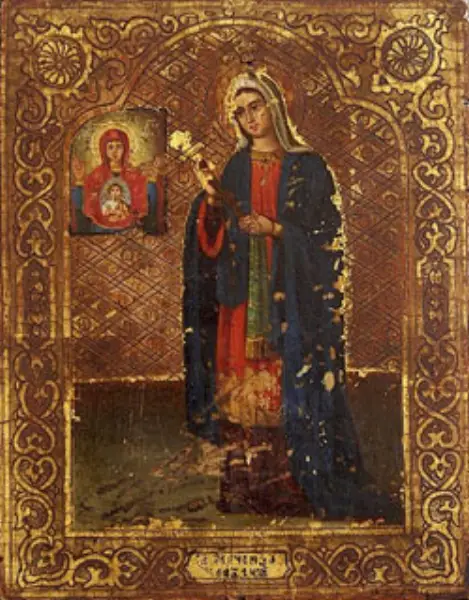
Overview
Claudia is the name of a Christian woman whom the Apostle Paul greets in his Second Epistle to Timothy, where she stands in the company of Eubulus, Pudens, and Linus. The single greeting has invited reflection for nearly two millennia, because Scripture preserves nothing further about her: her origins, her social standing, and her marital condition are all unknown, and that silence has given room to centuries of conjecture. Fourth-century Eastern tradition, recorded in the Apostolic Constitutions, identified her as the mother of Linus, whom that tradition honors as the first holder of the Roman see, consecrated to the office by the apostle's own hands. Since the nineteenth century, others have connected her with Claudia Rufina, a British woman living in Rome whom the poet Martial praised, and whose husband bore the name Aulus Pudens. The name Claudia is also carried by virgin martyrs of the Great Persecution: one among the eight martyrs of Amisos, who perished in the flames about the year 300, and another among the companions of Theodotus of Ancyra, put to death about 303.
The Complete Life
A Greeting Preserved in Scripture
The only certain notice of Claudia is the greeting of the Second Epistle to Timothy, where Paul, writing from confinement, sends her salutation together with that of Eubulus, Pudens, and Linus. Everything beyond that verse rests on inference, and the guesses began early. The fourth-century Apostolic Constitutions record a tradition that Linus, honored in the East as the first bishop of Rome and ordained to that office by Paul, was the son of a woman named Claudia; if the tradition is right, she stood at the head of one of the most consequential families of the early Roman church. A different line of identification arose in the nineteenth century, when scholars proposed joining the Claudia of the epistle to Claudia Rufina, a British noblewoman then living in Rome and celebrated by Martial for her wit and her fertility. That Claudia was the wife of Aulus Pudens, and the pairing of the two names in the epistle seemed to some too striking to be coincidence. She was accounted a daughter either of Cogidubnus or of Caractacus, kings of Britain within living memory of the Roman conquest. Yet the poet never says that she was a Christian, and no direct evidence binds her to the church, so the conjecture remains what it began as: an attractive possibility, incapable of proof.
§ Saint Claudia
The Martyrs Who Bear Her Name
Whatever the truth about the woman of the epistle, the church's calendars also remember other holy women named Claudia, witnesses of the great persecution under Diocletian. At Amisos on the Black Sea, a company of eight virgin martyrs gave their lives together, their names handed down together: Claudia, Alexandra, Euphrasia, Matrona, Juliana, Euphemia, and Theodosia, with Derphuta and her sister. Condemned for their faith, they were bound and burned at the stake around the year 300, and their common feast is kept on March 20. A second Claudia died at Ancyra among the companions of St. Theodotus, probably in 303. In that company she stood beside Theodotus' aunt Thecusa and six fellow virgins, named Alexandra, Phaina, Euphrasia, Matrona, and Julitta among them, who suffered outrage at the hands of their persecutors before being drowned in a marsh, a death devised to deny them even the dignity of a martyr's grave. Their feast is observed on May 18. Whether any of these witnesses is the same person as the Claudia of the epistle the evidence does not say, but the church honors them all under one name, joining the courage of the martyrs to the quiet fidelity of the apostolic age.
§ Saint Claudia
Timeline
- 300
A virgin martyr named Claudia was among the eight martyrs of Amisos who were put to death by fire during the persecutions.
§ Saint Claudia
- 303
Another Claudia suffered among the companions of Theodotus of Ancyra, who died in the Diocletianic persecution.
§ Saint Claudia
The Record
- Canonization
- Pre-congregation saint of the apostolic age, honored in Rome and in the calendars of the virgin martyrs
Prayer
Bibliography
Show 5 sources
- A. E. Humphreys, The Epistles to Timothy and Titus with Introduction and Notes, in J. J. S. Perowne (ser. ed.), Cambridge Bible for Schools and Colleges (Cambridge University Press, 1895), pp. 203 and 256 (Appendix H. Pudens and Claudia)
- Jerome D. Quinn and William C. Wacker, The First and Second Letters to Timothy: A New Translation with Notes and Commentary (William B. Eerdmans, 2000), p. 837
- Basil Watkins, The Book of Saints, 8th ed. (Bloomsbury, 2016 [1921]), p. 24
- Basil Watkins, The Book of Saints, 8th ed. (Bloomsbury, 2016 [1921]), pp. 713-14
- Martha Vandrei, "Claudia Rufina", in Gareth Atkins (ed.), Making and Remaking Saints in Nineteenth-Century Britain (Manchester, 2016), pp. 60-76
Profile text adapted from the Wikipedia article, licensed CC BY-SA 4.0.
Pray with this saint every day
Save St. Claudia to your favorites, read the full profile, and get feast-day reminders in the Saints app.
Get the Saints AppFree on the App Store for iPhone and iPad