
c. 607 – 696/699·Feast June 6
St. Claudius of Besançon
Abbot of Condat and bishop of Besançon
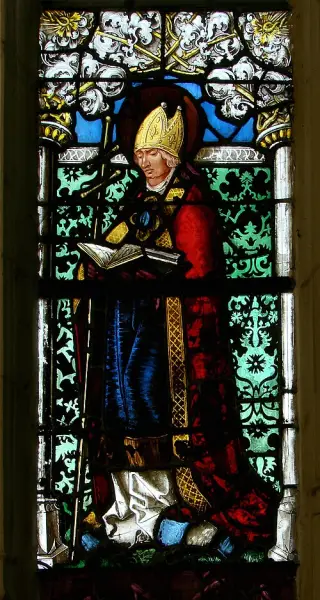
Overview
Claudius of Besançon, honored in French as Saint Claude and remembered as Claude the Thaumaturge, was a priest, monk, abbot, and bishop of the seventh-century Frankish church. Born around 607 in the castle of Bracon near Salins-les-Bains to a Gallo-Roman noble family named Claudia, he served as a border guard until the age of twenty, when the bishop of Besançon, Donatus, appointed him a canon. Renowned as a teacher and ascetic who ate but one frugal meal a day, he left his canonical post for the abbey of Condat in the Jura mountains, whose monks elected him their twelfth abbot in 641 or 642. He brought the Benedictine Rule to Condat, secured an annuity from King Clovis II at the persuasion of Queen Balthild, and made the house flourish with new churches, reliquaries, and care for the poor and pilgrims. In 685 the clergy of Besançon elected him their archbishop on the death of Saint Gervase; he served reluctantly as the city's twenty-ninth bishop, then, seeing discipline grown lax at Condat, abdicated his see and returned as its abbot. He died there in 696 or 699, and his memory reshaped the map of the Jura: the town of Saint-Claude bears his name.
The Complete Life
A Noble of the Franche-Comté
The Claudius whom the Church honors was born around 607, a native of the Franche-Comté, in the castle of Bracon near Salins-les-Bains, according to a long local tradition from Salins itself. His family, of Gallo-Roman stock, bore the name Claudia and had already given the Church another saint of the same name in the sixth century — a household in which sanctity ran in the line. Even the skeptics allowed the essentials: the Anglican patristic scholar Henry Wace, who dismissed so much of the surrounding legend as a vast farrago of improbabilities, saw no reason to question Claudius's noble birth. His biographer Laurentius Surius records that as a boy he was entrusted to tutors, and that alongside his academic studies he gave long hours to devotional reading, above all to the lives of the saints — an apprenticeship in holiness that would soon outstrip the career planned for him. He passed his youth on the frontier, a border guard under arms for the Frankish kingdom until his twentieth year; in 627 his path turned, when Donatus, the bishop of Besançon, appointed him a canon of that church and set him on the ecclesiastical road he would follow for the rest of his life.
§ Notes
Canon, Monk, Abbot of Condat
Under Bishop Donatus, Claudius became a model of the canonical life. Donatus had written regulations for his priests of the canonical order, and Claudius observed them assiduously; he grew famous in the city as a teacher and as an ascetic, restricting himself to a single frugal meal each day. Yet the cathedral was not to be his resting place. After serving as a priest at Besançon he withdrew to the abbey of Condat, set in the Jura mountains at the site later called Saint-Claude in his honor, and took up the monastic life. There the community recognized his gifts: in 641 or 642, at the age of thirty-four and during the pontificate of Pope John IV, the monks elected him to succeed as the twelfth abbot of Condat. The choice proved formative for the house. Claudius brought the Benedictine Rule to Condat, binding its common life to the discipline of the great Italian legislator, and under his governance the abbey thrived. He raised new churches and crafted new reliquaries for its shrines, and he opened the abbey's table to the poor and to pilgrims, feeding them in the region around the monastery.
§ Notes
Royal Patronage and a Flourishing Abbey
Claudius's reform of Condat drew support from the summit of Frankish power. He obtained the favor of King Clovis II — persuaded to grant it, the sources say, by his queen, Balthild, the former slave whose piety and patronage of monasteries marked the age — and from the monarch Claudius secured an annuity for his abbey. Steady royal subvention, strict observance, and the abbot's own gifts for building and charity combined to make Condat flourish. New churches rose within the complex, reliquaries enshrined the bones of its early abbots, and the poor and pilgrims of the Jura found food at its gates. It was a work of consolidation rather than conquest: unlike the missionary founders of the age, Claudius built no new foundation, but took an ancient house already venerable in the Jura and raised it to vigor under the Benedictine discipline. The fame that would later attach to the name of Claude the Thaumaturge had its roots in these decades: a monastery visibly prospering under a holy abbot, royal favor confirming its standing, and a region learning to associate the abbey's prosperity with the sanctity of the man who governed it.
§ Notes
A Reluctant Bishop Who Went Home
In 685, on the death of Saint Gervase, the clergy of Besançon elected Claudius as their archbishop. He accepted with reluctance, serving as the twenty-ninth bishop of the city according to the episcopal catalogues — a metropolitan throne for a monk who had never sought one. The episode that follows is the most telling in his life. Learning that discipline had grown lax at Condat in his absence, Claudius concluded that the abbey needed him more than the diocese did, and he determined to lay down his see and go back to be abbot of the community he had governed. A bishop resigning his office to go back to monastic obedience was a rare act in any century; the sources record it without embarrassment, because it was the key to his character. One tradition dates the resignation of his diocese to 687. He died at Condat in 696, though some accounts give 699, remembered there as the twelfth abbot rather than as a bishop — the office in which he had done his life's work, and to which he had sacrificed an archbishopric when the good of souls required it.
§ Notes
An Incorrupt Body and a Martyrologist's Pen
Claudius's veneration was established within two centuries of his death. Rabanus Maurus, the great abbot of Fulda, entered him in his ninth-century Martyrologium as an intercessor, with the words recording the deposition of the blessed Claudius, bishop, on the seventh ides of June — the sixth of June, the feast the Church still keeps. His body, said to have remained incorrupt, was hidden away for safekeeping during the Arab invasions that swept into the Frankish lands, and a ninth-century document testifies that it was already kept in the abbey church at what was then called Saint-Oyend, after Saint Eugendus. The shrine's history resumed dramatically in 1160, when the hidden body was rediscovered; in 1172 Peter II of Tarentaise came to venerate it, and the relics were borne in solemn procession across Burgundy before returning at last to Condat. Pilgrims came in such numbers that from the thirteenth century onward the town itself took his name: Saint-Claude superseded Saint-Oyend, and the cathedral built in the town was dedicated to him. The Revolution brought the cult's gravest loss — his relics were burned in March 1794 — but the name of the town, and the feast of June 6, remain.
§ Veneration
Saint-Claude and a Queen's Name
Few saints of the early medieval Frankish world left so legible a mark on the map. The Jura town where Claudius served and died, originally named for Saint Eugendus, has been Saint-Claude since the pilgrim crowds of the thirteenth century made his grave the heart of the place; its cathedral bears his dedication, and the abbey he ruled became one of the celebrated houses of the region. His cult also entered the history of French royalty in an intimate way: Queen Claude of France, first wife of Francis I, was named after him — a princess of the sixteenth century carrying the name of a seventh-century abbot of the Jura. Scholars have handled his legend with caution: Georges Goyau noted in the Catholic Encyclopedia that the saint's life has been the subject of much controversy, and Henry Wace dismissed the accretions of the legend-writers as improbable. Yet beneath the farrago stands a figure the sources consistently confirm — noble born, canon under Donatus, ascetic teacher, twelfth abbot of Condat, reluctant archbishop, and abbot again by choice. That outline, ratified by Rabanus Maurus and by centuries of pilgrims, is the Claudius the Church honors on June 6.
§ Veneration
Timeline
- 607
Claudius is born around this year in the castle of Bracon near Salins-les-Bains, to a Gallo-Roman family named Claudia.
§ Introduction
- 627
After serving as a border guard until the age of twenty, he is appointed a canon by Donatus, bishop of Besançon.
§ Introduction
- 641
At thirty-four, he is elected twelfth abbot of the abbey of Condat in the Jura mountains, during the pontificate of Pope John IV.
§ Introduction
- 685
On the death of Saint Gervase, the clergy of Besançon elect Claudius archbishop; he serves reluctantly as twenty-ninth bishop of the city.
§ Introduction
- 687
Seeing discipline grown lax at Condat, Claudius resigns his diocese and returns to the abbey as its abbot.
§ Veneration
- 6 Jun 696
Claudius dies at Condat on 6 June, remembered as its twelfth abbot; some sources instead place his death in 699.
§ Introduction
- 850
In the ninth century, Rabanus Maurus lists Claudius in his Martyrologium as an intercessor, noting his deposition on the seventh ides of June.
§ Veneration
- 1160
His body, hidden during the Arab invasions and said to be incorrupt, is rediscovered.
§ Veneration
- 1172
Peter II of Tarentaise visits the relics, which are carried solemnly through Burgundy before returning to Condat.
§ Veneration
- Mar 1794
Claudius's relics are burned in March 1794 amid the upheavals of the French Revolution.
§ Veneration
In Their Own Words
The Life of St. Claudius, Abbot of Condat, has been the subject of much controversy.
on this saint the inventors of legends have compiled a vast farrago of improbabilities
VII idus junii, depositio beati Claudii, episcopi
The Record
- Major works
- Abbey of Condat, reformed under the Benedictine Rule
- Symbols
- bishop's crozier·abbot's habit
- Canonization
- Pre-congregation: venerated since the early Middle Ages, recorded as an intercessor by Rabanus Maurus in the 9th century
Prayer
Bibliography
Show 6 sources
- "Saint-Claude (Municipality, Jura, France)".
- Herbermann, Charles, ed. (1913). "Saint-Claude". Catholic Encyclopedia. New York: Robert Appleton Company.
- Henry Wace, A Dictionary of Christian Biography, Literature, Sects and Doctrines (J. Murray, 1877), 552.
- "Saint Claude" (in French). Archived 31 December 2007 at the Wayback Machine.
- Matthew Bunson and Stephen Bunson, Our Sunday Visitor's Encyclopedia of Saints (Our Sunday Visitor Publishing, 2003), 211.
- Herbermann, Charles, ed. (1913). "St. Eugendus". Catholic Encyclopedia. New York: Robert Appleton Company.
Profile text adapted from the Wikipedia article, licensed CC BY-SA 4.0.
Pray with this saint every day
Save St. Claudius of Besançon to your favorites, read the full profile, and get feast-day reminders in the Saints app.
Get the Saints AppFree on the App Store for iPhone and iPad