
1751 – 1820·Feast March 15
St. Clement Mary Hofbauer
Redemptorist missionary and Apostle of Vienna
Overview
Clement Mary Hofbauer, born Johannes Hofbauer on 26 December 1751 at Tasovice in Moravia, was a hermit, baker, and finally a priest of the Redemptorist congregation, which he established north of the Alps and for that reason is honoured as a co-founder. The ninth of twelve children of a poor widow, he learned the baker's trade as a young man, tried the life of a hermit both in Moravia and at Quintiliolo near Tivoli, and completed his studies in his twenty-ninth year. Ordained in 1785 at Alatri, he and his companion were sent to plant the young congregation beyond the Alps. Blocked in Habsburg lands by the reforms of Emperor Joseph II, they went to Warsaw, where for twenty-one years Hofbauer built up the church of St. Benno, opened schools and a refuge for homeless boys, and recruited the first Germanic Redemptorists. Expelled in 1808 by order of Napoleon, he spent his last twelve years in Vienna as preacher, confessor, and spiritual guide to students and intellectuals, earning the title Apostle of Vienna. He died there on 15 March 1820, was beatified in 1888, and was canonized by Pius X in 1909.
The Complete Life
The Baker's Boy from Tasovice
Johannes Hofbauer, called Hansl by his family, was born on the feast of Saint Stephen, 26 December 1751, in the village of Tasovice in the Znojmo District of Moravia, in what is now the Czech Republic. He was the ninth of the twelve children of Maria Steer and Paul Hofbauer, a grazier and butcher whose family had formerly borne the Czech name Dvořák. The father died when the boy was six, leaving a widow with a large family and slender prospects. For the ninth child of such a household, the seminary seemed an impossible dream, yet Latin lessons with the local parish priest pointed early toward the priesthood. Those lessons ended abruptly when the boy was fourteen and the pastor died; the new incumbent had no time to continue the tuition. A trade had to be learned, and in 1767 Hansl was sent eight kilometres from home to Znojmo to apprentice as a baker. Three years later he moved to the bakery of the Premonstratensian priory at Louka, where war and famine had filled the poor at the priory gate, and where he laboured around the clock to feed them.
§ Early life
Hermit, Pilgrim, Late Student
In 1775 Hofbauer left the priory and attempted the solitary life of a hermit, but the experiment was cut short when Emperor Joseph II, the apostle of enlightened absolutism, abolished every hermitage in the Habsburg Empire. He went to Vienna and took up baking again. A pilgrimage to Rome in 1782 led him to Tivoli, where at the shrine of Our Lady of Quintiliolo the local bishop, Barnabas Chiaramonte, the future Pope Pius VII, clothed him in the hermit's habit. There he took the name by which history knows him: Clement, most likely after the martyr Pope Clement of Rome, and Mary in honour of the Virgin. He gave himself to prayer and to the service of pilgrims, but within six months he understood that the call to priesthood outweighed even the eremitical life. Back at Louka he baked bread and resumed his Latin, and at twenty-nine, sponsored by two women he had met serving Mass in the priory basilica, he enrolled at the University of Vienna. The theological faculties were permeated by Josephist rationalism, yet by 1784 he had finished philosophy — and there his road to ordination ended, for the emperor had forbidden religious communities to receive candidates.
§ Baker and hermit
Warsaw: Twenty-One Years of Mercy
On Saint Joseph's day, 19 March 1785, Hofbauer and his companion Hübl received the Redemptorist habit and publicly professed vows; ten days later they were ordained priests in the cathedral of Alatri. Their superior general sent them to carry the congregation north of the Alps, and since Joseph II would not tolerate it in their homeland, they turned to Poland, joined on the road by the baker Peter Kunzmann, who became the first non-Italian Redemptorist lay brother. They reached Warsaw in February 1787 penniless, having given away their last three coins to beggars, and were entrusted with the church of St. Benno for the city's German-speaking faithful, together with an orphanage and a school. What followed was two decades of astounding work amid the catastrophe of Poland's partitions: five sermons on any weekday in German and Polish, a priest available for confession at any hour, and sacramental receptions rising from two thousand in 1787 to over a hundred thousand by 1800. Hofbauer opened the Child Jesus Refuge for homeless boys, enlarged it into an academy, begged from door to door for his orphans, and by 1808 numbered thirty-six Redemptorists around him — until Napoleon's order of 9 June 1808 sent them all to a Prussian fortress and out of Poland.
§ Mission beyond the Alps
Preacher, Beggar, Man of the Blessed Sacrament
The spirituality that sustained Hofbauer's ceaseless activity was Eucharistic and Marian, practical and unsentimental. He begged for his boys without embarrassment, and one evening in a tavern, when a customer spat beer into his face at the request for a donation, he wiped his face and answered that that was for him — what did the man have for his boys? The humiliated drinkers handed over more than a hundred silver coins. Overwhelmed by need, he would go to stand in front of the tabernacle, crying out for the Lord's help, for it was high time. His programme at St. Benno's amounted to a daily mission in perpetuity: three sung Masses, the little office of our Lady, adoration of the tabernacle, stations of the Cross, evening prayer, litanies, and sermons in two languages. From the boys in his care he recruited future Redemptorists, teaching them philosophy and theology himself. In Vienna the pattern repeated among a different class: he gathered students and the intellectual elite around him, guided the artist Friedrich August von Klinkowström, the philosopher's daughter Dorothea von Schlegel, and Zacharias Werner into the Church, and helped to frustrate the plan of a German national church that would have absorbed Vienna's Catholics.
§ Evangelisation
Apostle of Vienna
Released from the fortress of Kostrzyn after a month but barred forever from Poland, Hofbauer arrived in Vienna in September 1808 and remained there until his death almost thirteen years later. When Napoleon's forces attacked the city in 1809 he served as a hospital chaplain among the wounded. The archbishop gave him an Italian church to care for, and in July 1813 he was appointed chaplain to the Ursuline Sisters, attending to the nuns and to the lay people who crowded their chapel; word ran through the capital of his power in the pulpit and his gentleness in the confessional. Once more opposition found him: he was briefly forbidden to preach, and for corresponding with his superior general in Rome he was threatened with expulsion. But when the instrument of expulsion reached Emperor Franz in Rome, the pope's representations turned it around entirely — the emperor returned not with a writ but with an invitation, and chose and refurbished a church for the congregation's first Austrian house. Hofbauer never saw it open: he sickened at the beginning of March 1820 and died on the 15th; his funeral was one of the great public events of Vienna, and his remains were moved to the Redemptorist church in 1862.
§ Vienna
Raised to the Altars
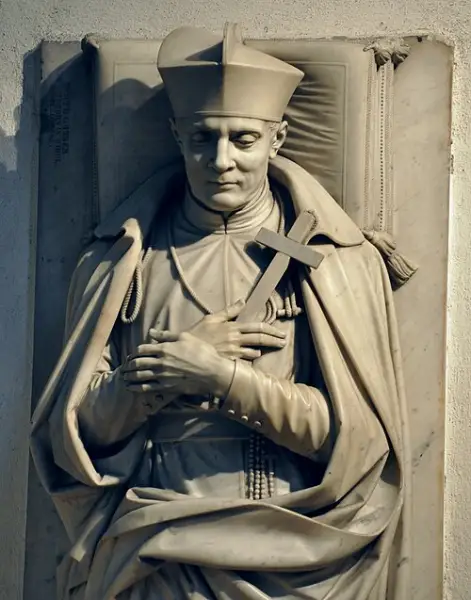
The recognition of Hofbauer's sanctity moved swiftly by the standards of the age. In 1888 Pope Leo XIII opened the process of canonisation with his beatification, twenty-one years of fruitfulness in Warsaw still fresh in the Church's memory. In 1909, twenty-one years later again, Pope Pius X declared him a saint. In gratitude for his two decades of labour in their capital, the Polish Episcopate wrote his name into the catalogue of Poland's saints, and his liturgical feast was fixed on 15 March, the day of his death, though the Franciscan calendar lists him on 16 March. Devotion followed the paths of his own life: a few months after the canonisation a parish church was dedicated to him in New York City to serve the Polish community, and in 1911 the St.-Clemens-Kirche rose in Berlin. He had entered the iconography of the Church depicted in the Redemptorist habit with the cross as his attribute, and he stands among the patrons of bakers and waiters, honourable trades at which he had worked with his own hands. Dartmouth College's Catholic student chapel honours him as patron, a fit patron for the students he never stopped gathering.
§ Veneration
Co-Founder and Father of a Revival
Hofbauer's lasting significance rests on two foundations. As the man who established the Redemptorists beyond the Alps, he is honoured as a co-founder of the congregation: every Redemptorist house in the German-speaking world, in Poland, and eventually in Ireland through his disciple Frederick von Held descends from the two wandering priests he led to Warsaw in 1787. As the Apostle of Vienna he stands at the head of the Catholic revival in nineteenth-century Austria: the circle of learned converts and students who gathered in his rooms nourished a religious renewal that outlived him, even though the revolution of 1848 scattered the order's archives and cost posterity many documents of his activity. His name is woven into the culture of two nations — Jan Matejko placed him among the figures of his great 1891 painting of the Constitution of 3 May 1791, and a statue of him stands on the Minoritenplatz in Vienna, where he shares the city's patronage with St. Colmán, St. Leopold, and St. Peter Canisius. The teacher of the poor and the confessor of professors is remembered by both: the Church honours in him the man who proved that a baker's hands and a theologian's mind can serve the same love.
§ Legacy
Timeline
- 26 Dec 1751
Born Johannes Hofbauer at Tasovice in Moravia on the feast of Saint Stephen, the ninth of twelve children.
§ Early life
- 1757
His father Paul, a grazier and butcher, died when the boy was six years old.
§ Early life
- 1767
Sent to Znojmo as an apprentice baker.
§ Baker and hermit
- 1770
Took work at the bakery of the Premonstratensian priory of Louka, feeding the war- and famine-stricken poor at its door.
§ Baker and hermit
- 1775
Left the priory to embark on the life of a hermit.
§ Baker and hermit
- 1782
On pilgrimage to Italy, was clothed as a hermit at the shrine of Our Lady of Quintiliolo near Tivoli and took the name Clement Mary.
§ Baker and hermit
- 1784
Completed his philosophy studies at the University of Vienna, sponsored by two ladies of the priory basilica.
§ Baker and hermit
- 19 Mar 1785
Receives the Redemptorist habit on the feast of Saint Joseph, vowing poverty, chastity, and obedience together with Hübl.
§ Redemptorist
- 29 Mar 1785
Ordained to the priesthood ten days later at the Cathedral of Alatri with his companion Hübl.
§ Redemptorist
- Feb 1787
Reached Warsaw in February; the bishop of Poznań entrusted the trio with the church of St. Benno for the city's German-speaking Catholics.
§ Poverty
- 1791
The children's refuge he had opened was enlarged into an academy; a boarding school for girls was begun.
§ Evangelisation
- 1793
Made vicar-general for all Redemptorist work beyond the Alps; opened houses in Germany and Switzerland.
§ Evangelisation
- 9 Jun 1808
At Marshal Davout's request, Napoleon signed an order that the Redemptorists be transported to the fortress at Kostrzyn nad Odrą.
§ Evangelisation
- Sep 1808
Released after a month and barred from Poland, he arrived in Vienna, where he would remain for nearly thirteen years.
§ Vienna
- Jul 1813
Appointed chaplain to the Ursuline Sisters in Vienna, after four years caring for an Italian church and wounded soldiers.
§ Vienna
- 15 Mar 1820
Died in Vienna after a short illness; his funeral was a great public event in the city.
§ Vienna
- 1862
His mortal remains were exhumed and transferred to Vienna's Redemptorist church.
§ Vienna
- 29 Jan 1888
Beatified by Pope Leo XIII, who thereby started the process of canonisation.
§ Veneration
- 20 May 1909
Canonized by Pope Pius X twenty-one years later; a New York parish under his patronage soon followed.
§ Veneration
In Their Own Words
Lord, help! It's high time...
The Record
- Major works
- Redemptorist congregation established north of the Alps·Church of St. Benno, Warsaw·Child Jesus Refuge for homeless boys·Redemptorist foundation in Austria
- Patron of
- Vienna·bakers·waiters·co-patron of Warsaw
- Symbols
- Redemptorist habit·cross
- Canonization
- Beatified by Pope Leo XIII on 29 January 1888; canonized by Pope Pius X on 20 May 1909
Prayer
Bibliography
Show 7 sources
- "Saint Clement Mary Hofbauer | Franciscan Media". 2022-03-16.
- Magnier, John. "Blessed Clement Mary Hofbauer." The Catholic Encyclopedia Vol. 4. New York: Robert Appleton Company, 1908.
- "St. Clement Hofbauer", Living Redemptorist Spirituality: Prayers, Devotions and Reflections. North American Commission for Partnership in Mission, 2009.
- "New Catholic Dictionary – Saint Clement Mary Hofbauer". CatholicSaints.Info. 2012-09-15.
- Franz, Hermann. "Joseph II." The Catholic Encyclopedia Vol. 8. New York: Robert Appleton Company, 1910.
- Davies, N. (2005). God's Playground. A History of Poland: Volume II: 1795 to the Present. OUP Oxford. ISBN 978-0199253401.
- Kempf, Constantine, SJ. The Holiness of the Church in the Nineteenth Century: Saintly Men and Women of Our Own Times. Francis Breymann, SJ, trans., 1916.
Profile text adapted from the Wikipedia article, licensed CC BY-SA 4.0.
Pray with this saint every day
Save St. Clement Mary Hofbauer to your favorites, read the full profile, and get feast-day reminders in the Saints app.
Get the Saints AppFree on the App Store for iPhone and iPad