
c. 147 – c. 215·Feast December 4
St. Clement of Alexandria
Theologian of the Catechetical School of Alexandria
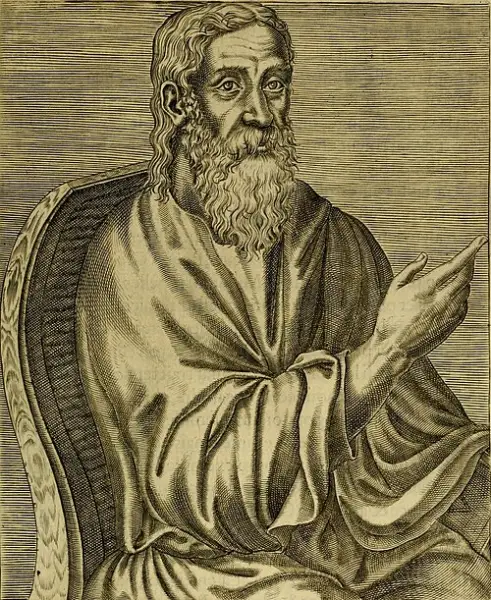
Overview
Titus Flavius Clemens, known to history as Clement of Alexandria, lived from about 147 to about 215 and taught Christian theology and philosophy at the catechetical school of Alexandria; among those who sat under him were Origen and Alexander of Jerusalem. A convert from paganism, he brought to the faith a deep education in Greek letters, and he absorbed Hellenistic philosophy — Plato and the Stoics above all — more thoroughly than any Christian writer of his generation. After rejecting paganism as morally corrupt, he wandered in search of Christian teachers through Greece, Asia Minor, Palestine, and Egypt before settling in Alexandria around 180, where he studied under Pantaenus and was ordained a priest. During the Severian persecution of 202–203 he left the city, and he died around 215, probably far from Egypt. His great trilogy — the Protrepticus, the Paedagogus, and the Stromata — made the first systematic case that Greek philosophy was a preparation for the Gospel, and he articulated a Christian understanding of gnosis as spiritual knowledge perfected by love. Once revered as a Father of the Church in East and West, he remains venerated in the Coptic, Ethiopian, Eastern Catholic, and Anglican traditions, and his feast is kept on 4 December.
The Complete Life
A Pagan Education Turned to Christ
Neither the date nor the place of Clement's birth can be fixed with certainty; scholars place it around the year 147, and while Epiphanius of Salamis reports that he was born in Athens, a rival tradition gives Alexandria as his city. His parents were pagans, and he was formed in the whole apparatus of Greek religion and the mystery cults — knowledge he later displayed so exactly in the Protrepticus that it can only have come from his family's own practice. As a young man he rejected that inheritance, judging paganism morally corrupt, and he set out on a journey that was at bottom a religious quest: through Greece, Asia Minor, Palestine, and Egypt. Along the way he attached himself to Christian teachers of different traditions — an Ionian theologian in Greece whom many identify as Athenagoras, an Assyrian in the East sometimes identified with Tatian, and a Jew who may have been Theophilus of Caesarea. The journey made him one of the most cosmologically educated Christians of his age, at home in classical philosophy and literature as no other Father of his generation was. Around the year 180 the search ended at Alexandria, where he found Pantaenus teaching in the Catechetical School and submitted himself to his instruction.
§ Biography
Pantaenus, Priesthood, and the School
At Alexandria Clement studied under Pantaenus, the teacher whom Eusebius presents as head of the Catechetical School, though scholars debate how formally the school's leadership was structured before the time of Origen. There Clement's vocation crystallised: he was ordained to the priesthood before 189, and in due course he himself taught in the school, numbering among his students Origen, the greatest theological mind of the following generation, and Alexander, later bishop of Jerusalem, who remembered him always as master and benefactor. Virtually nothing is known of his personal circumstances in the city; a passage in his own writings has suggested to some that he was married. His teaching was shaped by the conviction that would mark all his work: that the God who spoke in Scripture had also prepared the Greeks through philosophy, as he had prepared the Jews through the law. The persecution that broke out under Septimius Severus in 202–203 scattered the Alexandrian church and ended his time in the city. He left Alexandria, and by 211 a letter of Alexander of Jerusalem commending him to the church of Antioch suggests he was then living in Cappadocia or Jerusalem, carrying his Alexandrian learning into the churches of the East.
§ Biography
The Trilogy: Exhorting, Educating, Instructing
Clement's three great surviving works form a deliberate programme. The Protrepticus, written about 195, is an appeal to the Greeks to abandon the gods of poetry and cult for the true Logos; it traces Greek religion through seven successive stages, from the first honours paid to sun and moon down to the deification of men like Asclepius and Heracles, it exposes paganism with an anthropologist's eye and opposes the song of Orpheus to the Word of Christ. The Paedagogus, composed about 198, presents Christ himself as the Tutor of humanity, training Christians — depicted as his children — in conduct, temperance, and the right use of God's creation; against the Gnostics it insists that faith, not secret knowledge, unites the soul to God. The Stromata, its books gathered between about 198 and 203, is a looser, more esoteric work, patches of theology growing like wildflowers in a meadow: philosophy as the Greeks' preparatory discipline, faith as the root of all knowledge, marriage against the encyclopedic asceticism of the Gnostics, martyrdom against those who court death, and a final vision of the true Christian gnostic perfected in love. To these he added the tender treatise on the rich man's salvation, teaching that wealth is dangerous but not damned, provided it serves the poor.
§ Theological works
Faith, Gnosis, and the Logos
Clement's theology turns on the Logos, the Word through whom the Father is known, who is the source of all truth whatever channel carries it. He boldly took the word gnosis from the Gnostics he opposed and gave it Christian content: not a secret password of the elect, but the spiritual knowledge to which faith leads, and which is perfected in love. He distinguished the ordinary believing Christian, who lives by God's law, from the true gnostic, who lives at the level of the Gospel and responds with discipline and charity — a distinction that later readers see as a forerunner of the monastic movement that rose in Egypt after his death. Philosophy he defined as the desire for true being, a tutor for the Greek world as the law was for the Jews; scripture is the true philosophy that human reason completes. His hope was expansive: he taught that punishment in the divine economy is remedial rather than vindictive, and he is often counted the first of the Christian universalists. On creation he read the days of Genesis allegorically; on wealth he taught that property, rightly used, can heal the neighbour's want. His piety was warm, sane, and joyful, confident that God's creation is good.
§ Theology
Exile and an Unknown Grave
The last decade of Clement's life is traced only in glimpses. When the Severian persecution struck Alexandria in 202–203 he left the city, and he never, so far as the records show, returned. His pupil Alexander of Jerusalem, writing in 211 to the church of Antioch, commended Clement to them in terms of the highest respect, which implies that the old teacher was then living somewhere in the orbit of Cappadocia or Jerusalem, sustained by the esteem of the churches of the East. No ancient writer records the place or manner of his death; the tradition assigns it to about the year 215, and places it in Jerusalem or its Syrian neighbourhood. He left the faith's first great library of Christian philosophy — though parts of it survived only in fragments, and the esoteric works of his secret tradition, the Hypotyposes and their companions, came down so damaged that posterity has had to reconstruct his boldest speculations from scraps. His friends remembered him with reverence; his pupil Alexander called him holy, and the historians of the next century, Eusebius above all, preserved his name, his works, and the judgement that he was without equal as a teacher of Christian philosophy.
§ Biography
A Saint Contested
Clement's cult presents one of the most instructive anomalies in the history of the saints. For more than a millennium his name stood in the martyrologies of the West, with a feast on the fourth of December, and the Catholic Church reckoned him among her saints until the seventeenth century. When Pope Clement VIII revised the Roman Martyrology, the counsel of Cardinal Baronius prevailed and Clement's name was dropped from the calendar; Pope Benedict XIV afterwards maintained the removal, reasoning that Clement's life was too little known, that he had never received a public cultus, and that certain of his doctrines were at least suspect. The Orthodox East had reached a similar reserve even earlier, officially ceasing his veneration in the tenth century, and the ninth-century patriarch Photius had attacked the Hypotyposes as heretical — though modern scholars suspect Photius mistook for Clement's own voice the Gnostic opinions he was reporting. Yet the affection of the churches proved durable: the Coptic and Ethiopian traditions never ceased to honour him, Anglicanism keeps his commemoration, Eastern Catholics and the Prologue of Ohrid call him saint, and a Coptic academy in Nashville bears his name. He is a pre-congregation saint of the undivided memory of the Church.
§ Veneration
The First Christian Scholar
The judgement of posterity on Clement has been extraordinarily constant in one respect: primacy. Modern scholars have called him the first Christian scholar, the first systematic teacher of Christian doctrine, the founder of Christian philosophical theology, the true creator of ecclesiastical theology, and the great founder of the Alexandrian School — titles earned by a man who taught the Church how to think in Greek without surrendering the faith of the martyrs. Eusebius, Jerome, Cyril of Alexandria, Theodoret, and Maximus the Confessor all praised his learning; Jerome judged him the most learned of men, full of eloquence in Scripture and secular literature alike. His writings have been admired for their temper as much as their erudition — a happy, peaceful, optimistic spirit that sees creation as good and paints human life in warm colours. He anticipated Augustine in the theory of just war and the two cities, taught the equality of men and women in education, and first distinguished the visible from the invisible Church. His influence flowed through Origen, his greatest pupil, into the whole of Eastern Christian thought. Photius could call him heretic, Baronius could strike his feast, and still the Church reads him — the inquisitive, independent spirit in which Christianity first examined its own mind.
§ Legacy
Timeline
- 147
Born around this year, in Athens according to Epiphanius, though an Alexandrian birth is also recorded.
§ Biography
- 180
Reached Alexandria around this time and came under the teaching of Pantaenus at the Catechetical School.
§ Biography
- 189
Ordained to the priesthood by Pope Julian before this date.
§ Biography
- 195
Wrote the Protrepticus, the exhortation to the Greeks that opens his trilogy.
§ Theological works
- 198
Composed the Paedagogus on Christ the teacher and began the Stromata.
§ Theological works
- 202
Left Alexandria during the Severian persecution of 202–203.
§ Biography
- 203
Brought the Stromata to completion about this year, after roughly five years of work on the miscellany.
§ Theological works
- 211
Alexander of Jerusalem wrote commending him to the Church of Antioch, suggesting he was then in Cappadocia or Jerusalem.
§ Biography
- 215
Died around this year at an unknown location, remembered in the Jerusalem tradition as Syria Palaestina.
§ Biography
- 1586
Pope Sixtus V, at Baronius's urging, struck his name from the Roman Martyrology.
§ Introduction
- 1605
Pope Clement VIII suppresses the Catholic cult of Clement, treating him as the heretic Photius had deemed him.
§ Introduction
In Their Own Words
The God of the universe has disposed everything for universal salvation, in general and singularly.
Let us recognize, too, that both men and women practice the same sort of virtue; surely, if there is but one God for both, then there is but one Educator for both.
the holy Clement, who was both my master and benefactor
It is monstrous for one to live in luxury while many are in want.
There is one river of truth, which receives tributaries from every side.
All possessions are by nature unrighteous when a man possesses them for personal advantage as being entirely his own, and does not bring them into the common stock for those in need.
Take care never to speak what you have not weighed and pondered beforehand; nor interject your own words on the spur of the moment and in the midst of another’s; for you must listen and converse in turn, with set times for speech and for silence.
Let everything you do be done for God, both deeds and words; and refer all that is yours to Christ; and constantly turn your soul to God; and lean your thought on the power of Christ.
The Record
- Major works
- Protrepticus (Exhortation to the Greeks)·Paedagogus (Tutor)·Stromata (Miscellanies)·Salvation for the Rich (Who is the Rich Man who is Saved?)·Hypotyposes·Excerpta ex Theodoto·Eclogae Propheticae·Adumbraetiones
- Canonization
- Pre-congregation veneration in East and West; his name was dropped from the Roman Martyrology under Pope Clement VIII on the advice of Cardinal Baronius
Prayer
Bibliography
Show 7 sources
- Ashwin-Siejkowski, Piotr (2010). Clement of Alexandria on Trial: The Evidence of "Heresy" from Photius' Bibliotheca. Leiden: Brill. ISBN 978-90-04-17627-0.
- Buell, Denise Kimber (1999). Making Christians: Clement of Alexandria and the Rhetoric of Legitimacy. Princeton: Princeton University Press. ISBN 0-691-05980-2.
- Ferguson, John (1974). Clement of Alexandria. New York: Twayne Publishers. ISBN 0-8057-2231-9.
- Hägg, Henny Fiskå (2006). Clement of Alexandria and the Beginnings of Christian Apophaticism. Oxford: Oxford University Press. ISBN 0-19-928808-9.
- Itter, Andrew C. (2009). Esoteric Teaching in the Stromateis of Clement of Alexandria. Leiden: BRILL. ISBN 978-90-04-17482-5.
- Osborn, Eric (2008). Clement of Alexandria. Cambridge: Cambridge University Press. ISBN 978-0-521-09081-0.
- Outler, Albert C. (1940). "The 'Platonism' of Clement of Alexandria". The Journal of Religion. 20 (3): 217–240.
Profile text adapted from the Wikipedia article, licensed CC BY-SA 4.0.
Pray with this saint every day
Save St. Clement of Alexandria to your favorites, read the full profile, and get feast-day reminders in the Saints app.
Get the Saints AppFree on the App Store for iPhone and iPad