
c. 258 – 312·Feast January 23
St. Clement of Ancyra
Hieromartyr bishop beheaded under Diocletian
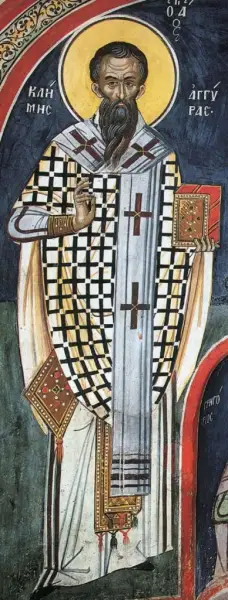
Overview
Clement of Ancyra (c. 258 – 312) was a bishop who shepherded the church of Ancyra, the city that is now Ankara, during the final and fiercest persecution of the ancient Church. Arrested by the Roman authorities in the age of the emperor Diocletian, he was brought before Diocletian himself, who sought to win him over to paganism. The bishop refused, and for his refusal he endured terrible tortures. His fidelity ended before the altar: while he was celebrating the Divine Liturgy, a Roman soldier beheaded him in the year 312, the very year in which the persecuting empire at last submitted to Christ. He suffered together with his disciple Agathangelus of Rome, with whom he is still commemorated in the Christian East. His memory is kept on 23 January by those following the Gregorian calendar, and on 5 February by Orthodox Christians who compute the same date on the Julian calendar. His relics lie today in Sicily, honoured in the Trapani basilica of the Madonna, and in Ankara the church that bears his name endures as the city's last surviving Byzantine building.
The Complete Life
Bishop of Ancyra in the Age of Diocletian
Clement served as bishop of Ancyra during the rule of the emperor Diocletian, the years in which the Roman state mounted its most systematic assault on Christianity. Ancyra, in the heart of Galatia in Asia Minor, was a city of consequence, and its bishop was necessarily a marked man when the imperial edicts against the Church went out. The ancient sources that survive present him as a shepherd who did not abandon his people: he was arrested by the Roman authorities and taken for trial not before a provincial governor only, but before Diocletian himself, an honour reserved for prisoners whose case mattered to the court. The emperor's purpose at the trial was not merely judicial. He attempted to convert Clement to paganism, seeking by argument and enticement what the persecution sought by force — the surrender of a Christian leader whose example would carry others after him. Clement refused. In the account the Church has preserved, the refusal cost him tremendous torture, endured before and after that imperial confrontation. He remained steadfast through it, held together with his disciple Agathangelus of Rome, who shared his confession and his commemoration down the centuries.
§ Introduction
Martyrdom at the Altar, 312
Clement's martyrdom came, by a singular providence, not in the arena or the prison but at the altar. In the year 312, while he was celebrating the Divine Liturgy, a Roman soldier beheaded him — the shepherd slain in the very act of offering the Eucharist he had refused to abandon. The year of his death was the turning point of the age: within months Constantine's victory would end the era of persecution and open the era of the Christian empire, so that Clement belongs to the last band of believers who paid the ancient price. The Church counted him among her martyrs from the beginning, without any formal process — a pre-congregation saint whose cult spread through East and West alike. The Roman Catholic, Eastern Orthodox, and Oriental Orthodox Churches all preserve his memory. In the Christian East he is honoured on 23 January of the Gregorian calendar; those Orthodox churches that follow the Julian calendar keep the same feast on its civil equivalent of 5 February, and in some countries all Orthodox Christians observe it together. He is never remembered alone: his disciple Agathangelus of Rome, companion in torture, is commemorated at his side wherever his feast is kept.
§ Introduction
Relics in Trapani, a Church in Ankara
Two memorials of Clement have survived the seventeen centuries since his death, one in the West and one in the city of his birth. His relics are venerated at Trapani in western Sicily, placed upon the altar of the saints in the basilica of the Madonna di Trapani, where the hieromartyr of Galatia has been honoured for generations alongside the great devotion to Our Lady of that shrine. In Ankara itself his name is attached to a more fragile monument: the church that bears his name is the sole Byzantine building left standing anywhere in the Turkish capital, a lone witness in stone to the Christian centuries of a city that was once a great episcopal see. That the last Byzantine building of Ankara should bear the martyr's name is itself a form of commemoration — the city that watched his trial and received back his blood still keeps his memory standing in its midst. For the Christians of modern Turkey, and for Orthodox believers worldwide who keep his feast on 23 January or 5 February, Clement of Ancyra remains the type of the bishop who would not surrender the Liturgy, and who sealed that refusal with his own blood upon the altar.
§ Introduction
Timeline
- 258
Born at Ancyra in Galatia, the city now called Ankara.
§ Introduction
- 312
Beheaded by a soldier in Rome while offering the Divine Liturgy, having resisted the emperor's attempt to win him to paganism.
§ Introduction
The Record
- Canonization
- Pre-congregation martyr; venerated from antiquity by the Roman Catholic, Eastern Orthodox, and Oriental Orthodox Churches
Prayer
Bibliography
Show 3 sources
- Serbian Orthodox Church. "The Hieromartyr Clement, Bishop of Ancyra (January 23rd)".
- "Arte della Chiesa | Santuario 'Maria SS. Annunziata'". Archived from the original on 2014-03-08. Retrieved 2015-12-23.
- "Last Byzantine church in Ankara close to disappearing".
Profile text adapted from the Wikipedia article, licensed CC BY-SA 4.0.
Pray with this saint every day
Save St. Clement of Ancyra to your favorites, read the full profile, and get feast-day reminders in the Saints app.
Get the Saints AppFree on the App Store for iPhone and iPad