
c. 830 – 916·Feast July 27
St. Clement of Ohrid
Slav apostle and founder of the Ohrid Literary School
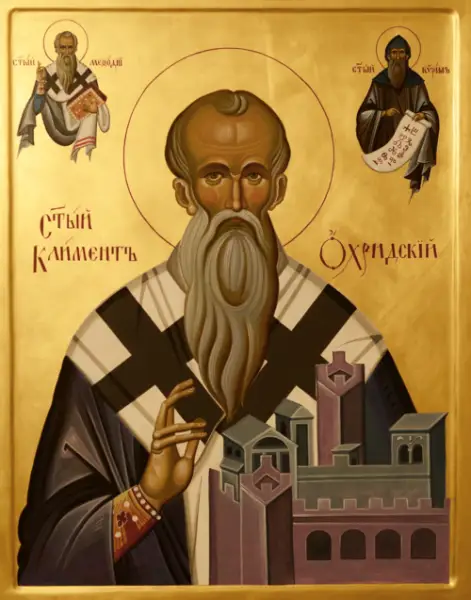
Overview
Clement (or Kliment) of Ohrid (c. 830 – 916) was a Slav scholar, writer, and missionary who became the most productive of the disciples of Saints Cyril and Methodius and the decisive figure in the Christianisation of the medieval Bulgarians. Born probably in the southern Macedonian lands where Methodius had served, he joined the great mission to Moravia as a young man, was ordained a priest in Rome in 867 or 868, and after Methodius's death in 885 endured imprisonment and expulsion by the German clergy. He reached Bulgaria in 885 or 886 in the company of Naum, Angelarius, and possibly Gorazd, and was sent by Prince Boris I to the region of Kutmichevitsa, where over seven years he instructed around three and a half thousand pupils in Slavonic letters and the Glagolitic script and founded the Ohrid Literary School. His translations of Christian books into the Slavonic tongue, with the work of his companions, laid the foundations of the Bulgarian Orthodox Church. In 893 he was made bishop of Drembica and Velika. He died in 916 and was buried in the monastery of Saint Panteleimon in Ohrid, which he had founded, and was soon numbered among the saints. He is honoured as patron of North Macedonia and of the city of Ohrid.
The Complete Life
A Slav of the Southern Macedonian Lands
The exact date and place of Clement's birth are unknown; he was born around 830–840, most probably on Byzantine soil, in the region where Methodius had pursued his political career, which points to a Slav of the southern Macedonian lands, with the region of Thessalonika often designated as the likeliest birthplace. Other scholars place his birthplace in the same southern Macedonian area when it belonged to the First Bulgarian Empire, since most of Macedonia became Bulgarian territory between 830 and 840, precisely when Clement was born. What his own tradition asserts is his Slavic origin: Theophylact of Ohrid, in his Short Life of the saint, names him the earliest bishop of the Bulgarian tongue; the Ohrid Legend from the pen of Demetrios Chomatenos ranks him instead among the European Moesians, commonly known as Bulgarians. Modern scholars accordingly describe him as a Bulgarian Slav, or with Dimitri Obolensky as a Slav dwelling within the Bulgarian kingdom. As a young man he joined Methodius, following him in his work and later to the monastery on Mysian Olympus, and his hagiographer bears witness that no one understood Methodius's course of life as Clement did — the testimony of a disciple who had grown old in his master's service.
§ Life
Disciple of Cyril and Methodius
Clement had a part in the entire Moravian undertaking of Cyril and Methodius, the enterprise that gave the Slavs a Christian literature and liturgy of their own. In 867 or 868 he stood in Rome with two fellow disciples, Gorazd and Naum, and was ordained to the priesthood by the bishops Formosus and Gauderic — the same journey during which the papacy approved the Slavonic books. When Cyril died, Clement went with Methodius on the road from Rome through Pannonia into Moravia again, serving the mission in its hardest years. When Methodius died in 885, the German clergy of Moravia moved against his Slavonic work and his disciples; Clement, together with Gorazd, headed the resistance, and for it spent time in jail before being expelled from the country altogether. In 885 or 886 the exiles arrived at Belgrade, a city then lying under Bulgarian rule — Clement in the company of Naum, Angelarius, and on some accounts Gorazd, though others report Gorazd had already died. Angelarius perished soon after their arrival, but Clement and Naum were sent on to the Bulgarian capital of Pliska, where Prince Boris I commissioned them to train the future clergy of his state in the Slavonic language, closing the Moravian chapter of their lives and opening the Bulgarian one.
§ Life
Kutmichevitsa and the Ohrid Literary School
Boris I had adopted Christianity for his realm in 865 and knew precisely what it would cost: the Greek-speaking clergy sent from Byzantium carried Byzantine influence with them, and the king, fearing for his state's independence, saw the Old Slavonic language as the safeguard of Bulgaria's political and cultural stability. To Clement fell the decisive commission. While Naum remained at Pliska founding the literary school there, Clement was sent to the empire's south-western region, then called Kutmichevitsa, to build up the training of Bulgaria's future clergy in the Slavonic tongue. There, at Ohrid, he founded the school that bears the city's name. Between 886 and 893, seven years of unremitting labour, he instructed around three and a half thousand pupils in Slavonic letters and the Glagolitic script, and rendered Christian books into the Old Church Slavonic tongue, laying with his co-workers the foundations of the Bulgarian Orthodox Church. The effect reached beyond the church: Slavonic literacy prevented the South Slavs' assimilation into Byzantine culture and forged a distinct Bulgarian identity, so that in the early tenth century the Slavic tribes of Macedonia took the name Bulgarians for their own. In 893 the church crowned his work with the episcopate, ordaining him bishop of Drembica and Velika.
§ Life
Writer, Translator, First Bishop of the Bulgarian Tongue
Among the writers of Old Church Slavonic, Clement stands among the most fertile and the most consequential, and his authorship gathers around the central conviction that the Slavs should worship God in their own tongue. He is credited with the Pannonian hagiography of Saints Cyril and Methodius, the story of the teachers whose disciple he had been, and with the oldest service dedicated to the two brothers — a fitting tribute from the man who had carried their work from Moravia to the Balkans. To him are also ascribed the Holy Service and the Life of St. Clement of Rome, the martyr pope whose name he bore. He translated the Flower Triode, the book of church songs sung from Easter to Pentecost, making the Paschal season sing in Slavonic. The invention of the Cyrillic alphabet is traditionally assigned to him as well, though scholars judge that it probably took shape instead at the school of Preslav early in the tenth century; what is beyond dispute is his part in popularising the new letters among the Christianised Slavs. Theophylact of Ohrid honoured him with a title that has never been forgotten: the first bishop in the Bulgarian language — a shepherd who made the faith at home in his people's speech.
§ Life
Bishop, Death, and Burial at Ohrid
Clement's episcopal years closed the long labour of his life. Ordained in 893 as archbishop-bishop of Drembica and Velika, he governed the church in the region where he had taught and built, the first bishop of the Bulgarian tongue in the phrase of his hagiographer. He died in 916, and his disciples buried him in the monastery of Saint Panteleimon at Ohrid, the house he himself had established — a burial within sight of the school that had trained three thousand teachers of his people's faith. The veneration of the local church was immediate: soon after his death he was canonized by the Bulgarian Orthodox Church, and from the tenth century onward his name stood in the front rank of the Bulgarian saints, one of the Seven Apostles of Bulgaria. His tomb at the monastery became a centre of devotion, and the memory of the apostle of Kutmichevitsa remained living on both sides of the later border between Bulgarians and Macedonians, both of whom claim his inheritance. In November 2008 the Macedonian Orthodox Church conveyed relics of Clement to the Bulgarian church as a gesture of goodwill, an exchange of the saint's own body between the two churches he belongs to, in the city where he was buried a thousand years before.
§ Life
One of the Seven Apostles of Bulgaria
Clement's canonization followed his death within living memory of his disciples, the Bulgarian Orthodox Church enrolling him among her saints in the tenth century and joining him to the band honoured as the Seven Apostles of Bulgaria — the leading missionaries who gave the nation its Christian alphabet, liturgy, and clergy. From that century to this he has stood among the premier saints of the Bulgarian church, venerated also by the Orthodox Church at large and by Catholics, with his feast on 27 July, the date of his burial. His title of first bishop of the Bulgarian language made him the ecclesiastical father of every Slavonic-liturgy church of the region, and the mission he led is judged the crucial factor that transformed the Slavs of Kutmichevitsa, the region of present-day Macedonia, into Bulgarians — an act of evangelisation that shaped national identity itself. In the iconography of the Church he is shown in art among the followers of Cyril and Methodius, bearing the two Slavonic alphabets that were the instruments of his apostolate. Medieval frescoes of the saint survive throughout North Macedonia, Serbia, and northern Greece, the majority in North Macedonia, where the Zograf monastery on Mount Athos preserves one of the classic images of the schoolmaster-saint.
§ Life
Universities, Libraries, and a Name in Antarctica
Few medieval scholars have been honoured by their heirs as Clement of Ohrid has been. Sofia University, the first modern Bulgarian university, founded in 1888, took his name at its establishment; the Macedonian National and University Library, founded on 23 November 1944, bears it as well; the university established at Bitola in 1979 is his; and even the Bulgarian scientific base at St. Kliment Ohridski on Livingston Island in Antarctica carries his name to the far south. In Ohrid itself his tomb lies in the church of Sts. Clement and Panteleimon, and in Skopje the church dedicated to him is the largest cathedral of the Macedonian Orthodox Church, of which he is patron together with the whole country of North Macedonia. His cult is written in fresco across the medieval churches of Macedonia, Serbia, and northern Greece. Scholarship still advances around him: in May 2018 it was announced that his signature, dated 24 April 889, had been identified on a stone plate among the graffiti of the ruined Ravna Monastery in Provadiya Municipality, evidence that the disciples of Cyril and Methodius had settled there after their expulsion from Moravia — the apostle's own hand, a millennium old, still testifying to the route by which Slavonic Christianity reached the Balkans.
§ Legacy
Timeline
- 830
Born around 830–840, most probably in the Byzantine Empire in the region where Methodius served, though the First Bulgarian Empire is also claimed.
§ Life
- 868
Ordained a priest in Rome in 867 or 868 alongside Gorazd and Naum at the hands of bishops Formosus and Gauderic.
§ Life
- 885
Methodius died; Clement led the resistance to the German clergy in Moravia and, after imprisonment, was expelled.
§ Life
- 886
Reached Belgrade in 885 or 886 with Naum, Angelarius, and possibly Gorazd, and was sent on to the Bulgarian capital of Pliska.
§ Life
- 24 Apr 889
A stone plate bearing his signature, dated 24 April of this year, was identified centuries later at the Ravna Monastery.
§ Legacy
- 893
Ordained bishop of Drembica and Velika, after seven years in which he taught some 3,500 disciples and founded the Ohrid Literary School.
§ Life
- 27 Jul 916
Died on 27 July and was buried in his monastery of Saint Panteleimon at Ohrid; he was soon canonized.
§ Life
- 1888
Sofia University, the first modern Bulgarian university, was named in his honour at its foundation.
§ Legacy
- Nov 2008
The Macedonian Orthodox Church handed over relics of Clement to the Bulgarian church as a gesture of goodwill.
§ Legacy
- May 2018
His dated signature was identified on a stone plate in the ruins of the Ravna Monastery in Bulgaria.
§ Legacy
In Their Own Words
This great father of ours and light of Bulgaria was by origin of the European Moesians whom the people commonly known as Bulgarians...
The Record
- Major works
- Ohrid Literary School·Translation of the Flower Triode into Old Church Slavonic·Pannonian Hagiography of Saints Cyril and Methodius (attributed)·Life of St. Clement of Rome (attributed)·Holy Service (attributed)·Oldest service dedicated to Saints Cyril and Methodius
- Patron of
- Ohrid·North Macedonia
- Symbols
- Glagolitic alphabet·Cyrillic script
- Canonization
- Canonized soon after his death by the Bulgarian Orthodox Church; among the premier saints of Bulgaria since the 10th century
Prayer
Bibliography
Show 7 sources
- Gardner, Johann von; Morosan, Vladimir, trans. (1980). Russian Church Singing, vol. II. St Vladimir's Seminary Press. ISBN 0881410462, p. 11.
- Butler, Alban; Burns, Paul; Farmer, David Hugh (1995). Butler's Lives of the Saints, Volume 7. A&C Black. ISBN 0860122565, p. 220.
- Crampton, R. J. (2005). A Concise History of Bulgaria. Cambridge University Press. ISBN 978-0-521-61637-9, p. 15.
- Fine, John Van Antwerp (1991). The Early Medieval Balkans: A Critical Survey from the Sixth to the Late Twelfth Century. University of Michigan Press. ISBN 0472081497, pp. 127-128.
- Gautier, Paul (1964). "Clément d'Ohrid, évèque de Dragvista". Revue des études byzantines. 22: 199–214.
- Iliev, Ilia G. (1995). "The Long Life of Saint Clement of Ohrid: A Critical Edition". Byzantinobulgarica. 9: 62–120.
- Popović, Mihailo St. (2016). "Saint Clement of Ohrid: His Life and Aftermath Between Sofia and Skopje". Споменица др Тибора Живковића. Београд: Историјски институт. pp. 77–90.
Profile text adapted from the Wikipedia article, licensed CC BY-SA 4.0.
Pray with this saint every day
Save St. Clement of Ohrid to your favorites, read the full profile, and get feast-day reminders in the Saints app.
Get the Saints AppFree on the App Store for iPhone and iPad