
died c. 100·Feast November 23
St. Clement of Rome
Pope Clement I, first of the Apostolic Fathers
Overview
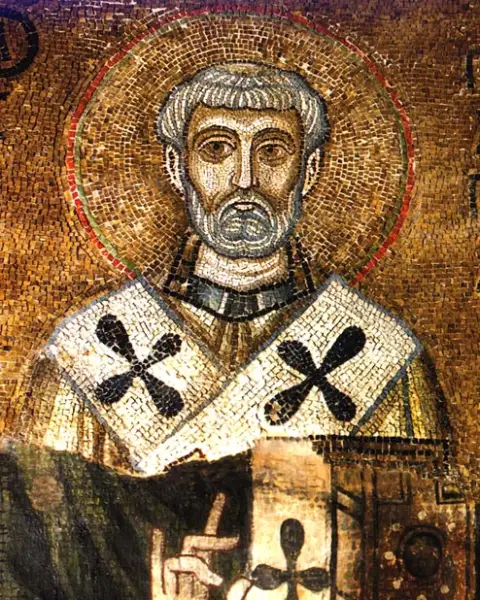
Clement of Rome, honored as Pope Clement I, led the church of Rome in the last quarter of the first century and is reckoned the first of the Apostolic Fathers — the generation of Christian writers who had touched, or stood immediately downstream from, the apostles themselves. Ancient testimony about his office varies: Tertullian says Peter himself ordained him, Irenaeus makes him the successor of Anacletus and a personal acquaintance of the apostles, Eusebius calls him the third bishop of Rome and a co-worker of Paul, while the modern Annuario Pontificio places him fourth, reigning from about 92. His undisputed legacy is the letter he sent from Rome to the church at Corinth around 96, settling a revolt against the city's presbyters by appealing to their apostolic appointment — the earliest surviving affirmation of apostolic succession and one of the oldest Christian documents outside the New Testament, read publicly in Corinth alongside Scripture as late as 170. Later tradition, first recorded in apocryphal acts of the fourth century, says Trajan banished him to the Crimea, where a miraculous spring converted his fellow prisoners and he won the martyr's crown by being bound to an anchor and drowned in the sea. His relics rest today in the Basilica of San Clemente in Rome.
The Complete Life
The Man Behind the Earliest Succession Lists
Almost nothing certain survives about Clement's origins and career, and the little we have comes wrapped in the competing chronologies of the earliest Roman church. Tertullian claimed he was ordained by Saint Peter himself; Irenaeus, writing around 180, described him as the successor of Anacletus and a personal acquaintance of the apostles; Eusebius, in his Church History, made him the third bishop of Rome and a fellow laborer of Paul; and the Annuario Pontificio settles on fourth in the line, occupying the Roman see as the first century drew to its close. The Liber Pontificalis preserves a delicate compromise: Peter had ordained Linus and Anacletus to carry out the community's priestly ministry while he himself gave his days to prayer and preaching; the Church entire, however, was entrusted to Clement alone. The Shepherd of Hermas mentions a Clement whose task was to communicate with other churches, likely the same man, and a tradition from the third and fourth centuries identified him with the Clement Paul greets in Philippians 4:3 — though modern scholars such as Ralph Martin, Gerald Hawthorne, and F. F. Bruce judge that Paul's Clement cannot be pinned down. The Coptic Synaxarium alone preserves a domestic memory: born in Rome to an honorable senator named Fostinus, educated by his father in Greek literature.
§ Life
Shepherd of a Persecuted and Contentious Church
Clement led the Roman church in the shadow of recent blood. Paul's Epistle to the Romans, written about 58, already presupposed a flourishing congregation in the capital, and the apostle reached the city itself around 60; and both Peter and Paul were said to have been martyred in the city, whose Christians Nero had persecuted after the fire of 64, with further suffering possible under Domitian between 81 and 96. Out of this community Clement emerged as the first of its really notable bishops, a man who had known Peter according to the Liber Pontificalis. His leadership was exercised not through administration we can trace but through a single extraordinary intervention. When the church at Corinth tore itself apart by deposing its presbyters, the Romans under Clement's name wrote back across the sea, calling the Corinthians to repentance and to the reinstatement of their clergy, because the apostles themselves had established the ministry of bishops and deacons. The epistle never names its author and gives no indication of his title, but the act itself — an elder church instructing a younger one in the order received from the apostles — fixed his place in history as the first voice of the Roman see sounding beyond its own bounds.
§ Life
The Letter to the Corinthians
The letter known as 1 Clement, written about 96, is the oldest fully authentic Christian document outside the New Testament and the uncontested heart of Clement's legacy. Its occasion was a mutiny: certain presbyters — the class of clergy above the deacons — had been deposed in Corinth, and Clement demanded their restoration, arguing that ministers rightly ruled because the apostles had appointed them and provided for a succession. The letter treats bishops and presbyters as terms for the same higher order, served by deacons, and even mentions the offering of the gifts among their functions — precious evidence for the shape of first-century ministry. It also carries historical freight, recalling persecutions of Christians, recording the martyrdom of Peter, and suggesting that Paul reached Spain. So highly was the letter regarded that it was read in the church at Corinth alongside the Scriptures around 170, and later ages saw more in it still: some have called it the first work to assert Roman primacy, though most scholars, with the Orthodox historian John Meyendorff, read it as fraternal counsel flowing from the Roman church's sense of standing first among the local churches, not from any claimed jurisdiction. Dave Armstrong has argued it even supports papal infallibility, since Clement writes that the Corinthians should obey what he has written through the Holy Spirit.
§ Epistle of Clement
Humility, Faith, and the High Priest
The theology of Clement's letter has fed fourteen centuries of argument, particularly over justification. In one famous passage he writes that believers are not justified through themselves, their wisdom, understanding, piety, or works, but through faith — a text that moved the Protestant scholar Tom Schreiner and the church historian Philip Schaff to hear in him a grace-oriented, even faith-alone doctrine, while the Catholic Encyclopedia finds works woven into his idea of justification, and Rudolf Knopf and Rudolf Bultmann discerned a synergism in which the believer must cooperate with grace. David Downs has gently dissolved the debate: Clement was not writing deep soteriology but moral guidance to a quarrelsome congregation, and in his economy all depends on the Creator's goodness, mercy, and gracious election. What is unforced in the letter is its spirituality of humility: Christ, Clement insists, is with the lowly of mind, not with those who exalt themselves over the flock, and the sin he attacks most fiercely is jealous ambition against appointed shepherds. According to the Catholic Encyclopedia, the letter is thoroughly Trinitarian and repeatedly names Christ the high priest; he even finds room for hope of the resurrection, arguing that the Creator who governs birds can raise those who have served him in holiness.
§ Theology
Exile, the Spring in the Quarry, and the Anchor
How Clement's life ended, the oldest witnesses do not say: Eusebius and Jerome record his death in the reign of Trajan and are silent about martyrdom. But apocryphal acts, dating to the fourth century at earliest and preserved by Rufinus, filled the silence with one of the most beloved legends of the early Church. Banished from Rome, Clement was sent to the Chersonesus in the Crimea and set to labor in a stone quarry. Finding the prisoners there dying of thirst, he knelt in prayer, looked up, and saw a lamb on a hilltop; going to the spot where it had stood, he struck the ground with his pickaxe and released a gushing fountain of clear water. The wonder brought crowds of local idol-worshippers and fellow prisoners to the faith, and as its price the prefect had him martyred: an anchor was tied to him and he was cast from a boat into the sea. The legend continues that every year the sea miraculously ebbed, uncovering a shrine divinely built around his bones. The Liber Pontificalis places his death in Greece in the third year of Trajan, that is, 100; the Inkerman Cave Monastery marks the place of his supposed burial in Crimea.
§ Death and legends of final days
A Pope Honored Across Every Division
Veneration of Clement arose without any process and never stopped crossing the boundaries of Christendom. His name is fixed in the Roman Canon of the Mass, and the Catholic Church commemorates him as pope and martyr on November 23, a date he shares with the Anglican Communion and the Lutheran churches; the Church of England and the Episcopal Church keep the same day. The Byzantine tradition, including the Syriac Orthodox, Malankara, Macedonian, and Greek Orthodox churches and all the Eastern Catholic churches of the Byzantine rite, keeps him on November 24 under his Syriac name Mor Clemis, while the Russian Orthodox Church celebrates him on November 25. The Coptic Orthodox Church remembers him in its Synaxarium on the 29th of Hatour — corresponding to 8 December on the Gregorian calendar — recording his martyrdom in 100 under Trajan by drowning with an anchor at his neck, and preserving its own account of his Roman birth and senatorial father. He is one of the few Roman pontiffs honored with a church of his own in Russian Orthodoxy: the baroque St. Clement's in Moscow, seized in 1934 and returned to worship in 2008, glitters again with its gilded iconostasis.
§ Sainthood
Relics from the Black Sea to the Canary Islands
The afterlife of Clement's body rivals the legend of his death. In Crimea, the Inkerman Cave Monastery still marks his supposed grave; near the end of his life, in 869, Cyril came upon bones in the Crimea laid to rest with an anchor and brought them home to Rome, where they now rest beneath the Basilica of San Clemente — the church layered over a fourth-century titular house and a pagan shrine. Other traditions speak of an ancient cult of the relics at Chersonesus itself and a translation of his head to Kyiv; the Kyiv Monastery of the Caves claims his head among its treasures, and far to the west the shinbone of Clement is kept at the Church of the Immaculate Conception in Santa Cruz de Tenerife, a gift of Sidotti, Patriarch of Antioch, once among the city's most revered relics. In art he is unmistakable: robed in papal vestments with the pallium, tiara or mitre, holding the palm of martyrdom, an anchor at his side or bound to his neck, sometimes shown at a spring of water, or resting in a temple beneath the waves. The anchor-cross recalling his drowning became the Mariner's Cross, and through it Clement, patron of mariners and stone-cutters, has anchored sailors' hopes for nearly two millennia.
§ Symbolism
Timeline
- 92
Assumes leadership of the church of Rome in the twelfth year of Domitian, succeeding Anacletus, according to Eusebius and Jerome
§ Introduction
- 96
Writes the letter known as 1 Clement to the church at Corinth, calling for the reinstatement of deposed presbyters and grounding their authority in apostolic appointment
§ Epistle of Clement
- 100
Dies after about nine years of leadership; Jerome dates his death to 99 and Eusebius to 100, in the third year of Trajan
§ Introduction
- 100
By fourth-century apocryphal acts, is banished by Trajan to the Chersonesus, works in a stone quarry, and is drowned with an anchor tied to him after a water miracle wins converts
§ Death and legends of final days
- 170
The letter to Corinth is read in the church there alongside the Scriptures, a mark of the esteem it quickly enjoyed
§ Epistle of Clement
- 406
Rufinus transmits the martyrdom legend of Clement, which the earliest sources, Eusebius and Jerome, do not mention
§ Death and legends of final days
- 869
St. Cyril, shortly before his own death, carries bones found in Crimea buried with an anchor to Rome, where they are enshrined in the Basilica of San Clemente
§ Death and legends of final days
- 2008
The baroque church of St. Clement in Moscow, seized in the Soviet era, is returned to the Russian Orthodox Church
§ Sainthood
In Their Own Words
We should be obedient unto God, rather than follow those who in arrogance and unruliness have set themselves up as leaders in abominable jealousy.... For Christ is with them that are lowly of mind, not with them that exalt themselves over the flock.
And so we, having been called through His will in Christ Jesus, are not justified through ourselves or through our own wisdom or understanding or piety or works which we wrought in holiness of heart, but through faith, whereby the Almighty God justified all men that have been from the beginning.
The Record
- Major works
- First Epistle of Clement to the Corinthians (1 Clement)
- Patron of
- Mariners·Stone-cutters·Angono, Rizal
- Symbols
- Papal vestments·Mariner's cross (anchored cross)·Anchor tied to his side·Palm of martyrdom
- Canonization
- Pre-congregation; venerated as pope and martyr since the early Church
Prayer
Bibliography
Show 11 sources
- Chapman, Henry Palmer (1908). "Pope St. Clement I". The Catholic Encyclopedia. Vol. 4. New York: Robert Appleton Company
- Cross, Frank Leslie; Livingstone, Elizabeth A. (2005). "Clement of Rome, St". The Oxford Dictionary of the Christian Church. Oxford University Press. p. 363. ISBN 978-0-19-280290-3
- Kelly, John Norman Davidson; Walsh, Michael J. (2005). The Oxford Dictionary of Popes (2nd ed.). Oxford University Press. ISBN 978-0-19-861433-3
- Eusebius of Caesarea. Ecclesiastical History, Books III and VIII
- Jerome. Chronicon; De Viris Illustribus, Ch. XV
- Loomis, Louise Ropes (2006) [1917]. The Book of the Popes (Liber Pontificalis). Arx Publishing. ISBN 978-1-889758-86-2
- Schaff, Philip (1883). "Ch XIII, §162 Clement of Rome". History of the Christian Church. Vol. II: Ante-Nicene Christianity. A.D. 100-325
- McBrien, Richard (2000). Lives of the Popes. HarperCollins. p. 35
- Libreria Editrice Vaticana (2008). Annuario Pontificio (2008). p. 7. ISBN 978-88-209-8021-4
- Tyrannius Rufinus (2024) [406]. "The Martyrdom of Clement - an English Translation". Early Church Texts
- "Hieromartyr Clement, Pope of Rome". The Orthodox Church in America, 2024
Profile text adapted from the Wikipedia article, licensed CC BY-SA 4.0.
Pray with this saint every day
Save St. Clement of Rome to your favorites, read the full profile, and get feast-day reminders in the Saints app.
Get the Saints AppFree on the App Store for iPhone and iPad