
1st century·Feast September 25
St. Cleopas
Disciple who met the risen Christ on the Emmaus road
Overview
Cleopas, also spelled Cleophas, is one of the few private disciples whom the Gospels name. He appears in Luke 24:13–32 as one of two followers walking from Jerusalem to the village of Emmaus on the day of the Resurrection, crushed by the crucifixion and bewildered by the women's report of an empty tomb. A stranger joins them, rebukes their unbelief, opens the Scriptures concerning the Messiah, and is recognized at the breaking of bread as the risen Jesus himself before vanishing; Cleopas and his companion hurry back to Jerusalem that same evening to tell the other disciples. Mark's Gospel records the appearance briefly in chapter 16. Beyond this episode he never appears again in the New Testament, but an extensive tradition grew around him. Ancient writers identified him with Clopas of John 19:25, believed to be the brother of Saint Joseph, and with Alphaeus, the father of several of the Twelve; Eusebius of Caesarea preserves Hegesippus's report that Simeon, son of Clopas, succeeded James as bishop of Jerusalem. Papias of Hierapolis recorded that Cleophas and Alphaeus were one person, husband of Mary and father of James the bishop, Simon, Thaddeus, and Joseph. He is venerated across the Catholic, Eastern Orthodox, Oriental Orthodox, and Coptic traditions, with feasts on September 25, October 30, and November 10 respectively.
The Complete Life
A Name Between Aramaic and Greek
The Gospels tell us almost nothing of where Cleopas came from, and even his name has been the subject of learned debate. Some writers connect it to Clopas, the name found in John 19:25 in the phrase "Mary of Clopas", understood as a Hellenized form of the Aramaic Qlopha; others derive Cleopas from the Greek Cleopatros, meaning "glory of the father", a name best known in its feminine form Cleopatra. These etymologies matter because they bear on the older question of identity: Catholic and Eastern Orthodox tradition has generally held that Clopas, remembered as the brother of Saint Joseph, is the same man as Cleopas, while other interpreters have argued that Clopas, Cleophas, and Alphaeus are all variants of a single name. If those identifications hold, Cleopas stands within the extended household of Jesus himself — brother of Joseph, husband of one of the Marys at the cross, and father, according to the fourth-century fragments of Papias, of James the bishop and apostle, of Simon, of Thaddeus, and of Joseph. Epiphanius of Salamis even preserves a pedigree, making Joseph and Cleopas sons of a certain Jacob surnamed Panther. The man on the Emmaus road, in other words, was no stranger to the family he mourned.
§ Etymology
Apostle and Disciple of the Seventy
Although Cleopas is named only once in Scripture, the Churches ranked him among their apostolic heroes from an early date. His titles in the ancient lists are Apostle and Disciple of the Seventy, placing him in the wider circle of missionaries sent out by the Lord beyond the Twelve, and the Greek Orthodox Archdiocese of America still commemorates him under the title Apostle of the Seventy. The Emmaus narrative itself explains the honor. Luke presents him as a disciple who knew the events of Holy Week intimately, who could rehearse them to a stranger with painful accuracy — Jesus of Nazareth, a prophet mighty in deed and word, condemned by the chief priests, crucified, and now three days dead — and who had heard the women's testimony about the empty tomb without yet daring to believe it. That combination of nearness to Christ and slowness of heart is precisely why his story became foundational: he embodies every believer who grieves without understanding. The Roman Martyrology in its current edition summarizes the substance of Luke's account as the reason for his cult, and the Eastern Orthodox Church keeps his memory on October 30, the Coptic Orthodox Church on November 10, and the Roman Rite on September 25.
§ Cleopas
The Road to Emmaus
Cleopas's single recorded act is among the most narrated scenes in Christian art and preaching. It falls on the very day of the Resurrection: he and an unnamed companion are leaving Jerusalem for Emmaus, a seven-mile walk, debating everything that has happened. A stranger falls in beside them and asks what they are discussing; Luke notes with quiet irony that their eyes were kept from recognizing him. Cleopas answers with the disappointment of a man whose hopes have died, and the unknown traveler rebukes their unbelief and unfolds the prophecies concerning the Messiah. At the village the disciples press him to stay for the evening meal; when he takes bread, blesses it, and breaks it, their eyes are opened, they know the risen Jesus, and he vanishes from their sight. Then comes the missionary reflex that gave Cleopas his apostolic rank: the two men rise at once and hurry the seven miles back to Jerusalem in the dark to tell the Eleven that the Lord is alive and has appeared to Simon. Mark's Gospel, in a brief parallel passage, records the same appearance to two of them walking into the country, a second witness to the story Luke tells in full.
§ Account in the Gospel of Luke
Memory in the Churches
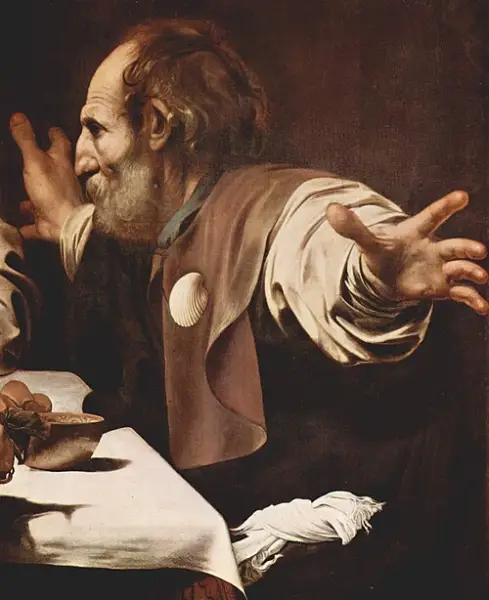
The tradition that grew from Cleopas's single appearance is remarkably rich for so briefly mentioned a man. In the second century Hegesippus, the chronicler quoted by Eusebius of Caesarea, spoke with the grandchildren of Jude the Apostle and passed on the report that once James had been put to death, the choice of the whole church fell on Simeon, Clopas's son, for the Jerusalem throne — a cousin of the Lord, as Hegesippus notes, and evidence that Clopas's family remained leaders in the Jerusalem church. Papias of Hierapolis, writing even earlier, tied Cleophas to Alphaeus and made him the father of James the bishop and apostle, Simon, Thaddeus, and one Joseph, an identification that J.B. Lightfoot and later scholars examined at length in the debate over the brethren of the Lord. Medieval tradition, drawing on the Gospel of Pseudo-Matthew, made Clopas the husband of Saint Anne and father of Mary of Clopas, weaving him into the Holy Kinship. Today his cult spans the divided Christian world: the Roman Martyrology of 2004 keeps him on September 25, the Eastern Orthodox Church on October 30, and the Coptic Orthodox Church on November 10, while Caravaggio's Supper at Emmaus has fixed his astonished face at the broken bread in the imagination of centuries.
§ Traditions
Timeline
- 180
Hegesippus, as quoted by Eusebius, reports that Clopas was the brother of Joseph and that Simeon, son of Clopas, succeeded James in the see of Jerusalem
§ Traditions
- 650
The Gospel of Pseudo-Matthew, probably written in the seventh century, presents Mary of Clopas as the daughter of Clopas and Saint Anne
§ Apocryphal books
- 2004
The latest official edition of the Roman Martyrology, promulgated under John Paul II, commemorates Cleopas on September 25 with an account of the Emmaus appearance
§ Traditions
In Their Own Words
Jesus met them, with Mary His mother, along with her sister Mary of Clopas, whom the Lord God had given to her father Clopas and her mother Anna, because they had offered Mary the mother of Jesus to the Lord. And she was called by the same name, Mary, for the consolation of her parents.
The Record
- Canonization
- Pre-congregation; venerated as an apostle and disciple of the Seventy since the earliest centuries
Prayer
Bibliography
Show 10 sources
- Losch, Richard R. (2008). All the People in the Bible: An A-Z Guide to the Saints, p. 279
- Herbermann, Charles, ed. (1913). "St. Anne". Catholic Encyclopedia. New York: Robert Appleton Company
- Eusebius of Caesarea. Church History, Book III, ch. 11
- Epiphanius of Salamis; Williams, Frank (2013). The Panarion of Epiphanius of Salamis: De fide. Books II and III, Sect 78:7,5. BRILL. ISBN 978-9004228412
- Papias of Hierapolis. Exposition of the Sayings of the Lord. Fragment X. earlychristianwritings.com
- Wright, Tom (2002). Luke for Everyone. SPCK, London
- "The Brethren of the Lord" by J.B. Lightfoot
- Martyrologium Romanum, editio typica altera, Typis Vaticanis, 2004, p. 536. ISBN 88-209-7210-7
- The Gospel of Pseudo-Matthew
- "Cleopas, Apostle of the 70". Online Chapel, Greek Orthodox Archdiocese of America
Profile text adapted from the Wikipedia article, licensed CC BY-SA 4.0.
Pray with this saint every day
Save St. Cleopas to your favorites, read the full profile, and get feast-day reminders in the Saints app.
Get the Saints AppFree on the App Store for iPhone and iPad