
died 327·Feast October 19
St. Cleopatra
Widow of Galilee who enshrined the relics of St. Varus
Overview
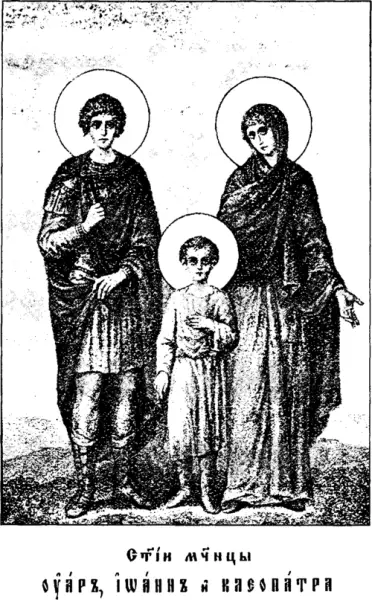
Cleopatra was a Christian woman of the third and fourth centuries who came from the village of Edra, near Mount Tabor in Lower Galilee. A widow with a single son, John, she witnessed the suffering and execution of the martyr Varus and afterward made sure that his remains were carried to her home in Daraa, in Syria, and laid to rest with fitting honor. When John, who had risen to the rank of centurion, died suddenly around 319, her grief drove her to the tomb of the martyr: she begged Varus to give her son back, and received in a dream the vision of the two of them standing in shining garments with crowns upon their heads, a sign that the Lord had received John into his kingdom. Comforted by the dream, she built a church over the relics of Varus and her son and went to live beside it. Wonders were reported there by those who came to pray. Cleopatra distributed her property to the poor and passed her remaining years in prayer and fasting until her death in 327. Her feast, kept with that of her son John, falls on October 19.
The Complete Life
A Widow of Galilee and the Martyr's Body
Cleopatra's life began in the village of Edra, at the foot of Mount Tabor in Lower Galilee, and from there her story moved across the border into Syria, to the town of Daraa where she kept her home. By the time the sources find her she was a widow, and the mother of one child, a son named John. She belonged to the generation that saw the last great assault on the church, and she was present when the martyr Varus was put to death, an eyewitness of the torments he endured for the name of Christ. What she did afterward set the whole course of her remaining life. She arranged for the martyr's remains to be brought to her own house in Daraa, and there she buried them with the reverence due to a confessor who had stood faithful where she had watched others fall away. In an age when the bodies of the martyrs were becoming the treasure of the church, Cleopatra made herself their guardian, and the tomb in her household became the place where her own deepest hopes and sorrows would soon be worked out. The widow's house at Daraa thus became, quietly, one of the shrines of the East.
§ Life
Grief, a Dream, and a Church
The blow fell around the year 319, when John, having won the rank of centurion in the army, died suddenly in the flower of his years. Cleopatra, deprived of her only child, carried her bereavement to the martyr's grave. She begged St. Varus to return her son to her, praying as a mother who believed the communion of saints to be a living reality. The answer came in the night: she saw in a dream Varus and John together, arrayed in brilliant clothing and wearing crowns upon their heads, and she understood the vision to mean that the Lord had taken John into his heavenly kingdom. Her sorrow was turned to consolation, and her consolation into action. Over the relics of the martyr and the remains of her son she raised a church, and she moved to live beside it, so that the rest of her days were spent in the shadow of the two graves. To the place where they lay, reports spread of miracles worked by God through the martyr's intercession, and pilgrims came to pray where the widow kept her vigil. Her mourning, once hopeless, had become the founding of a holy place.
§ Life
Poverty Chosen and Heaven Earned
The last years of Cleopatra's life took the shape of a quiet sacrifice. She gave away her property to the poor, exchanging the goods of a settled household for the freedom to devote herself wholly to God, and she passed her time in prayer and fasting at the church she had built. She died in 327, having lived long enough to see the persecution that had killed Varus give way to the peace of the church, and her body was laid near the relics she had guarded. Her memory did not remain a private one. In the Orthodox tradition her son John is honored as a saint alongside her, and the two are commemorated together on October 19, the pairing a lasting witness to the dream in which they appeared crowned together. In her the church remembers the widow who did not hoard her grief but gave it away: the Galilean matron who sheltered a martyr's bones, asked boldly for the impossible, received a vision that comforted the church at large, and turned a mother's mourning into a house of prayer where, as the faithful believed, the sick and the troubled found relief until the end of her days.
§ Life
Timeline
- 319
Her son John, by then a centurion, died suddenly, and Cleopatra turned in her grief to the relics of St. Varus.
§ Life
- 327
After years of prayer and fasting beside the church she had built, Cleopatra died.
§ Life
The Record
- Major works
- church built over the relics of St. Varus and her son John at Daraa
- Canonization
- Pre-congregation saint, venerated in the Catholic Church and in the Eastern and Oriental Orthodox churches
Prayer
Bibliography
Show 3 sources
- "St. Cleopatra - Saints & Angels"
- "Saint Luke Orthodox Church - Saints - Saints by Day - January - 1st" (archived from the original on 20 February 2020)
- "Blessed Cleopatra with her son in Egypt", Orthodox Church in America
Profile text adapted from the Wikipedia article, licensed CC BY-SA 4.0.
Pray with this saint every day
Save St. Cleopatra to your favorites, read the full profile, and get feast-day reminders in the Saints app.
Get the Saints AppFree on the App Store for iPhone and iPad