
522 – 560·Feast September 7
St. Clodoald
Merovingian prince who renounced the throne for monastic life
Overview
Clodoald, known in French as Saint Cloud, was a prince of the Merovingian royal house who traded an earthly crown for the obscurity of a hermit's cell. Born in 522, he was a grandson of Clovis I and the son of Chlodomer, King of Orléans. His early childhood was shattered by Frankish dynastic violence: after his father fell in battle against the Burgundians, his uncles Childebert I and Clotaire I murdered his two brothers to seize the kingdom of Orléans, and only Clodoald escaped, finding refuge with Remigius, Bishop of Rheims. Rather than press his hereditary claims, he placed himself under the direction of the hermit Séverin of Paris, received the monastic habit from his hands, and later had his royal hair cut before the Bishop of Paris as a public renunciation of his rank. After years of solitary life, including a decade of healing ministry in Provence, he was ordained a priest for Paris in 551. He then withdrew to a hill above the Seine at Novigentum, where he built a church honoring Martin of Tours and gathered a monastery around him. He died there on September 7, 560, aged thirty-eight, and the hamlet grew into the French town of Saint-Cloud, named for him.
The Complete Life
A Childhood Amid Frankish Dynastic Violence
Clodoald was born in 522 into the first family of Frankish Christianity and Frankish brutality alike. His father was Chlodomer, King of Orléans, one of the four sons of Clovis I who divided the kingdom at their father's death; his mother was Guntheuc. When Clovis died, the kingdom was split among four heirs — Chlodomer, Childebert, Clothaire, and Thierry, the last of them a half-brother — and the young kings, urged on by the aged Queen Clotilde the sons joined an expedition against the Burgundians of King Sigismund. Chlodomer captured and later killed Sigismund and his sons, but on a second campaign he himself fell at the Battle of Vézeronce on June 25, 524. His death left three young orphans whose kingdom their uncles coveted. Raised in Paris by their grandmother Clotilde, the boys stood between Salic law, which required their succession, and two uncles determined to remove them. In 525, by one account, Childebert and Clotaire obtained the children from their unsuspecting grandmother, clothed them in their finest, and killed them; another version has Clotilde declare she would rather see them dead than shorn of the long hair that marked their nobility. Thibault, aged ten, and Gonthaire, aged seven, were slain. Clodoald alone escaped, hidden by loyal supporters and taken to Remigius, Bishop of Rheims.
§ Early life
Renouncing a Kingdom for the Hermit's Cell
The surviving prince made a choice that stunned a warrior aristocracy: he renounced every claim to the throne of Orléans. He attached himself to Séverin of Paris, a solitary who lived in a hermitage at the gates of the city, on the ground where the church of Saint-Séverin now stands, and from the hermit's hands he received the religious habit. Sources describe the decision as a deliberate preference for a humble and quiet life of solitude over a bright but perilous existence at court, and Clodoald remained with his master long enough to be formed in the full range of monastic virtue. The transformation was made public around his twentieth year, when he appeared before the Bishop of Paris surrounded by clergy, civic dignitaries, and members of the royal family, and the bishop cut off the long hair that was the badge of Frankish royalty. The gesture settled his status forever: Childebert and Clotaire, seeing in the shorn prince no rival, left him undisturbed and even granted him inheritances to support his retired life. What they intended as a dismissal became his freedom, for the revenues of a prince were redirected to the support of a monk.
§ Adulthood
Healer in Provence and Priest of Paris
After Séverin's death, Clodoald left the Paris region altogether and withdrew secretly to Provence, seeking to bury his identity in distance. It did not work: the people of the countryside discovered his presence and came to him in numbers because they had learned that he possessed the gift of healing. He remained in Provence eleven years, his exile becoming an unexpected apostolate of bodily and spiritual mercy, before returning to his first hermitage, where the local people welcomed him back with joy. By then his reputation had outgrown his anonymity. At the request of the people he was ordained a priest in 551 by Bishop Eusebius of Paris, and contemporaries praised the humility and charity of his priestly service. Yet honors sat uneasily on a man who had abandoned a throne. Unable to bear the attention that followed his ordination, he withdrew a final time to a hill along the Seine about two leagues below Paris, at a place called Novigentum. There, among fishermen and farmers, he took up again the solitary, praying life, raising a church that he placed under the patronage of Martin of Tours — the soldier turned bishop whose renunciation had long stood as the pattern of Frankish holiness.
§ Adulthood
The Spirituality of the Reluctant Celebrity
Clodoald's spiritual profile is drawn entirely from the shape of his decisions, and it is strikingly consistent. First, dispossession: a man who lost his father to war and his brothers to assassination refused to make his survival a claim to power, and answered violence with renunciation. Second, discipleship: he did not invent a solitary life for himself but submitted to Séverin of Paris, remaining in a master's company to be trained in monastic virtue before he ever taught or governed anyone. Third, hiddenness: three times the sources show him withdrawing when fame approached — from Paris to Provence, from Provence back to his hermitage, and finally from the honors of priestly celebrity to the fishing village of Novigentum. Fourth, mercy: wherever he settled, his retreat became a place of healing, and his solitude kept opening into service. Even the gift of his uncles' money tells the same story, for tradition holds that he endowed the monastery he founded with those royal goods, converting dynastic wealth into a house of prayer. His spirituality, in short, was the patient conversion of everything the world values — lineage, hair, inheritance, reputation — into material for the kingdom of God.
§ Adulthood
Abbot at Novigentum and a Foretold Death
When word spread of the prince's hideaway at Novigentum, would-be monks began arriving to put themselves in his hands, and what followed was the familiar pattern of a foundation: first a few cells, then a proper monastery, built with a chapel and endowed, according to tradition, with the wealth his royal uncles had given him. Here the prince who had refused a crown finally accepted authority of another kind, living seven years among his brothers and giving them, the sources say, an example of every virtue. His community on the Seine became the seed of a sacred place, though he would not see its full flowering. The tradition credits him with foreknowledge of his passing, a gift the ages read as a mark of holiness; he died on 7 September 560, aged only thirty-eight, the span of life barely greater than what remained when he had sheared away his royal hair. He was buried where he had labored, and the miracles reported at his tomb began almost immediately, drawing crowds to a hamlet that had existed, until he chose it, only as a name on the riverbank.
§ Adulthood
From Tomb Pilgrimage to the Name of a Town
Clodoald's canonization followed the ancient pattern of the Franks: no formal process, but the verdict of pilgrims. Legend records that he predicted his death, and after his burial several miracles took place near his tomb. The Church acknowledged him as a saint, and the hamlet of Novigentum was transformed almost at once into a pilgrimage site where huge crowds gathered. So complete was his hold on the place that the settlement itself took his name, becoming Sanctus Clodoaldus — the modern commune of Saint-Cloud on the outskirts of Paris. The monastery he founded evolved over the centuries into a collegiate church of canons regular, the Église Saint-Clodoald, where his relics are kept. His cult later crossed the sea with French explorers and missionaries: St. Cloud, Minnesota, St. Cloud, Wisconsin, and St. Cloud, Florida all trace their names to the French town that bears his, and the Diocese of Saint Cloud in Minnesota numbers him among its official patrons. He is venerated today in both the Roman Catholic Church and the Eastern Orthodox Church, his feast kept on September 7, and his cult so woven into French memory that the Parisien could mark the fifteen-hundredth anniversary of his birth with a feature on the royal grandson who became a monk.
§ Veneration
A Prince Remembered in Stone and Paint
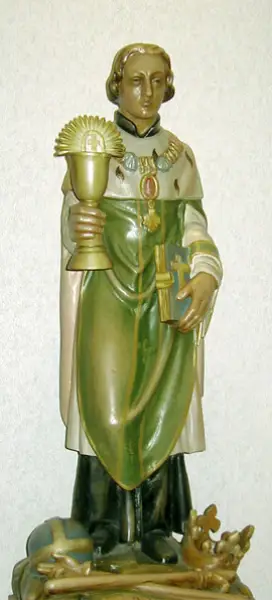
The memory of Clodoald has proved durable not only in liturgy but in art and geography. Gregory of Tours, the great sixth-century historian of the Franks, gave him a rare postscript in his History of the Franks, turning from the murder of the two brothers to add that the youngest slipped from their hands: scorning rule of any earthly kind, the bishop-historian records, Clodoald gave himself over to God, sheared his own hair, joined the clergy, continued in works of goodness, and closed his life as a priest — an acquittal, and from a historian seldom generous. In Paris, a statue of the saint stands on the portal of Saint-Germain l'Auxerrois, and a painting by Sébastien-Melchior Cornu, the nineteenth-century artist, depicts him in the chapel of the Élysée Palace, the residence of French presidents. His iconography is carefully worded: artists dress him as a Benedictine superior handing his own hood to a beggar, a halo encircling his head, the regalia of his royal birth cast down at his feet; sometimes he teaches the poor. The image condenses his whole biography — royalty surrendered, charity chosen — and explains why generations of French villagers, and three American towns, have carried his name.
§ In art
Timeline
- 522
Born into the Merovingian royal house, son of King Chlodomer of Orléans and Queen Guntheuc
§ Introduction
- 25 Jun 524
His father Chlodomer is killed at the Battle of Vézeronce during the second Frankish campaign against the Burgundians
§ Background
- 525
His uncles Childebert I and Clotaire I murder his brothers Thibault and Gonthaire; Clodoald escapes and finds sanctuary with Bishop Remigius of Rheims
§ Early life
- 542
Around the age of twenty, he appears before the Bishop of Paris, who cuts his long royal hair in a public renunciation of his rank
§ Adulthood
- 551
At the people's request, he is ordained a priest by Bishop Eusebius of Paris and serves the Church of Paris
§ Adulthood
- 553
Retires to the hill of Novigentum on the Seine below Paris, builds a church dedicated to Martin of Tours, and gathers a monastery
§ Adulthood
- 7 Sep 560
Dies at his monastery on September 7, aged thirty-eight; legend holds that he foretold his death, and miracles follow at his tomb
§ Veneration
In Their Own Words
They could not take the third, Clodoald, who was saved by the help of brave warriors; despising an earthly kingdom, he consecrated himself to God, and, having cut his hair with his own hand, he was made a cleric. He persisted in good works, and died a priest.
The Record
- Major works
- Church dedicated to Martin of Tours at Novigentum·Monastery at Novigentum, the origin of the abbey of Saint-Cloud
- Patron of
- Against carbuncles·Nail makers·Diocese of Saint Cloud, Minnesota·France
- Symbols
- A Benedictine abbot giving his hood to a poor man, with a halo and royal insignia at his feet·Instructing the poor
- Canonization
- Canonized by popular acclaim after miracles at his tomb; venerated in the Roman Catholic and Eastern Orthodox Churches
Prayer
Bibliography
Show 9 sources
- "Il y a 1500 ans naissait Clodoald, petit-fils de Clovis qui a donné son nom à Saint-Cloud". La Parisien, September 10, 2022
- Monastère du Magnificat (2006). "Saint Cloud or Clodoald". Lives of the Saints
- Jones, Terry. "Cloud". Patron Saints Index
- Moroldo, Arnaldo. "Le Traitement de la Fricative Laryngée Sourde Germanique en Francais, Occitan et Italien". The University of Nice-Sophia Antipolis, p. 49
- "Venerable Cloud (Clodoald) the Abbot-Founder of Nogent-Sur-Seine Near Paris". Orthodox Church in America
- "Saint Cloud, (Saint Clodoald) the Patron Saint of the Diocese of Saint Cloud (522 – c. 560)". Roman Catholic Diocese of Saint Cloud
- "Saint Clodoald". Nominis
- Rabenstein, Katherine (November 1998). "Cloud (Clodoald, Clodulphus) of Nogent". Saint of the Day, September 7
- "Les saints à Paris". Commission diocésaine d'Art Sacré de Paris
Profile text adapted from the Wikipedia article, licensed CC BY-SA 4.0.
Pray with this saint every day
Save St. Clodoald to your favorites, read the full profile, and get feast-day reminders in the Saints app.
Get the Saints AppFree on the App Store for iPhone and iPad