
c. 474 – 545·Feast June 3
St. Clotilde
Queen of the Franks who brought Clovis I to baptism
Overview
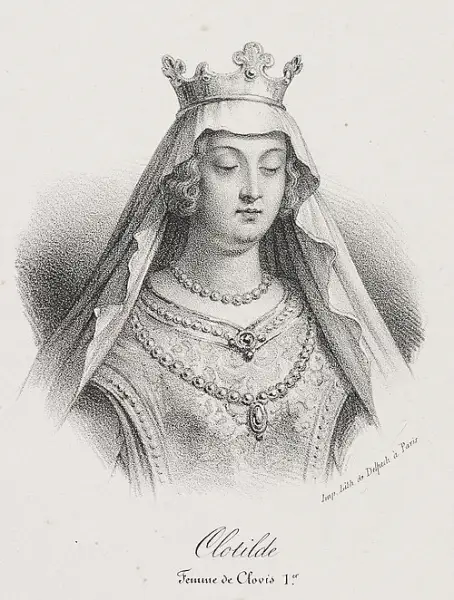
Clotilde, born around 474 at Lyon in Burgundy, was a Burgundian princess whose marriage changed the religious history of western Europe. Granddaughter of King Gondioc and daughter of Chilperic II, she was orphaned by violence when her uncle Gundobad murdered her father, her brothers, and her mother Carétène; she and her sister were nevertheless raised as Catholics at the Arian court of their uncle. In 492 or 493 she was wed to Clovis I, the pagan king of the Franks, whose beauty-and-wisdom impression of her deepened into willingness to let their sons be baptized. Clotilde urged her husband persistently toward the faith, and after a desperate battle against the Alemanni, in which Clovis appealed to her God for victory, he was baptized by St. Remigius at Reims in 496 together with some 3,000 of his warriors. Through her the Franks remained Catholic for centuries, shaping the destiny of the French monarchy. Widowed in 511, she buried Clovis in the Basilica of the Holy Apostles in Paris, completed the church he had begun, adopted her murdered son's grandsons, and endured the killing of two of them. She spent her last thirty-four years in retirement at Tours, near the tomb of St. Martin, praying, fasting, and giving everything to the poor. She died on June 3, 545.
The Complete Life
Orphan of a Burgundian Bloodbath
Clotilde was born around 474 into the royal house of Burgundy, a family already accustomed to murder as an instrument of policy. Her grandfather Gondioc left four sons: her father Chilperic II, and his brothers Gundobad, Gondemar, and Godegisel, among whom the kingdom was divided. After Gondioc's death Gundobad seized sole power by killing his brothers, and in the same purge destroyed Clotilde's own immediate family, murdering her father, her brothers, and her mother Carétène — a woman of such distinction that Sidonius Apollinaris and Venantius Fortunatus called her remarkable, and who may herself have first brought Christianity to Chilperic's household. Clotilde and her sister Sedeleuba, later the nun Chrona who founded the church of Saint-Victor in Geneva, were raised at the court of the very uncle who had orphaned them. Astonishingly, their schooling was Catholic — this in the household of an uncle who, in common with nearly every Burgundian monarch, followed the Arian creed. The hagiographer Sabine Baring-Gould records that the girl grew into piety and a marked tenderness toward those who suffered, a disposition formed, perhaps, by a childhood that had already seen nearly everyone she loved destroyed.
§ Early life
Marriage to the Pagan King
In 492 or 493, shortly after her parents' murder, Clotilde was married to Clovis, the young king of the Franks and the most powerful pagan ruler of Gaul. Farmer notes that her beauty and wisdom struck the Frankish king at once, and few unions in European history would prove to carry such consequences. Few concrete details of her life as queen survive, but her influence on her husband's religious development is beyond dispute. She persuaded him to allow the baptism of their firstborn son Ingomir, who died in infancy, and then of their next son Chlodomer; when Ingomir's death was blamed by Clovis on her faith, she did not retreat, and when Chlodomer fell ill and recovered, the argument for her God gained ground. Of their five children — four sons, all of whom would reign, and a daughter named after her mother — the daughter's own story became another martyrdom of the family, married to the Visigoth Amalaric, unsuccessfully pressed to convert, cruelly treated, and eventually rescued by her brothers only to die on the road to Paris. Clotilde urged Clovis toward the Catholic faith throughout these years, quietly and persistently, until his resistance broke.
§ Later life and marriage
The Baptism at Reims
The decisive moment came in battle against the Alemanni. Clovis's army was breaking, and the king — according to the account preserved by Gregory of Tours — appealed aloud to the God of his wife, promising that if victory were granted he would accept the Christian faith. The battle turned, and Clovis kept his word: in 496 he was baptized by St. Remigius at Reims, together with some 3,000 of his people, the founding act of Catholic Francia. Tradition wove Clotilde into the legend of the lilies: as she prayed during the battle and Clovis began to prevail, an angel was said to have brought her three white lilies, which the king afterwards placed on his shield in place of the three frogs of the old insignia — an image that passed into French royal symbolism. Later hagiographers disputed whether she had urged him into his wars of vengeance against the Burgundians and Visigoths; Baring-Gould considers his conversion sincere rather than political, and Farmer finds no evidence linking her to his subsequent campaigns. What her influence unmistakably produced was the faith itself: through her the Franks remained Catholics for centuries, and Godefroid Kurth judged her story fascinating to later ages precisely because it dramatized Catholic Rome prevailing over the Arianism of the Germanic kingdoms.
§ Later life and marriage
Widowhood and the Tomb of Saint Martin
When Clovis died in 511, Clotilde buried him in the Basilica of the Holy Apostles in Paris, the church of Saints Peter and Paul he had built at her prompting — Saint Genevieve, patron of Paris, may herself have first proposed it — and she completed the building after his death. Her spirituality thereafter centered on two shrines. Having always honored Saint Martin of Tours with her husband, she left Paris and settled at Tours, spending the remaining decades of her life near the tomb of the great bishop. There, in Farmer's rendering she thenceforth gave herself to devout living, weaned entirely from politics and the contests of power, her only politics now being prayer. Dunbar's epitome is austere: her days were spent in prayer and fasting and tears, and everything she possessed went to those in need. The portrait is one of intercession and almsgiving standing in for the power she had formally put away. Her retreat was not absolute — her intercession kept working upon the brutal politics of the Merovingians, chiefly by way of her sons. Gregory of Tours preserves the tale of how her pleading held back a war between her two remaining sons: on the morrow, with the hosts on the point of contact, such a tempest burst upon them that the fighting had to be called off entirely.
§ Post-marriage and death
Grief Upon Grief
The last years of Clotilde's long widowhood were darkened by one of the cruellest episodes in Merovingian family history. An old epic accused her of inciting her son Chlodomer to war against his cousin Sigismund of Burgundy to avenge her parents' murder, but Kurth dismissed this as defamation, noting rather that she had once arranged a truce between Clovis and Gundobad; Butler agreed that critical scholarship had vindicated her character from charges of vindictiveness. Chlodomer captured and killed Sigismund, his wife, and his children, and was then himself killed by Sigismund's brother. Clotilde took in her three orphaned grandsons, but was persuaded to send them to her surviving sons, who murdered the two elder boys; only the youngest, Clodoald, escaped to become a monk in Paris, where the monastery that sheltered him was later renamed in his honour. Her daughter Clotilde, cruelly treated by the Visigothic Amalaric, died while being rescued by her brothers. Through all of it the old queen remained at Tours. A month after the storm that halted her sons' war, on June 3, 545, the queen breathed her last. Her burial followed in the Church of the Holy Apostles, laid at Saint Genevieve's feet, next to Clovis and the children gone before her — thirty-four years a widow.
§ Post-marriage and death
A Cult spanning Three Traditions
Clotilde was never formally canonized; she belongs to the pre-congregation saints whose cult arose from popular devotion in the early medieval Church. From the sixth century onward her union with Clovis supplied, as Farmer remarks, matter for epic storytelling in which the historical record was substantially reshaped, and later hagiographers exalted her as the holy foremother of the kings of France — a station that turned her the matriarch not only of a dynasty but of a Catholic monarchy. Her feast is kept on June 3, observed as June 4 in France, and she is venerated in the Catholic Church, the Eastern Orthodox Church, and Lutheranism alike. The faithful have sought her help across a broad field: brides at their weddings, adopted children, parents, exiles, notaries, widows, and those lame in limb; in Normandy she is hailed as the particular advocate of the lame, as she is of Les Andelys, where her convent kept a spring famous for healing skin diseases; she has also been invoked against sudden death and against iniquitous husbands, a formula that readers of her family history will find apt. Her cult thus joined the two halves of her life: the queen who built and interceded, and the widow who suffered and prayed.
§ Legacy
Foundations, Relics, and the Artists' Queen
Clotilde's buildings outlived her by centuries. At Les Andelys she founded a convent for young noblewomen, where the Collegiate Church of Notre-Dame des Andelys now stands; a local legend records that when her construction workers complained of heat and thirst, her prayer turned a fountain's water to wine for them, and the spring, long visited by pilgrims, became known for healing skin diseases. At the Merovingian villa of Chelles she raised a chapel to Saint George around 511, on whose ruins Saint Balthild built the great Chelles Abbey, for generations a place of education for English princesses descended from Clovis and Clotilde; churches at Rouen and Lyon are also attributed to her. Her relics came through the Revolution unscathed and since 1997 repose in Paris at the Church of Saint Louis of France; in 1857 the capital dedicated a great new church, Sainte-Clotilde, to her memory. Artists returned to her constantly: the Bedford Hours contains a painting attributed to Jan van Eyck of the granting of the lilies, the Master of Saint Giles painted the Baptism of Clovis, and later artists down to Alma-Tadema, whose Education of the Children of Clovis shows her grandsons' tragedy, kept her image alive as the praying queen with her crown beside her.
§ Legacy
Timeline
- 474
Born at Lyon in Burgundy, daughter of Chilperic II of Burgundy and Carétène, granddaughter of King Gondioc
§ Early life
- 492
Shortly after her parents are murdered by Gundobad, she is wed to Clovis I, king of the Franks, in 492 or 493
§ Later life and marriage
- 496
Clovis, having appealed to her God during a losing battle with the Alemanni, is baptized by St. Remigius at Reims along with 3,000 Franks
§ Later life and marriage
- 511
Clovis dies; she buries him in the Basilica of the Holy Apostles and completes the church to Saints Peter and Paul he had begun at her wish
§ Later life and marriage
- 511
At the royal villa of Chelles she founds a chapel dedicated to Saint George, on whose ruins Saint Balthild would later build Chelles Abbey
§ Legacy
- 3 Jun 545
Dies at Tours on June 3, after thirty-four years of widowhood, and is buried beside Clovis at the Church of the Holy Apostles
§ Post-marriage and death
In Their Own Words
grew up full of piety and tenderness to sufferers
prayed and fasted and wept, and gave all she had to the poor
The Record
- Major works
- Basilica of the Holy Apostles (later Sainte-Geneviève), Paris·Convent at Les Andelys·Chapel of Saint George at Chelles·Churches at Rouen and Lyon
- Patron of
- Brides·Adopted children·Parents·Exiles·Notaries·Widows·The lame
- Symbols
- As a praying queen and as a nun, with a crown on her head or beside her
- Canonization
- Pre-congregation; venerated as a saint since the early medieval period in the Catholic, Eastern Orthodox, and Lutheran traditions
Prayer
Bibliography
Show 8 sources
- Kurth, Godefroid (1908). "St. Clotilda". The Catholic Encyclopedia. Vol. 4. New York: Robert Appleton Company
- Farmer, David Hugh (1997). The Oxford Dictionary of Saints (4th ed.). Oxford University Press. p. 95. ISBN 9780192800589
- Butler, Alban (1995). "St Clotilda, Widow". Butler's Lives of the Saints. Christian Classics. pp. 462–463
- Dunbar, Agnes B.C. (1904). A Dictionary of Saintly Women. Vol. 1. London: George Bell & Sons. pp. 191–193
- Baring-Gould, Sabine (1897). The Lives of the Saints. Vol. 1. John C. Nimmo Publishers
- McNamara, Jo Ann; Halborg, John E.; Whatley, E. Gordon, eds. (1992). Sainted Women of the Dark Ages. Duke University Press. ISBN 0-8223-1200-X
- Kynast, Birgit (2021). "Das Ideal einer christlichen Königin? Königin Chrodechilde bei Gregor von Tours". Historisches Jahrbuch, vol. 141, pp. 3–42
- "Saint Clotilde's Fountain". Municipal Tourist Office, Les Andelys
Profile text adapted from the Wikipedia article, licensed CC BY-SA 4.0.
Pray with this saint every day
Save St. Clotilde to your favorites, read the full profile, and get feast-day reminders in the Saints app.
Get the Saints AppFree on the App Store for iPhone and iPad