
7th century·Feast May 12
St. Clotsinda
Abbess of Marchiennes in seventh-century Flanders
Overview
Clotsinda, whose name is also given as Clotsendus, belongs to one of the most remarkable saintly families of seventh-century Flanders. She was a daughter of Adalbard, a nobleman at the courts of Dagobert I and Clovis II, and of Rictrude, a noblewoman of Gascon birth whom Adalbard married against the opposition of her parents. Of their four children, every one came to be honored as a saint: the son Maurontus of Douai, who left court service to become a priest and abbot, and the daughters Eusebia of Hamage, Adalsinda of Hamage, and Clotsinda herself. The sacramental life of the household was placed in distinguished hands: Clotsinda was baptized by St. Amandus, the missionary bishop who served as her mother's spiritual guide, while Queen Nanthild, Dagobert's wife, stood as godmother to her sister Eusebia. After her father's assassination and her mother's entry into religious life, Clotsinda in due course succeeded Rictrude as abbess of Marchiennes, the double monastery at the heart of the family's religious foundation. Her story is preserved through the Vita Sanctae Rictrudis of Hucbald and the later collections devoted to the sainted women of the Frankish Church.
The Complete Life
A Daughter of a Saintly Frankish House
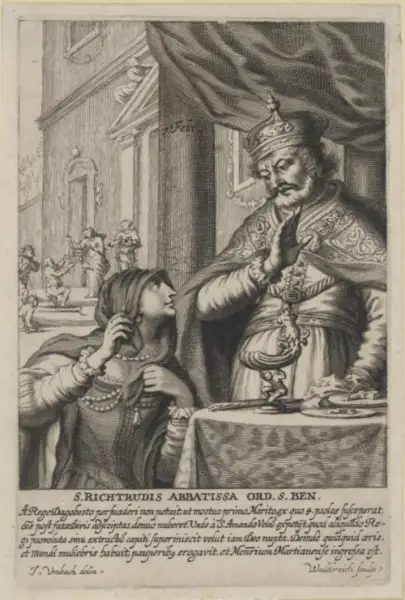
Clotsinda was born into the union of two worlds that met uneasily on the Frankish frontier. Her father, Adalbard, was a Frank of upright family, a loved and honored figure at the courts of Dagobert I and Clovis II; her mother, Rictrude, came of the Gascon nobility, daughter of Ernold and Lichia, born around 612 in a province harried by Basque raids. The marriage itself had taken place despite the violent opposition of Rictrude's parents, since Adalbard belonged to a people his in-laws counted as enemies, and the couple settled on Adalbard's lands at Marchiennes. There the four children of the marriage were raised, and their entry into the Church was marked by extraordinary sponsors: Karine Uge notes that they were baptized by the most prestigious churchmen of their day. Clotsinda received baptism from St. Amandus himself, the exiled missionary bishop who had become her mother's spiritual father, while her sister Eusebia had Queen Nanthild, wife of Dagobert, as godmother, and her brother Maurontus was baptized by the hermit St. Richarius. Few Merovingian children could claim a more distinguished entrance into the Christian faith.
§ Life
Abbess of Marchiennes
The household into which Clotsinda was born became a monastery almost against its will. Soon after the birth of the youngest child her father was assassinated while traveling toward Gascony, apparently at the instigation of kin who resented his marriage into their people. Her widowed mother, counseled by St. Amandus, resolved not to remarry, resisted a king who wished to give her to one of his officials, and after a famous public demonstration of her resolve was permitted to enter Marchiennes, which she governed as a double monastery for some forty years. In this environment of prayer and administration Clotsinda's own vocation matured. The later tradition, preserved in the French calendar collection Nominis, records that she in turn took up the government of the community, succeeding her mother as abbess, an office the sources date to 635. Whatever the exact chronology, the succession made real the family's strategy of endowing religious houses with their own members: mother and daughter ruled the same community in turn, and Clotsinda's abbacy carried the foundation founded in grief into its next generation of stability.
§ Life
One Family, Four Saints
Clotsinda's lasting distinction is that she formed, with her parents and siblings, an entire family of saints. The sources state plainly that all four of Rictrude's children were eventually named among the saints: Maurontus of Douai, who abandoned a court career for the priesthood and the abbot's office; Eusebia of Hamage, who ruled a house of her own; Adalsinda of Hamage, a nun who died young; and Clotsinda herself. Modern historians have read this constellation as more than private piety. Jo Ann McNamara describes the noble women of this generation as embracing religious life in family teams, enduring houses that secured land and power beyond the reach of a predatory court, and Karine Uge sees in the Marchiennes foundation a deliberate family strategy in an age of political turbulence. Clotsinda's cult, though slight in surviving detail, was kept within this family circle of memory: her mother's Vita, written by Hucbald in 907, and calendars such as Nominis kept her name alive, the family feast being observed on May 12, and devotion to the Marchiennes saints persists in Flanders and modern Belgium to this day.
§ Life
Timeline
- 612
Her mother Rictrude is born in Gascony amid Basque raids, in the reign of Clothar II
§ Life
- 635
Succeeds her mother Rictrude as abbess of Marchiennes, the family's double monastery
§ Life
- 676
Her mother Rictrude dies at Marchiennes, aged seventy-four, sometime in the years 676 to 691
§ Life
- 907
Hucbald writes the Vita Sanctae Rictrudis at Saint-Amand Abbey, the chief source for her family
§ Life
The Record
- Canonization
- Pre-congregation; honored as a saint from the early medieval period
Prayer
Bibliography
Show 6 sources
- Butler, Alban (1866). "St. Rictrudes, Abbess". The Lives of the Saints. Vol. 10
- McNamara, Jo Ann; Halborg, John E.; Whatley, E. Gordon (1996). "Rictrude, Abbess of Marchiennes". Sainted Women of the Dark Ages. Duke University Press. ISBN 0-8223-1200-X
- Uge, Karine (2005). Creating the Monastic Past in Medieval Flanders. York Medieval Press. ISBN 1-903153-16-6
- "Santa Rictrude: Spouse, Abbess". Santie Beati
- Wasselvnck, René (2008). "Saint Adalbald the Martyr". Santie Beati
- "Saint Clotsinde". Nominis
Profile text adapted from the Wikipedia article, licensed CC BY-SA 4.0.
Pray with this saint every day
Save St. Clotsinda to your favorites, read the full profile, and get feast-day reminders in the Saints app.
Get the Saints AppFree on the App Store for iPhone and iPad