
c. 466 – 511·Feast November 27
St. Clovis I
first Catholic king of the Franks
Overview
Clovis I (Chlodovechus, Frankish *Hlodowig, c. 466 – 27 November 511) was the ruler who first gathered the divided Frankish peoples under one crown, turning a patchwork of petty kingdoms into a single hereditary monarchy and founding the Merovingian dynasty, which governed the Franks for the next two centuries. Son of Childeric I and the Thuringian princess Basina, he took the throne of the Salian Franks at Tournai around 481, aged about fifteen. His victory over the Gallo-Roman commander Syagrius at Soissons in 486 broke the last Roman rump state north of the Alps, and the following decades brought the Alamanni, the Burgundians, Armorica and the Visigothic kingdom of Aquitaine under his power. His marriage to the Burgundian princess Clotilde led, after long resistance, to his baptism into Catholic Christianity by Saint Remigius — a step almost no other Germanic king had taken in its Roman form, and one that bound the Franks to the papacy and the Gallo-Roman clergy rather than to Arianism. In later centuries France revered him as a saint, the spiritual founder of the nation, though every papal attempt to canonize him failed. He is remembered as the maker of both the French monarchy and French Christianity.
The Complete Life
A Prince of Tournai
Clovis was the son of Childeric I, king of the Salian Franks, and of Basina, a princess of Thuringia; the dynasty he would found took its name instead from his supposed grandfather Merovech, and later legend went so far as to trace the Merovingians back to the Trojan War. The Franks of his day were not one people but many: numerous small kingdoms dotted the low countries and the Rhine, the Salians dwelling by the North Sea shore while the Ripuarian Franks held the river banks. The Salians had been settled at Toxandria under Roman license since the year 358, and from there Chlodio, around 430, had pushed west to seize Tournai, Artois and Cambrai, reaching as far as the Somme. Childeric, reckoned a kinsman of Chlodio, fought alongside the Roman commander Aegidius against the Visigoths at Orléans in 463, and historians judge that father and son both served as commanders of the Roman army in the province of Belgica Secunda. When Childeric died in 481, the throne passed to his son, then only fifteen years old. Imperial power in Gaul was collapsing — the last western emperor had been deposed in 476 — and the boy king inherited a frontier world in which Visigoths and Burgundians competed to fill the void.
§ Background
The Road to Soissons
Clovis's first great campaign set the pattern of his reign. In 486 he joined forces with Ragnachar of Cambrai, his kinsman, and with a third Frankish ruler, Chararic, and the three marched against Syagrius, the Gallo-Roman commander who held the so-called Kingdom of Soissons, the last shreds of Roman rule in northern Gaul. In the fighting Chararic betrayed his allies by refusing to engage, yet the Franks won a decisive victory all the same, and Syagrius fled to the court of Alaric II. The battle is counted as the end of the Western Roman Empire's rump state beyond Italy. Clovis's dealing with the church in these years showed a pragmatism that never left him: lacking the goodwill of the Gallo-Roman clergy, he had plundered Roman territory and its churches, but when the Bishop of Reims demanded back what had been seized, the young king, anxious for friendship with the clergy, restored a precious ewer taken from the cathedral. He took Paris only after a stubborn resistance that may have lasted five years, then chose the city for his capital and founded an abbey in honor of the apostles Peter and Paul on the left bank of the Seine — the house later known as Sainte-Geneviève, where he would one day be buried.
§ Road to Soissons
The Making of a Kingdom
The middle years of the reign joined diplomacy to conquest. Around 493 Clovis drew the Ostrogoths into alliance by giving his sister Audofleda as bride to their ruler, Theodoric the Great, and in the same turmoil of the Burgundian court — where Gundobad had murdered his brother and driven his nieces into exile — he received the fugitive princess Clotilde as his wife. War came to him in 496, when the Alamanni invaded and several Frankish kings defected to them; near the fort of Tolbiac, in a battle his men nearly lost, Clovis triumphed with the help of the Ripuarian Franks, and it was in this crisis, Gregory of Tours would tell, that the king and three thousand of his warriors turned to Christ. Further campaigns followed against Gundobad, whom he defeated near Dijon and besieged at Avignon before settling for tribute, and into Armorica, where arms failing, he won the Armorici instead by statecraft, their shared hatred of the Arian Visigoths drawing them into his realm. The climax came in 507, when the magnates of his kingdom authorized war against the Visigoths: forbidding his troops to plunder, presenting the invasion as liberation for oppressed Catholics, Clovis destroyed the army of Alaric II at Vouillé and swept Visigothic power out of Gaul, after which the Emperor Anastasius conferred on him the titles of patrician and honorary consul.
§ Late reign (507–511)
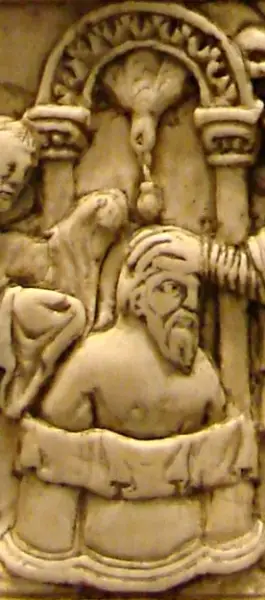
The Baptism at Reims
Clovis's conversion decided the religious future of western Europe. He was born into Frankish paganism and at one point inclined toward the Arian Christianity of the Goths, whose faith — declared heretical at Nicaea in 325 — then dominated Christian Gaul. His wife Clotilde, a Nicene Christian at an Arian court, pressed him for years: she had their first son baptized without his knowledge, and when the child died soon after, and the second son nearly died following his own baptism, Clovis's resistance only hardened. Yet her persistence, and perhaps the memory of Tolbiac, prevailed. On a Christmas Day — the year disputed, with scholars proposing dates between 498 and 506, though modern study of his correspondence with Bishop Avitus of Vienne favors December 508 — the king was baptized into the Catholic faith by Saint Remigius in a small church near the later abbey of Saint-Remi at Reims, where a statue of the scene still stands. The choice set him apart from the Arian Visigoths and Vandals and won him the loyalty of the Catholic Gallo-Roman aristocracy, though the historian Bernard Bachrach argues it also alienated fellow Frankish kings and weakened him militarily for years. He was not the first Germanic ruler to embrace Nicene Christianity — that honor belongs to Rechiar of the Suevi — but his conversion brought a whole people with him, and his wife would be venerated as a saint for it.
§ Baptism
Unification, Law and Death
After Vouillé, Clovis removed every rival to his supremacy. Hearing that Chararic planned to escape his monastic confinement, he had him killed; he induced Prince Chlodoric to murder his own father Sigobert, then struck Chlodoric down as a parricide; and when his old ally Ragnachar of Cambrai, strengthened by defectors from the newly Christian court, barred the gates against him, Clovis bribed the garrison and executed Ragnachar and his brother Ricchar. By about 509 every Frankish king was gone but himself. Under his rule the Salian law was codified for the first time, written with the help of Gallo-Romans to reflect both Frankish custom and Christianity. Shortly before he died he summoned the bishops of Gaul to the First Council of Orléans, where thirty-three prelates issued thirty-one decrees binding on Frank and Roman alike — the first legal statement of equality between conquerors and conquered, and a deliberate welding of crown to episcopate. He was last attested on 11 July 511 and died at Paris that autumn, on 27 November, aged about forty-five. Buried in the church of the Holy Apostles, later the Abbey of St Genevieve, he left his kingdom to be divided among four sons — Theuderic, Chlodomer, Childebert and Chlothar — a partition whose precedent of disunity shadowed Frankish history until the dynasty's fall in 751.
§ Unifying the Franks
The Saint Who Was Never Canonized
Clovis belongs to the curious company of saints whom the church venerates without ever having formally made one. No episcopal or papal act of canonization or beatification exists for him; his cult rests on popular acclaim, ancient and persistent. Shrines stood in the Basilica of Saint-Denis, where he was buried, and in the Abbey of Saint Genevieve in Paris — probably, scholars think, the cradle of his veneration — as well as at Tarascon and Saint-Pierre-du-Dorât. Strangely, his cult flourished less in the north he ruled than in the south: the abbot Aymeric de Peyrat claimed that Moissac Abbey itself was his foundation, medieval writers compiled hagiographies of his life, and historians debate whether the French crown fostered the southern cult to bind Occitania to the monarchy or whether the Occitans turned the saintly founder into a patron of their own autonomy. French kings, from the fourteenth century onward, campaigned repeatedly for his papal canonization — most ardently Louis XI, modeling his effort on the canonization of Louis IX — and a seventeenth-century Jesuit revival of the cause answered the Calvinist Jean de Serres, who had painted Clovis as a bloodstained tyrant. The cause never succeeded; the acclamation never died. His feast is kept on 27 November in France and 26 October in Southern Italy.
§ Sainthood
Father of a Kingdom
The kingdom Clovis built — most of Roman Gaul together with parts of western Germany — endured long after him, and to many French people he remains the founder of the French state; Charles de Gaulle could say that for him the history of France begins with Clovis. The unity he forged did not outlast his own household: his decision to divide the realm among his sons, made to guarantee them equal incomes rather than from any geographic logic, planted discord that recurred in every generation and helped bring the Merovingian dynasty to its end in 751. Yet he also bequeathed something more durable than territory — the alliance of throne and altar, a monarchy with the support of both people and Church, so that when magnates later moved against the royal house, they still sought papal sanction first. In Paris he left a symbolic capital: by choosing burial there he gave the city a sacred weight, and fifty years later his grandchildren still held it as common property of the dynasty. From his Frankish name descend the name of Louis, borne by eighteen kings of France, and the English Lewis. In art and memory he rides forever with the fleur-de-lis — the baptism at Reims, not the slaughter at Vouillé, being the image France chose to keep.
§ Legacy
Timeline
- 466
Born at Tournai, son of the Salian king Childeric I and the Thuringian princess Basina
§ Introduction
- 481
Succeeds his father Childeric I as king of the Salian Franks, aged about fifteen
§ Background
- 486
Defeats the Roman commander Syagrius at the Battle of Soissons, ending the rump western Roman state outside Italy
§ Road to Soissons
- 491
Attacks a small force of Thuringians near the Burgundian border, by which time the former Roman kingdom is under his control
§ Uniting Gaul
- 493
Marries the Burgundian princess Clotilde, while his sister Audofleda weds Theodoric the Great, allying him with the Ostrogoths
§ Barbarian Relations
- 496
Narrowly defeats the invading Alamanni at the Battle of Tolbiac; his conversion to Christianity is placed around this crisis
§ Assault of the Alamanni
- 500
Invades Burgundy on Godegisel's behalf, beats Gundobad near Dijon, and lifts the siege of Avignon for an annual tribute
§ Relations with Burgundy
- 502
Leads his army into Armorica and, when conquest fails, wins the region by diplomacy into his realm
§ Armorici allies
- 507
Crushes the Visigoths at the Battle of Vouillé, killing King Alaric II and ending Visigothic power in Gaul
§ Relations with the Visigoths
- 507
Receives from Emperor Anastasius I the Roman titles of patrician and honorary consul after his victory
§ Relations with the Visigoths
- 25 Dec 508
Baptized into Catholic Christianity at Reims by Bishop Remigius on Christmas Day, now dated December 508 from his correspondence with Avitus
§ Baptism
- 509
Executes the rival king Ragnachar and unites all the Franks under his sole rule, becoming king of all Francia
§ Chronology
- 11 Jul 511
Convenes the First Council of Orléans of thirty-three bishops; his last attested appearance is in its acts of 11 July
§ Chronology
- 27 Nov 511
Dies at Paris aged about forty-five and is buried in the Abbey of Saint Genevieve; the kingdom is divided among his four sons
§ Death
- 1896
Cardinal Langénieux's speech at the fourteenth centenary of his baptism shows his hagiography still widely cited
§ Sainthood
In Their Own Words
the first king of what would become France
Jesus Christ, whom Clotilda asserts to be the son of the living God, who art said to give aid to those in distress, and to bestow victory on those who hope in thee, I beseech the glory of thy aid, with the vow that if thou wilt grant me victory over these enemies, and I shall know that power which she says that people dedicated in thy name have had from thee, I will believe in thee and be baptized in thy name.
The Record
- Major works
- First codification of Salic law, written with Gallo-Roman assistance·Abbey dedicated to Saints Peter and Paul on the Seine at Paris (later Sainte-Geneviève Abbey)·First Council of Orléans (511)
- Patron of
- France
- Symbols
- suit of armour·upright sword·fleur-de-lis·three frogs (his attributed arms)
- Canonization
- Pre-congregation; never formally canonized by any pope, but venerated by popular acclaim in France and Southern Italy, with feasts on 27 November (France) and 26 October (Southern Italy).
Prayer
Bibliography
Show 9 sources
- Chisholm, Hugh, ed. (1911). "Clovis". Encyclopædia Britannica. Vol. 6 (11th ed.). Cambridge University Press. pp. 563-564.
- Brown, Peter (2003). The Rise of Western Christendom. Malden, MA: Blackwell Publishing Ltd. p. 137.
- Shanzer, Danuta (March 1998). "Dating the baptism of Clovis: the bishop of Vienne vs the bishop of Tours". Early Medieval Europe. 7 (1): 29-57. doi:10.1111/1468-0254.00017.
- Bachrach, Bernard S. (1972). Merovingian Military Organization, 481-751. University of Minnesota Press. ISBN 978-0816657001.
- Gregory of Tours (1997) [1916]. Halsall, Paul (ed.). History of the Franks: Book II. Translated by Brehaut, Earnest.
- Wood, Ian (2014). The Merovingian Kingdoms 450-751. Routledge. pp. 37-38. ISBN 978-1-317-87116-3.
- Mathisen, Ralph W. (2012). "Clovis, Anastasius, and Political Status in 508 C.E.: The Frankish Aftermath of the Battle of Vouillé". In Mathisen, Ralph W.; Shanzer, Danuta (eds.). The Battle of Vouillé, 507 CE: Where France Began. De Gruyter. pp. 79-110. ISBN 978-1-61451-099-4.
- Yardeni, Myriam (1996). "LE CHRISTIANISME DE CLOVIS AUX XVIe ET XVIIe SIÈCLES". Bibliothèque de l'École des chartes. 154 (1): 153-172. doi:10.3406/bec.1996.450815.
- Daly, William M. "Clovis: How Barbaric, How Pagan?" Speculum, 69:3 (1994), 619-664.
Profile text adapted from the Wikipedia article, licensed CC BY-SA 4.0.
Pray with this saint every day
Save St. Clovis I to your favorites, read the full profile, and get feast-day reminders in the Saints app.
Get the Saints AppFree on the App Store for iPhone and iPad