
died 249·Feast February 8
St. Cointha
martyr of Alexandria dragged behind a horse
Overview
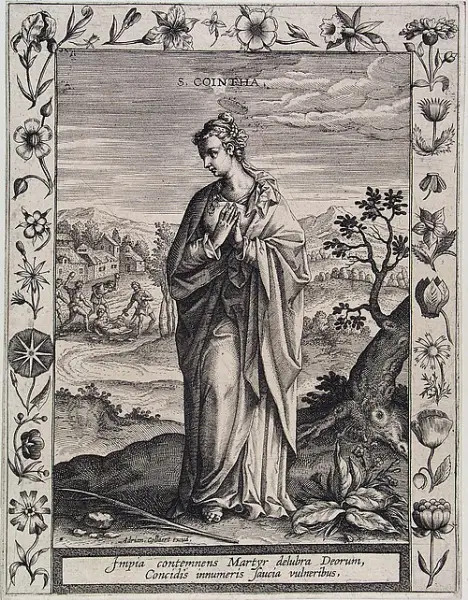
Cointha, also remembered under the names Quinta and Cynthia, was a Christian woman put to death in Alexandria during the persecutions unleashed by the emperor Trajanus Decius. Under Decius, who demanded that all subjects offer sacrifice to the Roman gods, Alexandria became a place of fierce violence against the church, and Cointha numbered among its victims. Her executioners bound her feet to a horse and dragged her through the streets of the city until she died. The churches of East and West preserved her name in their calendars, and her feast is kept on 8 February. She is venerated in the Roman Catholic Church as one of the early martyrs, canonized by the pre-congregation tradition of the undivided church — remembered not for writings or foundations but for a witness sealed in blood on the streets of one of Christianity's first great cities.
The Complete Life
Death in the Decian Persecution
The whole of what is known of Cointha belongs to a single hour in the year 249. The emperor Trajanus Decius had ordered sacrifice to the Roman gods throughout the empire, and in Alexandria — a city of many peoples and of one of the oldest Christian communities in the world — the command released savage persecution. Cointha, known also as Quinta and by the form Cynthia, refused and was condemned. Her death was designed for public terror: her feet were fastened to a horse, and the animal was driven through the streets, dragging her along the pavement until she was killed. The spectacle was meant to frighten a city full of believers; instead it created a martyr. Christians preserved her name in their memorial lists, set her feast on 8 February, and handed her on to the calendars of the Roman Catholic Church, which venerates her today. She belongs to the great company of the pre-congregation saints — those whose sanctity the church accepted from the beginning because their deaths declared it — and she stands in the roll of Egypt's martyrs beside far better-documented companions, a woman remembered chiefly because she would not let go of her faith when the horses began to run.
§ Introduction
A Martyr of the Undivided Church
Cointha never passed through any process of canonization, for the simple reason that none existed in her age. The church of the first centuries reckoned its saints by the witness of blood: those who died for the faith were named at the altar, their anniversaries kept as feasts, their stories read to the assembled faithful. By that ancient and universal consent Cointha has been venerated from the earliest times, and the Roman Catholic Church continues to number her among its martyrs. Her case illustrates the character of the whole pre-congregation calendar: a woman of whom nothing survives but a name, a city, an emperor's reign and the manner of her death is nevertheless a saint of the universal church, because the early Christian community judged her worthy of perpetual remembrance. Later generations built around her the ordinary apparatus of cult — a feast day on 8 February and a place in the martyrologies — while historians of the Alexandrian persecution group her with the many who died in those years. Her listing among the martyrs who are saints of the Catholic Church keeps her memory alive for the present age.
§ Introduction
The Record
- Canonization
- Pre-congregation; honored as a martyr of the early church, venerated in the Roman Catholic Church.
Prayer
Bibliography
Show 1 sources
- "St. Cointha". Catholic Online.
Profile text adapted from the Wikipedia article, licensed CC BY-SA 4.0.
Pray with this saint every day
Save St. Cointha to your favorites, read the full profile, and get feast-day reminders in the Saints app.
Get the Saints AppFree on the App Store for iPhone and iPad