
1381 – 1447·Feast March 6
St. Colette of Corbie
reformer of the Poor Clares and foundress
Overview
Colette of Corbie (13 January 1381 – 6 March 1447), born Nicolette Boellet in the Picardy village of Corbie, rose to become an abbess and the mother of the Colettine Poor Clares, her own reformed branch of the Order of Saint Clare, and the church counts her among its saints. the long-awaited child of a poor carpenter of the Benedictine abbey, she lost her parents in 1399 and passed through the Beguines and a Benedictine house before receiving the habit of the Third Order of St. Francis in 1402 and living as a hermit near the abbey church. Visions convinced her that heaven required her to bring the Second Order back to the unrelenting poverty and austerity of its Franciscan beginnings. Licensed by the Antipope Benedict XIII and aided by the preacher Henry de Beaume, she opened her first reformed monastery at Besançon in 1410; by her death eighteen monasteries of her reform had been founded, from Ghent and Poligny to Heidelberg and Pont-à-Mousson. Her rules prescribed extreme poverty, going barefoot, and perpetual fasting and abstinence. Because of miracles reported in her lifetime and after, childless wives, mothers-to-be and ailing children all claim her as their patron.
The Complete Life
A Child Given Through Prayer
Colette began life under a sign of answered prayer. Her birth came at Corbie, a village of Picardy in northern France, on 13 January 1381: Nicolette Boellet (spelled Boylet by some), daughter of Robert Boellet, a carpenter of modest means employed at the renowned Benedictine abbey there, and of his wife Marguerite Moyon. Her biographers, writing close to her own time, relate that her parents had grown old without children and had begged Saint Nicholas of Myra for help; Marguerite was sixty when a daughter was at last born to them. In gratitude the couple named the baby for the saint whose intercession they credited, and the affectionate 'Nicolette' soon shortened to the name by which the world knows her. Her childhood passed in the shadow of one of the great abbeys of northern France, and its world shaped her: the one she left in 1399, when both parents died, she turned at once toward the religious life. She entered the company of the Beguines, devout women who lived in community without solemn vows, but found their manner of living insufficiently demanding. A subsequent stay among Benedictines as a lay sister — probably undertaken, her biographers suggest, to escape an arranged marriage — likewise left her restless and seeking a stricter path.
§ Early life
Hermits and Visions at Corbie
The decisive turn came in September 1402, when Colette took the habit of the Third Order of St. Francis, becoming a hermit guided spiritually by the Abbot of Corbie and dwelling beside the abbey church, under an ascetic discipline she would keep for four years, from 1402 to 1406. It was in this silence that her peculiar mission took shape: in a stream of dreams and visions she discerned that heaven was summoning her to reform the Franciscan Second Order — the Poor Clares — and to lead it back to its founding ideals of absolute poverty and austerity. The claim was audacious from a woman of no standing: to re-form an entire religious order required authority no abbess could grant herself. Colette resolved to obtain it, and turned to the master of the fragmented church of her day, the Antipope Benedict XIII of Avignon, whom France recognized as rightful pope. In October 1406 Benedict received her at Nice in southern France. He allowed her to transfer to the Order of Poor Clares and, by a series of papal bulls issued between 1406 and 1412, empowered her both to establish new monasteries and to carry the reform of the order through to completion — the legal foundation of everything that followed.
§ Early life
Founding the Colettine Reform
With her bulls in hand, Colette began the work of foundation. Backed by the Countess of Geneva and aided by the itinerant Franciscan preacher Henry de Beaume, her confessor and spiritual director, she started at Beaune in the Diocese of Geneva, though her stay there proved brief. Besançon saw her first reformed house in 1410, established within a derelict monastery of the Urbanist Poor Clares; from that seed the reform spread rapidly — to Auxonne in 1412, to Ghent the same year, to Poligny in 1415, later to Heidelberg in 1444, and onward to Amiens, to Pont-à-Mousson in Lorraine, and into other communities of Poor Clares that adopted her discipline. By the end of her life eighteen monasteries of the reform had been founded. The regime she prescribed was severe even by Franciscan standards: extreme poverty, going barefoot, and perpetual fasting and abstinence. To govern the houses she drew up special Constitutions for the monasteries that embraced her reform, approved in 1434 by William of Casale, Minister General of the friars, and confirmed after her death by Pope Nicholas V in 1448, by Pius II in 1458, and by Sixtus IV in 1482. Together with Henry of Beaume she also undertook a reform of the Franciscan friars themselves, the Coletans, a small branch later merged into the Observants by Pope Leo X in 1517.
§ Foundress
Poverty, Prayer and Works of Mercy
The heart of Colette's reform was a return to what she understood as Clare's own way: poverty without compromise. Her monasteries owned nothing and depended entirely on the daily generosity of the towns around them — a dependence that alarmed the burghers of Besançon when she first imposed it, and one that only her patience and evident holiness gradually overcame. Fasting and abstinence were perpetual; shoes were laid aside; the enclosure was kept with a rigor meant to make each monastery a stable at Bethlehem. Yet the severe exterior enclosed a ministry of tenderness. According to her biographers she multiplied food and wine in times of need and effected cures, some of them occurring after her death. Two stories in particular fixed her memory as a helper in childbirth: while traveling to Nice to see Pope Benedict she stopped at a friend's house whose wife was in dangerous labor, and her prayers at the parish church brought the mother safely through; the child of that delivery, a girl named Petronilla, later entered one of Colette's monasteries and became her secretary and biographer. On another occasion she revived a stillborn infant by wrapping it in the veil the pope himself had given her when he conferred the habit of the Second Order — the act from which her modern patronage of mothers and sick children flows.
§ Miracles
Death at Ghent
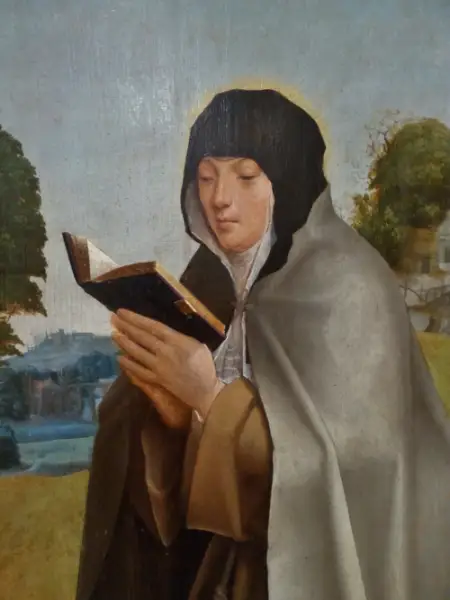
Colette's last years were spent in the network of monasteries she had raised, visiting, correcting and encouraging houses that stretched from Picardy through Burgundy to Flanders and the Rhineland. The reform was secure enough by then to outlive her: her Constitutions had been approved by the order's Minister General, her monasteries numbered eighteen, and new foundations were still being added in her final decade, including Heidelberg in 1444. She died at Ghent, in the County of Flanders, on 6 March 1447, at the age of sixty-six, in the Flemish house that had embraced her reform more than three decades before. Her remains were preserved in the city, where depictions of the saint in her Poor Clare habit were afterwards made; a painting of the period, the detail of 'Saint Clare and Saint Colette' executed around 1520 by the Master of Lourinhã, now in the National Museum of Ancient Art in Portugal, shows how quickly her figure joined the company of the great Franciscan saints. The date of her death, 6 March, became her universal feast; the Franciscan Order keeps her memory on 7 February. At Ghent her tomb drew the devotion of the Low Countries and remains a center of her cult.
§ Veneration
From Local Veneration to the Altars
Recognition of Colette's sanctity followed the slow, deliberate path of the modern canonization process. Her reputation had been secured during her lifetime by the reported miracles and by the sheer endurance of her reform; after her death in 1447 the devotion of her nuns and the Franciscan order kept her cause alive. Nearly three centuries passed before the church spoke formally: on 23 January 1740 Pope Clement XII beatified her, and on 24 May 1807 Pope Pius VII — the pope of Napoleon's Concordat, restoring the shattered institutions of European religion — canonized her a saint of the Catholic Church. Her feast was fixed on 6 March, the day of her death at Ghent, with the Franciscan Order celebrating her on 7 February. With canonical honors came the definition of her patronage: because of the events reported of her life, above all the rescue of mothers in childbirth and the revival of the stillborn child, women who long for a child implore her aid, and mothers-to-be, together with parents of ailing infants, claim her as their patroness. In this way the woman whose own birth was credited to prayer for a childless mother became, across the centuries, the refuge of others praying the same prayer.
§ Veneration
The Colettines Today
Colette's most permanent monument is a living one: the Colettine Poor Clares, the reform branch of the Order of Saint Clare that grew from her monastery at Besançon. Her nuns survive in France, Ireland, Italy, the United Kingdom and the United States, still governed by the special Constitutions she framed — approved within her lifetime by William of Casale in 1434, and confirmed by Popes Nicholas V in 1448, Pius II in 1458 and Sixtus IV in 1482 — with their strict poverty, bare feet and perpetual fast. The friars' side of her reform had a briefer history: the Coletans, inaugurated with Henry of Beaume, numbered only thirteen friaries at Henry's death in 1448, all attached to houses of her nuns, and were merged into the Observant branch of the Friars Minor by Pope Leo X in 1517. Among the Poor Clares, however, the Colettine observance became one of the order's defining traditions, studied by historians of late medieval religion as a landmark of the reform movements that swept the Franciscan family in the century before the Reformation. Devotion to the saint herself has flowed through the same channels: her patronage of mothers and children remains widely invoked, her image stands beside Clare's in the art of several nations, and Ghent keeps her remains as the focus of an unbroken cult.
§ Legacy
Timeline
- 13 Jan 1381
Born Nicolette Boellet at Corbie in Picardy, the child of Robert Boellet, a carpenter of the Benedictine abbey, and Marguerite Moyon.
§ Early life
- 1399
Left an orphan by the death of her parents, she joins the Beguines, whose way of life leaves her unsatisfied.
§ Early life
- Sep 1402
Receives the habit of the Third Order of St. Francis and lives as a hermit near the abbey church of Corbie under the abbot's direction.
§ Early life
- Oct 1406
Visits Antipope Benedict XIII at Nice, who receives her into the Poor Clares and empowers her to found monasteries and reform the order.
§ Foundress
- 1410
Establishes her first reformed house at Besançon, taking over a derelict monastery of Urbanist Poor Clares.
§ Foundress
- 1412
The reform spreads to new houses at Auxonne and at Ghent.
§ Foundress
- 1415
Founds a monastery of the reform at Poligny.
§ Foundress
- 1434
The Colettine Constitutions are approved by William of Casale, Minister General of the friars.
§ Foundress
- 1444
A monastery of the reform is established at Heidelberg.
§ Foundress
- 6 Mar 1447
Dies at Ghent on 6 March, aged 66, after founding eighteen monasteries of her reform.
§ Foundress
- 1448
Her Constitutions receive papal approval from Pope Nicholas V, confirmed again by Pius II in 1458 and Sixtus IV in 1482.
§ Foundress
- 23 Jan 1740
Beatified by Pope Clement XII on 23 January.
§ Veneration
- 24 May 1807
Canonized by Pope Pius VII on 24 May.
§ Veneration
The Record
- Major works
- Colettine Poor Clares (reform branch of the Order of Saint Clare)·Colettine Constitutions·Eighteen reformed monasteries, including Besançon, Auxonne, Poligny, Ghent, Heidelberg, Amiens and Pont-à-Mousson·Reform of the Franciscan friars (Coletans), with Henry of Beaume
- Patron of
- women seeking to conceive·expectant mothers·sick children
- Symbols
- Poor Clare habit·veil given by Pope Benedict XIII
- Canonization
- Beatified 23 January 1740 by Pope Clement XII; canonized 24 May 1807 by Pope Pius VII.
Prayer
Bibliography
Show 12 sources
- David Farmer, Oxford Dictionary of Saints (Oxford University Press, 1996), p. 105.
- Roest, Bert (2013). Order and Disorder: The Poor Clares Between Foundation and Reform. Brill, p. 169.
- Ty Mam Duw Monastery. "St Colette's life". Archived 2012-04-05 at the Wayback Machine.
- Farmer, David (1997). "Colette". Oxford Dictionary of Saints. Oxford University Press, p. 96.
- Bihl, Michael. "St. Colette." The Catholic Encyclopedia Vol. 4. New York: Robert Appleton Company, 1908.
- Foley O.F.M., Leonard. Saint of the Day, Lives, Lessons, and Feast. Franciscan Media. ISBN 978-0-86716-887-7.
- "Saint Colette of Corbie", Poor Clares, Belleville, Illinois. Archived from the original on 2015-07-09.
- "St. Colette of Corbie (1381-1447)", Maria Regina Mater Monastery, Kokomo, Indiana.
- Britannica, The Editors of Encyclopaedia. "Poor Clare". Encyclopedia Britannica, 17 Aug. 2023.
- Bynum, Caroline Walker. Holy Feast and Holy Fast, p. 138.
- "Saint Colette of Corbie", Daily Compass, June 3, 2022.
- Herbermann, Charles, ed. (1913). "St. Colette". Catholic Encyclopedia. New York: Robert Appleton Company.
Profile text adapted from the Wikipedia article, licensed CC BY-SA 4.0.
Pray with this saint every day
Save St. Colette of Corbie to your favorites, read the full profile, and get feast-day reminders in the Saints app.
Get the Saints AppFree on the App Store for iPhone and iPad