
died 22 May, early 7th century·Feast May 22
St. Collen
monk of Llangollen who banished the fairy king
Overview
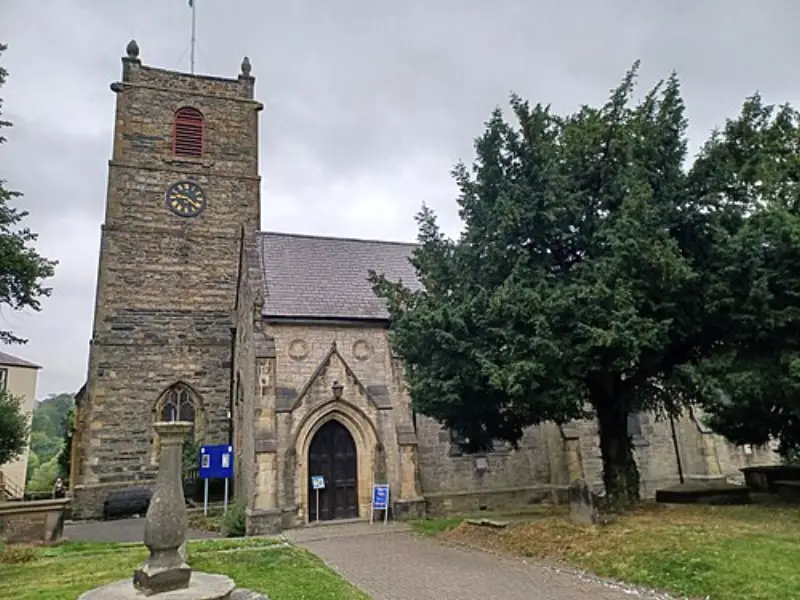
Collen was a seventh-century monk whose chief memorial is the town of Llangollen itself, its very name — llan, an enclosure, joined to a mutated form of his own — proclaiming its founder. Little of certainty survives about him. Tradition says he served overseas for a time as a soldier before embracing religious life, reached Llangollen by coracle, and raised a church beside the river. Legendary Lives link him with Wales, Rome and Glastonbury; the Buchedd Collin makes him a son of Gwynawc ap Caledawc and abbot of Glastonbury, famed for expelling Gwyn ap Nudd, lord of the Tylwyth Teg, whose fairy retinue he drove from the Tor by the use of holy water. Since a church in Brittany is dedicated to him, it has been conjectured that he also spent time in that country; Colan in Cornwall likewise keeps a dedication. He died on 22 May, probably early in the seventh century, and was buried in his chapel, known for centuries as the Old Church, standing just west of the site where the medieval church of St Collen now rises.
The Complete Life
From Soldier to Monk by the River
The outline of Collen's life is thin, but its shape is distinctive. He is said to have spent time abroad as a soldier, a past that sets him among those early monks whose first trade was violence and whose conversion turned it to prayer. In the course of his wanderings he traveled through many foreign lands before returning to Britain, and in time he arrived at the valley of the Dee, reaching Llangollen by coracle, the small hide-covered boat of the Celtic saints. There he founded a church beside the river, and the place took its very name from him: llan, the Welsh word for an enclosure or church settlement, joined to a mutated form of Collen. No other church in Wales keeps his dedication, but related names appear farther afield — at Colan in Cornwall, where the parish church honors him, and at Langolen in Brittany — which has led scholars to conjecture that he also lived for a season on the Continent. Legendary Lives attach him to Wales, Rome and Glastonbury alike; the Buchedd Collin gives him a lineage, naming him son of Gwynawc, ab Caledawc. Beyond these threads, nothing about him is known for certain.
§ Narrative
Abbot of Glastonbury and the Battle for the Tor
The most colorful strand of Collen's tradition belongs to Glastonbury. According to the Buchedd Collin, the saint after his travels returned to Britain and became Abbot of Glastonbury, taking charge of one of the holiest sites of the island church. There the tale sets its famous encounter. Gwyn ap Nudd, king of the Tylwyth Teg, the fairy folk of Welsh belief, held his retinue about Glastonbury Tor; Collen confronted the supernatural host and, with the use of holy water, banished Gwyn and his followers from the hill. The story has been told and retold — it survives in sources from the medieval Life to modern retellings by Llangollen Museum and BBC Wales — and whatever its historical basis, its symbolism is plain: the monk's blessing claims the high place for Christ against whatever older powers were imagined to dwell there. It is a legend of boundaries, in which the disciplined prayer of a soldier-turned-ascetic proves stronger than the glamour of the otherworld. For later generations the tale fixed Collen's character: an austere, courageous figure who would not share holy ground, and whose weapon was never a sword again but water blessed in the name of God.
§ Narrative
Death, Burial and the Old Church
Collen's death is remembered on 22 May, and his passing is placed probably sometime in the early seventh century, though the record will not support a firmer date. He was buried in his own chapel at Llangollen, and there his grave became the anchor of local memory. For centuries the building was known simply as the Old Church, and it stood immediately west of today's medieval church, which bears Collen's name and serves the town still. His cult, though concentrated in the Dee valley, was never confined to it: the dedications at Colan in Cornwall and Langolen in Brittany testify to a wider circulation of his fame, whether through his own travels or through the devotion of those who carried his story across the sea. The absence of firm facts has not diminished his hold on the imagination of Wales. A saint whose name is spoken daily in the name of a town, whose legend enlivens the great tor of Glastonbury, and whose feast returns each May, Collen remains one of the characteristic figures of the early Celtic church: imperfectly recorded, but unforgettable where he is known.
§ Narrative
The Record
- Major works
- Church of St Collen at Llangollen
- Canonization
- Pre-congregation; an ancient Celtic saint whose cult rests on local veneration and church dedications.
Prayer
Bibliography
Show 4 sources
- "The Story of St Collen". Llangollen Museum.
- Monks of Ramsgate. "Gollen". Book of Saints, 1921. CatholicSaints.Info, 16 July 2013.
- "St. Collen and Gwyn ap Nudd".
- "St Collen and the King of the Fairies". BBC Wales.
Profile text adapted from the Wikipedia article, licensed CC BY-SA 4.0.
Pray with this saint every day
Save St. Collen to your favorites, read the full profile, and get feast-day reminders in the Saints app.
Get the Saints AppFree on the App Store for iPhone and iPad