
3rd century·Feast 25 Pashons
St. Colluthus
Coptic physician-martyr of Antinoöpolis
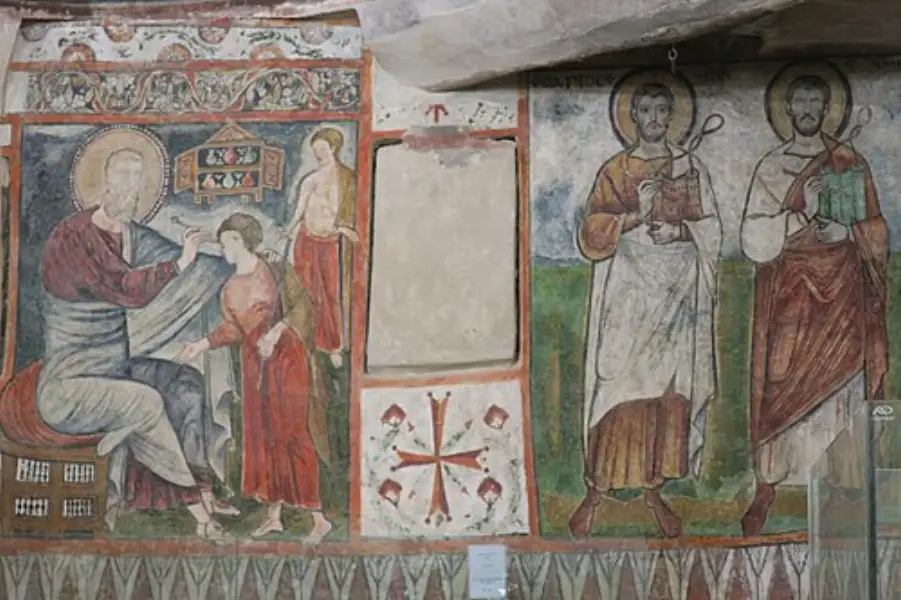
Overview
Colluthus, known in Arabic tradition as Abū Qultah, was a Coptic martyr of the third century from the Upper Egyptian city of Ansena, the ancient Antinoöpolis. Born into a Christian household headed by the governor of the city, he chose a celibate life and practiced medicine without ever accepting payment, serving the sick of his region as a work of charity. His sister's husband, Arianus, succeeded his father as governor, and when Diocletian's persecution of the church broke out Arianus apostatized to keep his office. Colluthus openly rebuked him for turning on the Christians, and the governor shipped him to Oxyrhynchus, where he was imprisoned for three years. His sister tried to win his release and failed. When a new governor took office at Oxyrhynchus, Colluthus was brought out of his cell, tortured, and beheaded on 25 Pashons, the day the Coptic church still keeps for him. Veneration at Antinoupolis is documented from an early date: a shrine to the martyr is first attested in the Lausiac History of Palladius around 420, and archaeology confirms the site's fifth-century existence. His Acts survive in two recensions, and modern scholarship has gathered his whole hagiographical dossier in a critical edition.
The Complete Life
A Governor's Household in Ansena
The hagiographical account places Colluthus in Ansena, the Antinoöpolis founded by Hadrian on the Nile in Middle Egypt, in the third century. His father served as the city's governor, and both of his parents were Christians, an unusual thing in the household of a Roman official and a formation that marked the son for life. Colluthus himself never married, keeping celibacy as a deliberate consecration even while his sister took a husband in the normal course of family life. The marriage proved fateful, for her husband was Arianus, the man who would step into their father's office when the old governor's term ended. In this way the future martyr stood within the very establishment that would later be turned against the church: kin to the governor, resident in a city whose Christian community is attested by Eusebius for the years between 220 and 250, and practicing a profession that brought him into daily contact with people of every rank. The story of his passion begins not with an outsider arrested at random, but with a man whose family occupied the governor's palace, and whose conscience would put him on a collision course with the man who now occupied it.
§ Hagiographical Life
The Physician Who Took No Payment
Colluthus practiced medicine, and the one detail about his practice that the tradition preserves is also the one that defines it: he charged nothing. In a world where physicians served those who could afford them, a doctor who healed the poor without a fee made his profession into an arm of charity, and the Coptic church has never forgotten that trait. His medicine was not separate from his faith but an expression of it, the care of bodies flowing from the same source as the care of souls. The description has led later readers to see him as a predecessor of the great unmercenary healers of the East, the anargyroi who refused payment in imitation of Christ, and his identity as a physician-martyr is the trait by which the tradition knows him. When Diocletian's edicts launched the last and fiercest persecution of the Christians in the empire's Egyptian provinces, it was precisely such visible, respected Christians who became its targets, for their standing gave shelter to the faith of others. The healer of Ansena, whose hands had restored so many to health, was about to learn what his own faith was worth when every earthly support was stripped from him.
§ Hagiographical Life
Rebuke, Three Years in Chains, and the Sword
When the persecution began, Arianus made his choice: he apostatized, sacrificing his faith to retain the governorship of Antinoöpolis. Once secure in his office, he set his hand to persecuting the Christians of the province, and it was his own brother-in-law who stood up to denounce him. Colluthus rebuked Arianus to his face for raising his hand against the church. The governor's answer was not a private settling of family scores but a legal maneuver: he dispatched Colluthus to the governor of Oxyrhynchus, removing him from the city where he was known and handing him to another jurisdiction. There the martyr was thrown into prison, and there he remained for three full years. His sister traveled and petitioned for his release, but her efforts came to nothing. At last the governorship at Oxyrhynchus changed hands, and the new official took Colluthus out of confinement. There was no release in the transfer: the prisoner was tortured, and when he would not yield, the sentence was carried out and his head was cut off. The Coptic Synaxarion preserves the date of his execution as 25 Pashons, and on that day his passion is still read in the churches of Egypt.
§ Hagiographical Life
The Dossier of a Martyr in the Manuscripts
The literary memory of Colluthus is unusually rich. His Martyrdom, or Acts, circulates in at least two recensions. The first reads like an actual court transcript, sober in manner and free of miracle stories, and it appears to have been composed originally in Greek, with the surviving Coptic text a translation from that original. It came to light among the Coptic codices of the Pierpont Morgan Library in New York, all of which derive from the library of the monastery of St. Michael the Archangel near Sopehes, the modern Hamuli in the Fayum, uncovered in 1910, and the text has been printed together with an English translation. From this sober version a second recension was drawn, more legendary in flavor. A Coptic fragment of that second recension, which came from the White Monastery at Sohag, was among the first of its parchments to reach Europe, and it was printed at Rome in 1781 alongside other material about the saint gathered from Greek and Armenian sources. Two encomia also survive, one attributed to Isaac of Antinopolis and another composed by Phoibammon of Shmin. The whole dossier, Coptic texts and all, has now been edited critically by Gesa Schenke with a German translation.
§ Hagiographical Material
The Shrine at Antinoupolis
The city of Colluthus remained a Christian center through the Late Antique period, and his cult took root there early. Eusebius records a Christian community at Antinoupolis in the decades between 220 and 250, before the martyr's birth as the tradition reckons it, and once the Diocletianic persecution ended in 311 the church emerged into the open: a bishopric is attested there as early as 325, and may be older still. The sanctuary of St. Colluthus enters written history with the Lausiac History of Palladius, composed around 420, which is the earliest documentary witness to the shrine, and archaeological traces at the site bear out a fifth-century date for the structure. Pilgrims therefore came to venerate the martyr at Antinoupolis within living memory of the persecution, and the sanctuary endured as a fixture of the city's Christian topography. Through the Synaxarion of the Coptic church his name has been read out on 25 Pashons in every generation since, and modern scholarship, by publishing his Acts and encomia in critical editions, has restored to view one of the fullest dossiers belonging to any Egyptian martyr of the Great Persecution.
§ The Shrine at Antinopolis
Timeline
- 311
The persecution of Diocletian came to an end in Egypt, opening the way for the church at Antinopolis to organize openly.
§ The Shrine at Antinopolis
- 325
A bishopric is recorded at Antinopolis, and may in fact have been established earlier.
§ The Shrine at Antinopolis
- 420
The shrine of St. Colluthus at Antinoupolis received its first written notice, in the Lausiac History of Palladius.
§ The Shrine at Antinopolis
- 1781
A Coptic parchment fragment of the second recension of his Acts, from the White Monastery at Sohag, was printed in Rome with other material on the saint.
§ Hagiographical Material
- 1910
The library of the monastery of St. Michael the Archangel near Sopehes, in the Fayum, was discovered, preserving the sober first recension of his Acts.
§ Hagiographical Material
- 2013
Gesa Schenke published a critical edition of all the Coptic texts of the Colluthus dossier, with a German translation, in the Corpus Scriptorum Christianorum Orientalium.
§ Hagiographical Material
The Record
- Major works
- The Acts of St. Colluthus, first recension (court-transcript tradition, Coptic translation of a Greek original)·The Acts of St. Colluthus, second recension·Encomium on St. Colluthus attributed to Isaac of Antinopolis·Encomium on St. Colluthus by Phoibammon of Shmin
- Symbols
- physician's instruments
- Canonization
- Pre-congregation martyr, commemorated in the Synaxarion of the Coptic Orthodox Church
Prayer
Bibliography
Show 8 sources
- Aaltje Hidding, "3 Physician, Martyr, Miracle Worker. Remembering the Great Persecution at the Sanctuary of Saint Colluthus", in: The Era of the Martyrs: Remembering the Great Persecution in Late Antique Egypt, Berlin, Boston: De Gruyter, 2020, pp. 67-98
- Tito Orlandi, Review of Reymond & Barns, Four Martyrdoms from the Pierpont Morgan Coptic Codices, Aegyptus 56 (1976) pp. 315-317
- Reymond & Barns, Four Martyrdoms from the Pierpont Morgan Coptic Codices (1973)
- K. H. Kuhn, Review of Reymond & Barns, Four Martyrdoms from the Pierpont Morgan Coptic Codices, JTS 25 (1974), Pages 527-529
- Stefano Borgia & Giorgi A., Fragmentum Copticum ex Actis S. Coluthi Martyris Erutum ex Membranis Vetustissimis Saeculi V ac. Latine Redditum, Romae 1781
- S. Thompson (ed.), "Encomium on St. Coluthus, Attributed to Isaac of Antinoe", in L. Depuydt (ed.), Encomiastica from the Pierpont Morgan Library, 2 vols. (Leuven, 1993) lines 46-83
- Tito Orlandi, "Hagiography, Coptic", Coptic Encyclopedia: 1191a-1197b
- Gesa Schenke, "Das koptisch hagiographische Dossier des Heiligen Kolluthos", Corpus Scriptorum Christianorum Orientalium volume 450, Louvain: Peeters (2013)
Profile text adapted from the Wikipedia article, licensed CC BY-SA 4.0.
Pray with this saint every day
Save St. Colluthus to your favorites, read the full profile, and get feast-day reminders in the Saints app.
Get the Saints AppFree on the App Store for iPhone and iPad