
c. 560 – 632·Feast October 29
St. Colman mac Duagh
Hermit of the Burren and abbot-bishop of Kilmacduagh
Overview
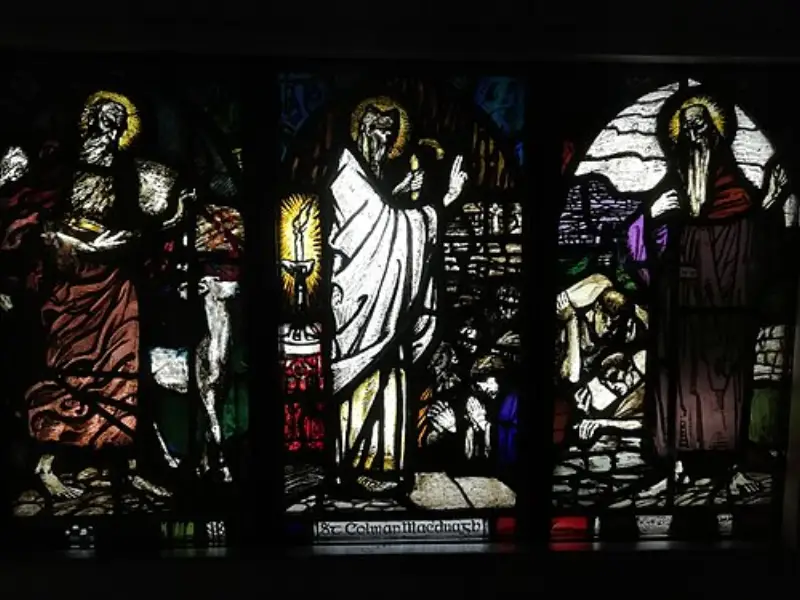
Colman mac Duagh was born around 560 at Corker near Kiltartan in County Galway; his father was the Irish chieftain Duac and, tradition adds, his mother the queen Rhinagh. Educated at Saint Enda's monastery on Inishmore, the largest of the Aran Islands, he embraced the eremitical life there and raised two small churches near Kilmurvy that later numbered among the group known as the Seven Churches. Seeking deeper solitude around 590, he withdrew with a servant to a hermitage at Keelhilla beneath the cliffs of Slieve Carran in the Burren, then cloaked in forest. His reputation for holiness reached Guaire Aidne mac Colmain, king of Connacht, who urged upon him the episcopal oversight of Aidhne. Around 610 Colman established at Kilmacduagh, 'the church of the son of Duac,' the monastery that became the centre of the tribal diocese of Aidhne; though reluctant, he was ordained a bishop and governed the house as abbot-bishop until his death on 29 October 632. Medieval tradition surrounds him with stories of miraculous provision during Lent and of gentle companionship with a rooster, a mouse, and a fly, and he has often been confused with the earlier Colman of Templeshambo.
The Complete Life
A Chieftain's Son of Kiltartan
Colman was born around 560 at Corker in Kiltartan, in what is now County Galway, the son of the local chieftain Duac and, in the surviving tradition, of a queen named Rhinagh. A prophecy uttered before his birth promised that the child would rise to a greatness exceeding all the rest of his race. The tales that gathered about his childhood are dramatic ones: they tell how Rhinagh, fearing her husband would harm the child, fled while pregnant, was overtaken by the king's men, and had a stone tied about her neck before being cast into the Kiltartan river, from which she was washed alive to shore. When she brought her newborn for baptism there was no water to be found, and as she prayed beneath an ash tree a fountain bubbled up from the earth; that spring became the well of Colman mac Duagh. The mother then entrusted the child to monks to be reared, and it was in the monastic school, chiefly at Saint Enda's foundation on Inishmore, that the boy of Kiltartan received the formation that carried him toward the hermit's life.
§ Early life
From Aran to the Burren
Colman's formal education took place at Saint Enda's monastery on Inishmore, the largest of the Aran Islands, and there he chose to remain as a recluse, giving himself to prayer and prolonged fasting. During his years on the island he built a church known as Teampuill Mor Mhic Duagh and a smaller oratory called Teampuill beg Mhic Duagh near Kilmurvy; these belong to the grouping traditionally called the Seven Churches, a name that does not correspond to the actual number of buildings, many of which were destroyed in the Cromwellian era. Yet even Aran did not offer solitude enough. Around 590 Colman moved to the Burren, a region then covered in forest, taking with him only a servant. His hermitage stood in the townland of Keelhilla in the parish of Carran, below a cliff of Slieve Carran; on the site there survive a small stone oratory, a holy well, the shallow cave in which he sheltered, his servant's grave, and a bullaun stone. Modern scholars observe that a stone oratory cannot date from his own day, since churches of his time were built of wood, but the place remains the memory of his retreat.
§ Priesthood
Kilmacduagh and the See of Aidhne
News of the hermit's sanctity travelled to King Guaire Aidne mac Colmain, Colman's kinsman, whose principal residence stood at Kinvara near the site of the later Dunguaire Castle. Impressed by what he learned, the king begged Colman to accept episcopal oversight of the whole territory of Aidhne. Tradition relates that Colman would not choose the site of his monastery himself, but asked God for a sign; while walking through the woods of the Burren his cincture fell from his waist, and on that spot he raised the monastery founded around 610, the house that took from him its very name: Kilmacduagh means the church of the son of Duac. This house then became the centre of the tribal diocese of Aidhne, practically coextensive with the See of Kilmacduagh. Although reluctant to accept the dignity, Colman was ordained a bishop and ruled the monastery as abbot-bishop, numbering among his associates Surney of Drumacoo. From a solitary's cell there had grown a mother church for a whole territory, and the monastic family he gathered became the spiritual pivot of south Galway for the centuries that followed.
§ Priesthood
Fasting, Providence, and Small Creatures
The legends of Colman paint a spirituality of austere fasting joined to disarming tenderness. According to the Menology of Aengus, after a severe Lent he asked his servant what food they had for Easter and heard there was only a small fowl and the usual herbs. Seeing the servant's patience nearly spent, Colman prayed, and at that very moment the dishes set before his cousin King Guaire at a banquet were borne away by unseen hands; Guaire and his retinue tracked the vanished dishes and discovered the feast spread before the hermit and his servant. The limestone pavement nearby is still called Bothar na Mias, the road of the dishes. The same affection for creation marked his daily life. He kept a rooster to wake the monks at dawn, tamed a mouse that roused him for the night office, and even trained a fly to mark his place in a great parchment prayer book while he was called away. When rooster, mouse, and fly all died in one season, he wrote of his grief to Saint Columba, who answered that such trouble visits only those who have riches; and Colman saw that a man may be wealthy without ever holding coin.
§ Legends
Abbot-Bishop to the End
Colman's last years were spent ruling the twin office he had never sought. The sources describe him as reluctant to accept episcopal ordination, and that reluctance became the tone of his government: an abbot who presided as a servant rather than a lord, with companions such as Surney of Drumacoo around the monastery of Kilmacduagh. The house he founded remained the centre of the tribal diocese of Aidhne, and its viability depended on the quiet stability of his long leadership after the foundations of 610. Tradition adds a striking promise to this period, crediting him with the declaration that no person or animal within the diocese of Kilmacduagh would ever die by a lightning strike, a saying that the local tradition claims still holds. He died on 29 October 632, aged about seventy-one or seventy-two, and his passing was kept as the day of his feast. The bishop-hermit who had begun in a cave beneath a cliff finished his course as the father of a diocese, leaving behind a monastic family, a well-loved memory, and a landscape still marked by the places of his prayer.
§ Priesthood
Feast and Pilgrimage
Colman was never formally canonized, for he belongs to the age before congregational processes, when sanctity was recognised by the acclamation of the local church. He is venerated in both the Roman Catholic and Eastern Orthodox traditions. His cult settled early around two dates. The Martyrology of Donegal enters his feast under 2 February; the stronger evidence, however, together with the tradition cherished in the diocese of Kilmacduagh, favours 29 October, the day of his death, and that observance prevailed. A second annual observance grew at the place of his retreat: each year on 21 October pilgrims climb to the hermitage at Keelhilla below Slieve Carran, where the shallow cave, the holy well, and the grave of his servant keep the memory of the Burren years alive. The continuity of these pilgrimages, together with the survival of his cult across both Catholic and Orthodox calendars, marks him as one of the enduring saints of Connacht, honoured not by decree but by the unbroken devotion of the people among whom he prayed, fasted, and governed. Both the Roman Catholic and the Eastern Orthodox churches number him among their saints, and his cult has never been confined to one rite or to one century.
§ Veneration
Crozier, Well, and Road of the Dishes
The memory of Colman mac Duagh remains written into the landscape and treasuries of south Galway. Through the centuries his abbatial crozier was used whenever oaths were sworn; the O'Heynes of Kiltartan, who sprang from King Guaire, guarded it along with their kinsmen the O'Shaughnessys, until it came at last to the National Museum in Dublin, where it can still be seen. The fountain that rose for his baptism became the miraculous well of Colman mac Duagh, and the spring at his Burren hermitage still draws pilgrims each October. The limestone pavement near Kilmacduagh carries the name Bothar na Mias, the road of the dishes, fixing the Easter banquet legend to the ground itself. The monastery he founded around 610 gave its name to an entire diocese, Kilmacduagh, whose round tower and ruins remain among the most striking in Ireland. His stories of the rooster, the mouse, and the fly circulated for centuries as beloved examples of humility toward all creatures. Finally, generations of writers have had to untangle his memory from that of Colman of Templeshambo, who died around 595 and laboured in a different province, a confusion that itself testifies to how widely his name was honoured.
§ Legends
Timeline
- 560
Born at Corker, Kiltartan, County Galway, son of the chieftain Duac and, by tradition, Rhinagh.
§ Early life
- 560
Baptised at a spring that rose miraculously under an ash tree, afterward known as Colman's well.
§ Legends
- 590
Left Inishmore for a hermitage with a servant at Keelhilla, at the foot of Slieve Carran in the Burren.
§ Priesthood
- 610
Founded the monastery of Kilmacduagh, centre of the tribal diocese of Aidhne, in territory held by King Guaire.
§ Priesthood
- 29 Oct 632
Died on 29 October after governing Kilmacduagh as abbot-bishop.
§ Priesthood
The Record
- Major works
- Kilmacduagh monastery, County Galway (founder)·Teampuill Mor Mhic Duagh, Inishmore (builder)·Teampuill beg Mhic Duagh, Inishmore (builder)
- Patron of
- patron of the diocese of Kilmacduagh·invoked against death by lightning, a protection he is said to have secured for the diocese
- Symbols
- abbatial crozier·holy well·hermit's cave·rooster, mouse, and fly from the legends
- Canonization
- Pre-congregation; venerated as a saint in Ireland from the early medieval period
Prayer
Bibliography
Show 7 sources
- "Kilmacduagh", The Lady Gregory and Yeats Heritage Trail
- Musther, John. "Saint Colman Mac Duagh", The Saints of Great Britain and Ireland
- Fahey, Jerome. The History and Antiquities of the Diocese of Kilmacduagh, M. H. Gill & Son, 1893
- Bergh, Stefan and Drew, David. "Holy Wells and Pilgrimage in Carran", Burran Insight, 2014
- Carthy, Hugh (2011). Burren Archaeology. The Collins Press. ISBN 9781848891050
- Grattan-Flood, William. "St. Colman." The Catholic Encyclopedia. Vol. 4. New York: Robert Appleton Company, 1908
- Lapa, Dmitry. "Saint Colman of Kilmacduagh in Ireland, Wonder Worker", Pravoslavie.ru
Profile text adapted from the Wikipedia article, licensed CC BY-SA 4.0.
Pray with this saint every day
Save St. Colman mac Duagh to your favorites, read the full profile, and get feast-day reminders in the Saints app.
Get the Saints AppFree on the App Store for iPhone and iPad