
c. 600 – 689·Feast July 8
St. Colman
Irish missionary martyred with St. Kilian at Würzburg
Overview
Colman, whose Latin name was Colomannus and who is also called Kolonat, was an Irish-born priest and missionary of the seventh century, remembered in Germany as an apostle to the Franconians. Around the year 600 he was born in Ireland, and from there he joined the great Hiberno-Scottish mission to the continent, becoming a companion of St. Kilian and St. Totnan in their evangelization of Franconia and Thüringen. In 686 the three missionaries, traveling with nine other Christians, made their way to Rome, where they met Pope Conon and received his blessing for the work ahead, before continuing north to Würzburg on the Main. There the duke, Gozbert, accepted the Christian faith, but his wife Geilana remained a pagan. When Kilian told the duke that his marriage to his brother's widow violated Christian Scripture, Geilana's fury fell upon the preachers: she dispatched her soldiers to the square in Würzburg where the three were proclaiming the Gospel, and there Colman, Kilian, and Totnan were beheaded on July 8, 689. Their relics were honored as a source of cures, and in 752 Bishop Burchard translated them into the new cathedral of Würzburg.
The Complete Life
From Ireland to the Mission of Kilian
Colman belongs to the wave of Irish monks and priests who carried the Gospel back across the continent of Europe in the seventh century. Ireland, having received the faith without ever having been part of the Roman Empire, was sending out its own sons as missionaries within a few generations, and Colman took his place among them as one of the companions of St. Kilian. With Kilian and Totnan he set his face toward Franconia and Thüringen, the German lands east of the Rhine where Christianity had as yet taken only shallow root. The three did not travel alone or in ignorance: in 686 they journeyed to Rome with nine other Christians, and there they met Pope Conon, aligning their mission with the Apostolic See before venturing into the field. From Rome the party moved on to Würzburg on the River Main, in the duchy of the Franks. There the three principals settled while their companions dispersed through the surrounding country, so that the work of evangelization proceeded both from a fixed center and from wandering preachers. Colman, whose Latin name Colomannus marks him in the continental records, thus became one of the founding witnesses of the church in Lower Franconia.
§ Life
Converting a Duke and Provoking a Duchess
At Würzburg the mission scored its greatest success and provoked its own destruction in the same act. Duke Gozbert of Würzburg heard the preaching of the Irish missionaries and became a Christian, bringing his court and his territory to the edge of conversion; his wife Geilana, however, remained a pagan. The crisis came when St. Kilian confronted the duke with the demands of Christian Scripture: Gozbert was living in marriage with Geilana, his brother's widow, a union the law of Christ did not permit. Whether the duke intended to obey, the preacher's words had already sealed the missionaries' fate. Geilana, enraged at the judgment pronounced on her marriage, dispatched armed men against the square in Würzburg where the three missionaries stood preaching to the people, and there, in the open air and in the midst of their work, Colman was beheaded alongside Kilian and Totnan. The date of their martyrdom, July 8, 689, is the day the church keeps for them still. Colman died not in old age nor in a bed, but in the act of proclaiming the Gospel, a missionary of barely a few years' labor who won the martyr's crown alongside the apostle he had followed from Ireland.
§ Life
Relics, Cathedral, and Memory in Franconia
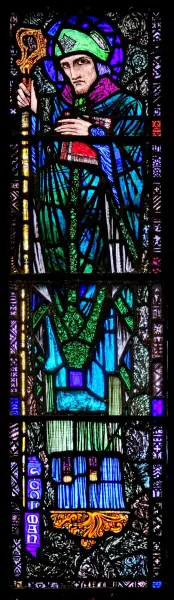
The blood shed in the square of Würzburg proved to be the seed of the Franconian church. After the execution of the three missionaries, their relics were revered by the faithful as a channel of cures for illness, and the memory of the martyrs outlasted the pagan reaction that had killed them. When the episcopal order was established in the city, it was Burchard of Wessex who became the first bishop of Würzburg in 752, and one of his early acts was to gather the remains of Kilian, Colman, and Totnan and translate them into the new cathedral, a church raised in St. Kilian's honor. There the martyrs lay at the heart of the diocese they had founded in blood. Colman's feast is kept on July 8, the anniversary of his martyrdom, and his cult is shared between the Roman Catholic Church, the Eastern Orthodox Church, and the True Orthodox Church. In Ireland his memory returned home too: a stained-glass window by Harry Clarke, depicting the martyr, preserves his image in St. Mary's Church at Ballinrobe, a reminder that the apostle to the Franconians was first a son of Ireland.
§ Legacy
Timeline
- 600
Colman was born in Ireland around the beginning of the seventh century.
§ Life
- 686
With Kilian, Totnan, and nine other Christians, he traveled to Rome and met Pope Conon before setting out for Würzburg.
§ Life
- 8 Jul 689
He was beheaded in the main square of Würzburg on the orders of Geilana, the duke's pagan wife, together with Kilian and Totnan.
§ Life
- 752
Burchard of Wessex, first bishop of Würzburg, translated the relics of the three martyrs into the new cathedral dedicated to St. Kilian.
§ Legacy
The Record
- Canonization
- Pre-congregation martyr, venerated in the Roman Catholic and Eastern Orthodox churches
Prayer
Bibliography
Show 3 sources
- "St. Colman", Celtic Saints website
- "St. Colman", Catholic Ireland website
- Herbert J. Thurston and Donald Attwater, Butler's Lives of the Saints, Vol. III, Christian Classics (1956), p. 40
Profile text adapted from the Wikipedia article, licensed CC BY-SA 4.0.
Pray with this saint every day
Save St. Colman to your favorites, read the full profile, and get feast-day reminders in the Saints app.
Get the Saints AppFree on the App Store for iPhone and iPad