
c. 530 – 600·Feast November 24
St. Colman of Cloyne
Bard turned bishop and royal poet of Munster
Overview
Colman of Cloyne, also known as Colman mac Lenine, lived as a monk and became founder and patron of Cluain Uama, today's Cloyne in County Cork, and among the first Irish poets known by name to compose in the vernacular. His birth fell in Munster about 530; his father was Lenin, and through him he descended through him from the Rothrige, a subject people of the Deisi, he was formed in the fili's demanding twelve-year curriculum and became a bard of the Cashel court, remaining there until he was about forty-eight. His contemporaries styled him the royal poet of Munster. In about 570 he and Brendan of Clonfert settled a dispute over the throne of Cashel, and when the lost shrine of Ailbhe of Emly was discovered during the coronation, Brendan declared that hands which had held so sacred a relic should not be defiled; the bard offered himself to God and received the name Colman, a diminutive meaning dove. After studies under Saint Iarlaithe of Tuam he preached through eastern County Cork; the sources call him a religious and holy presbyter who afterward rose to fame as a bishop. He founded Cloyne, received lands from King Coirpre mac Crimthainn, baptised the future Declan of Ardmore, and died on 24 November, about 600, at Cloyne.
The Complete Life
The Bard of Cashel
Colman came from the Munster of the mid-sixth century, a son of Lenin, and through his father a descendant of the Rothrige, an obscure people known elsewhere as subjects of the Deisi. The genealogists, however, worked hard to associate his lineage with the Eoganachta, the ruling dynasty of Munster, tracing his ancestry back through seven generations to Mug Nuadat, an honour that reflected the standing his monastery would later enjoy. What is certain is his schooling and profession: whether the Christian faith surrounded his upbringing remains unclear, but he underwent the bard's special and lengthy course of training, for the highest grade of fili required twelve years of study. From that learned class he passed into the service of the court of Cashel, Munster's royal centre, and there he stayed until he was about forty-eight years old. His poetic powers were regarded as extraordinary, and his contemporaries styled him the royal poet of Munster. An early triad preserved in the tale Conall Corc and the Corco Loigde names him one of the three ex-laymen of Ireland, a title suggesting that he entered clerical life later than was usual, a mature artist with half a life behind him.
§ Background
The Hands That Held the Shrine
Later tradition holds that it was Brendan of Clonfert who finally persuaded the aging bard to become a cleric, and the story of his conversion is among the most vivid in the Irish sources. In about 570 the two of them, so the tale runs, brought peace between rival claimants to Cashel's throne, and Aodh Caomh was acknowledged king, Cashel's first Christian king, with Brendan himself performing the installation. As the coronation proceeded, Colman stood among those who found the long-lost shrine of Ailbhe of Emly. Such hands, Brendan declared, had held a relic too sacred ever to be defiled again; at those words the son of Lenin gave himself to God. Brendan blessed him and bestowed the name Colman, a diminutive of Colm, the Gaelic twin of the Latin columba, a dove. The newly-made religious then went to the great school of Saint Iarlaithe of Tuam, and once his studies ended he is next found preaching to the pagan peoples of eastern County Cork. The sources picture him as a religious and holy presbyter who afterward rose to fame as a bishop, the completed transformation of a court poet into a bishop of God.
§ Poet
Founder of Cluain Uama
Colman's enduring work was the foundation of the monastery at Cluain Uama, the lawn of the cave, now Cloyne in County Cork, in the kingdom of the Ui Liathain and the Ui Meic Caille. According to the origin tale Conall Corc and the Corco Loigde, the land was given not by the local king but by Coirpre mac Crimthainn, king of Munster of the Eoganacht Glendamnach, who also bestowed on Colman the churches of Aired Cechtraige and Cell Naile, identified with the later parishes of Erry and Killenaule in the diocese of Cashel. As an estate Cloyne was extensive and held some of the richest land in the district; quite possibly it was conquered ground, handed to the church so that reconquest would be impossible. The site itself rose above a cave extending far underground, from which the town takes its name; there Colman was supposed to have taken up his abode, and his primitive oratory, known as Colman's Chapel, could still be seen in 1813. A monastery at the place later known as Killagha Abbey in County Kerry is likewise thought to have been his foundation. Among his works of pastoral care, the sources count the baptism of a Deise prince's child, whom he named Declan and urged his parents to educate well; the boy became Declan of Ardmore.
§ Cloyne
Strife, Verse, and a Quiet End
The death of Coirpre mac Crimthainn around 580 brought Colman into troubles he had not sought. In some fashion he was drawn into the feuds of the dead king's descendants: persecution came from some of them, protection from others, namely the forebears of the line that later prevailed. The same origin tale alludes to earlier conflicts: it tells how Colman and his brothers were once driven out of Maethalach by Maele Umai, son of Coirpre's brother Fiachna Onchind, an expulsion for which Maele Umai's line was barred forever from kingship; and it records a malediction the saint pronounced, by which the walls of Ress, or Ressad, came crashing down, an archaic designation, it appears, for the Ui Chairpre of County Limerick. Through these disturbances Colman continued to write; his surviving verses are dated to the period between about 565 and 604, and include the poem Luin oc laib in praise of Domnall mac Muirchertaig, king of Tara, and a poem on the death of Aed Slaine about 604, which has not survived complete. His death came on 24 November, around the year 600; Cloyne was probably his burying place, and there a school of poetry, it may be, outlived him.
§ Cloyne
Patron of Cloyne
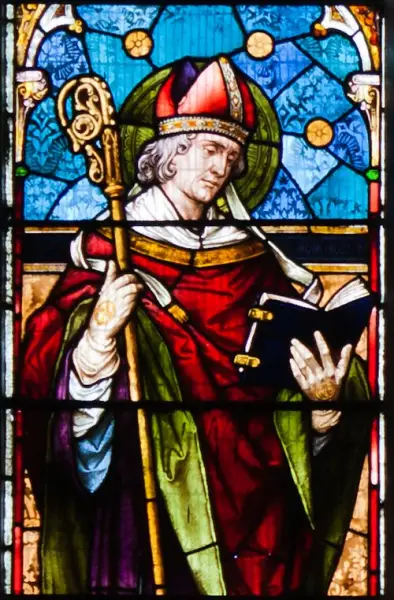
Colman was never canonized by any formal process, for he died around the year 600, in an age when the church recognised its saints by popular and local acclamation. The calendars were unanimous in dating his death to 24 November, and that day became and remains his feast. The church honours him as patron of the Diocese of Cloyne and of its cathedral at Cobh, and there his memory is kept with particular devotion; the great shrines associated with him are Cloyne Cathedral and Cobh Cathedral. A stained glass window in Buttevant, created by Franz Mayer and Company in 1886, depicts the saint. The Felire of Oengus records that a different Colman was venerated on the same day, pairing the names in its verses, a reminder of how crowded the Irish calendars of this period are with bearers of the saint's name. The received picture of Colman mac Lenine comes to us largely from the hagiographies of the nineteenth and twentieth centuries, since no formal Life was ever written for him; his cult rests instead on the annals, genealogies, and martyrologies, and on the unbroken attachment of the church of Cloyne to the bard who became its father in God.
§ Veneration
Poet, Founder, and Law School
Colman of Cloyne occupies a rare place in Irish history as both a founding saint and a founding poet. History remembers him among the first Irish poets known to have composed in their own tongue, and the verses that survive, written across the years from about 565 to 604, stand with the very oldest specimens of Irish committed to the Latin alphabet. The metrical panegyric on Saint Brendan is still extant, and Colgan names a metrical life of Saint Senan as his work besides. Commonly he is credited as well with Luin oc laib, praising the king of Tara, and with the elegy on Aed Slaine. His monastery at Cloyne grew into an institution of national consequence: the tenth-century Triads ranks Cloyne among the island's great law schools, evidence of the intellectual life that flourished above the cave. He is further credited with founding the monastery that became Killagha Abbey in Kerry, and the lands granted him at Erry and Killenaule rooted his followers in two provinces. Though few details of his life were ever committed to writing, the many places in counties Cork and Limerick that bear his name have been taken as proof of the reality of his labours, and his double memory, as poet and as bishop, remains unique among the saints of Munster.
§ Extant verse
Timeline
- 530
Born in Munster, son of Lenin, descended from the Rothrige, a subject people of the Deisi.
§ Background
- 565
His surviving verses begin to be dated from this period, among the earliest Irish writing in the Latin alphabet.
§ Extant verse
- 570
With Brendan of Clonfert settled the succession dispute at Cashel; Aodh Caomh was acknowledged as the first Christian king of Cashel.
§ Poet
- 570
After the discovery of the shrine of Ailbhe of Emly, offered himself to God and received the name Colman from Brendan.
§ Poet
- 580
On the death of Coirpre mac Crimthainn, king of Munster, became entangled in factional strife among the king's descendants.
§ Cloyne
- 24 Nov 600
Died on 24 November, circa 600, probably buried at Cloyne, where a school of poetry may have survived him.
§ Veneration
In Their Own Words
Coirpre mac Crimthainn it was who gave Cloyne to God and to Colman mac Colcon who is also called Mac Lénéne and Aired Cechtraige and Cell Náile. Because of this they [the Eoganacht Glendamnach] are entitled to secular rule.
Mac Lenine the most excellent With Colman of Duth-chuilleann.
The Record
- Major works
- Cloyne monastery, Cluain Uama, County Cork (founder)·Metrical panegyric on Saint Brendan·Metrical life of Saint Senan (mentioned by Colgan)·Luin oc laib, in praise of Domnall mac Muirchertaig (attributed)·Poem on the death of Aed Slaine (attributed, incomplete)·Killagha Abbey, County Kerry (believed founder)
- Patron of
- patron of the Diocese of Cloyne·patron of Cobh Cathedral
- Canonization
- Pre-congregation; patron of the Diocese of Cloyne, feast kept on the day of his death
Prayer
Bibliography
Show 9 sources
- Johnston, Elva. "Munster, saints of (act. c. 450 – c. 700)", Oxford Dictionary of National Biography, Oxford University Press, 2004
- O Corrain, Donnchadh. "Creating the Past: The Early Irish Genealogical Tradition"
- Welsh, Robert (1996). Oxford Concise Companion to Irish Literature. Oxford University Press. ISBN 0-19-280080-9
- Herbermann, Charles, ed. (1913). "St. Colman Mac Lenine", Catholic Encyclopedia, New York: Robert Appleton Company
- Charles-Edwards, T. M. (2000). Early Christian Ireland. Cambridge: Cambridge University Press
- Busse, P. E. (2006). "Colman mac Leneni". In Koch, John T. (ed.). Celtic Culture: A Historical Encyclopedia. ABC-CLIO
- "Conall Corc and the Corco Luigde", ed. Kuno Meyer (1910); trans. Vernam Hull (1947), Proceedings of the Modern Language Association, 62 (4): 887-909
- Oengus of Tallaght (1905). Stokes, Whitley (ed.). The Martyrology of Oengus the Culdee. Henry Bradshaw Society
- McCotter, Paul (1994). Colman of Cloyne: A Study. Dublin: Four Court Press
Profile text adapted from the Wikipedia article, licensed CC BY-SA 4.0.
Pray with this saint every day
Save St. Colman of Cloyne to your favorites, read the full profile, and get feast-day reminders in the Saints app.
Get the Saints AppFree on the App Store for iPhone and iPad