
c. 605 - 674·Feast February 18 (also August 8 and November 13)
St. Colman of Lindisfarne
Bishop of Lindisfarne and Father of Mayo of the Saxons
Overview
Colman of Lindisfarne, born around 605 in the west of Ireland, was the third bishop of Lindisfarne, serving from 661 until 664, and one of the most consequential figures in the Easter controversy that divided the church of Northumbria. Educated on Iona and probably a nobleman of the Conmaicne Mara, he succeeded Aidan and Finan in the see created for the Ionan mission to the Anglo-Saxons. When King Oswiu of Northumbria convened the Synod of Whitby in 664 and the assembly chose to calculate Easter by the Roman method rather than the Celtic one Colman upheld, the bishop resigned rather than abandon the tradition of his formation. He withdrew first to Scotland and Iona, then sailed for Ireland, settling on Inishbofin in 668, where he founded a monastery that became known as the School of Mayo, carrying half of Lindisfarne's precious relics, Aidan's bones among them. Disputes between his Irish and English monks led him to settle the English on the mainland at Magh Eo, Mayo of the Saxons. He died on Inishbofin in 674.
The Complete Life
A Western Irishman Formed on Iona
Colman was born around 605 in the west of Ireland, and tradition adds that he belonged to the Conmaicne Mara of the western seaboard, probably as a nobleman. His formation took place not at home but on Iona, the island monastery founded by Columba off the coast of what is now Scotland. There he absorbed the monastic usages of the Celtic church: its manner of fixing Easter, its style of tonsure and its austere tradition of missionary scholarship. The choice of Iona proved decisive for his life, because Lindisfarne itself stood in the same lineage, established from Iona by Aidan for the kingdom of Northumbria. Colman therefore belonged to the second generation of the men who carried the Ionan tradition among the Anglo-Saxon peoples. When Aidan and then Finan had led the see of Lindisfarne, it was this Irish-trained monk who was judged ready to succeed them, and he received appointment as bishop in 661. His path from an Atlantic island to the royal circuits of Northumbria illustrates how closely the churches of Ireland, Scotland and England were bound together in the seventh century.
§ Life
Bishop of Lindisfarne and the Synod of Whitby
As bishop of Lindisfarne Colmán led a see that served the Northumbrian court from its island monastery. His episcopate was short but placed him at the centre of the great dispute between the usages of the Celtic church and those of Rome. In 664 King Oswiu summoned the Synod of Whitby to settle the question, and the assembly resolved to calculate Easter by the method of the First Ecumenical Council rather than by the Celtic reckoning that Colman preferred. For the bishop this was no technical adjustment: it touched the tradition in which he had been formed and the authority of his spiritual home. Rather than accept the decision he resigned the bishopric, abandoned his see and set out first for Scotland and eventually for Iona itself, while Tuda took his place. His departure made him a lasting emblem of conscience within the controversy, a churchman who surrendered office rather than forsake the discipline of his fathers, and his withdrawal remains one of the most cited episodes in the encounter of Celtic Christianity with Roman practice. Whitby thus ended an Irish episcopate of barely three years in the northern kingdom.
§ Life
Inishbofin and Mayo of the Saxons
Colman's work after Whitby proved as consequential as his episcopate. Later tradition holds that between 665 and 667 he established a number of Scottish churches before going back to Iona, an activity no seventh-century source attests. From Iona he sailed for Ireland and in 668 settled on Inishbofin, off the Connacht coast, where he established a monastery that came to be called the School of Mayo. He carried with him half the relics of Lindisfarne, among them the bones of St. Aidan and a portion of the true cross, reputedly kept at Mayo Abbey until they vanished at the Reformation in 1537. He arrived in a land ravaged by the plague of 664 and 665, and he may rather have been restoring a church already old. On the island a rift opened between his Irish and English monks: in summer the Irish wandered away to places they knew, and coming back in winter expected a share of what the English had gathered. Commentators have linked the pattern to booleying, a form of transhumance, or to visits to kinsmen on the mainland. Colman resolved the quarrel by moving his Saxon followers to the mainland, where he founded a house for them at Magh Eo, the plain of the yew trees, afterwards famous as Mayo of the Saxons.
§ Life
Last Days on Inishbofin
Colman spent his last days on Inishbofin, the island he had chosen for his Irish foundation, and died there in 674. He had passed through three homelands: the Ireland of his birth, the Northumbria of his episcopate and the monastic world of Iona and Connacht where he ended his life. His final settlement gathered up the fruits of his resignations. The monastery of Mayo of the Saxons endured as a centre of learning, and the relics he had carried from Lindisfarne, including the bones of Aidan and a fragment of the true cross, remained honoured there down to the Reformation. He died within a decade of the plague that had scarred the region and ten years after the synod that had driven him from his see, having built rather than merely retreated. The movement from Lindisfarne to Iona, from Iona to Inishbofin and from Inishbofin to Magh Eo traced a coherent course: wherever the discipline he honoured could no longer be kept, he carried it elsewhere and planted it again. The plague years had emptied many settlements of the west; his community gathered survivors about it and gave them once more a common rule and a common livelihood.
§ Life
A Divided Feast and an Enduring Memory
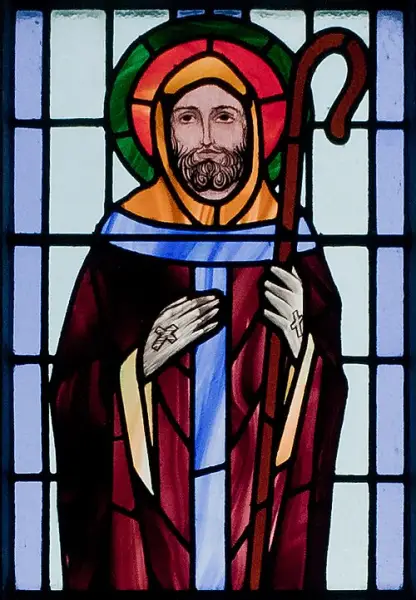
Colman is venerated in the Eastern Orthodox Church, the Roman Catholic Church and the Anglican Communion. His principal feast falls on 18 February, with additional commemorations on 8 August and 13 November. His name holds its place in the episcopal lists of Lindisfarne, where he stands between Finan and Tuda, and in the landscape of Connacht, where Inishbofin and Mayo of the Saxons preserve the memory of his final foundations. A stained-glass window at the church of St. Benin at Kilbennen in County Galway depicts him. Historians remember him as a figure whose conscience reshaped geography: the Synod of Whitby turned Northumbria toward Roman usage, but his withdrawal ensured that the Ionan tradition did not simply end, for it crossed back over the Irish Sea and flourished in new houses. The schools he founded outlived the controversy that produced them, and the bishop who resigned rather than conform remains a living presence in the calendars of three communions. Devotion to him also crossed confessional lines that later centuries drew, and his three separate commemorations in February, August and November suggest that different churches each kept the day they had received from antiquity.
§ Life
Timeline
- 605
Born in the west of Ireland, probably into the noble family of the Conmaicne Mara
§ Life
- 661
Appointed bishop of Lindisfarne, succeeding Aidan and Finan in the Ionan line
§ Life
- 664
Resigned the bishopric after the Synod of Whitby chose the Roman Easter reckoning
§ Life
- 665
Later tradition has him found several churches in Scotland between 665 and 667
§ Life
- 668
Sailed from Iona to Ireland and settled on Inishbofin, founding the School of Mayo
§ Life
- 674
Died on the island of Inishbofin, his final monastic home
§ Life
- 1537
Relics carried from Lindisfarne reportedly vanished from Mayo Abbey at the Reformation
§ Life
In Their Own Words
because in summer the Irish went off to wander on their own around places they knew instead of assisting at harvest, and then, as winter approached, came back and wanted to share whatever the English monks had gathered.
The Record
- Major works
- Monastery on Inishbofin (668)·Mayo of the Saxons (Magh Eo)
- Symbols
- Bishop's crozier·Monastic habit of Iona
- Canonization
- Pre-congregation; venerated since the middle ages across Ireland, Scotland and England
Prayer
Bibliography
Show 7 sources
- Wallace, Martin. A Little Book of Celtic Saints. Belfast: Appletree Press, 1995, ISBN 0-86281-456-1, p. 59
- Grattan-Flood, William. "St. Colman." The Catholic Encyclopedia. Vol. 4. New York: Robert Appleton Company, 1908
- Fryde, E. B.; Greenway, D. E.; Porter, S.; Roy, I. (1996). Handbook of British Chronology (Third revised ed.). Cambridge, UK: Cambridge University Press. ISBN 0-521-56350-X, p. 219
- Walsh, Michael. A New Dictionary of Saints: East and West. London: Burns & Oats, 2007, p. 127
- Nolan, Gerard (2014). Mayo: History and Society. Dublin: Geography Publications, p. 79. ISBN 978 0 906602 683
- Brett, Joe. "The Monastic Settlement of 'Mayo of the Saxons'", Mayo Abbey Parish Magazine, 1994
- O Riain, Padraig (2011). A Dictionary of Irish Saints. Dublin: Four Courts Press, p. 190. ISBN 978-1-84682-318-3
Profile text adapted from the Wikipedia article, licensed CC BY-SA 4.0.
Pray with this saint every day
Save St. Colman of Lindisfarne to your favorites, read the full profile, and get feast-day reminders in the Saints app.
Get the Saints AppFree on the App Store for iPhone and iPad