
died 1012·Feast October 13
St. Coloman of Stockerau
Irish Pilgrim Martyred on the Austrian Frontier
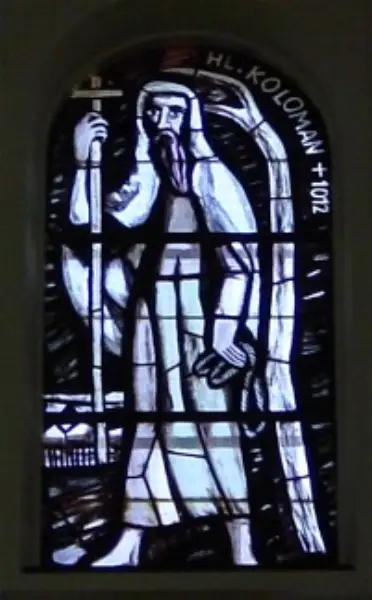
Overview
Coloman of Stockerau was an Irish pilgrim who set out for the Holy Land at the opening of the eleventh century and never arrived: passing through the contested frontier lands south of the Danube, his odd looks and his foreign tongue led men to take him for a spy, tortured and hanged near Vienna in 1012. In an age of continual skirmishing among Austria, Moravia and Bohemia, an unknown traveller of foreign speech was an easy suspect, and he died on the gallows alongside robbers. Yet the local people, moved perhaps by remorse and by the miracles reported from his grave, soon honoured him as a saint. Legend tells that his body stayed incorrupt for eighteen months, unmolested by birds and beasts, and that the timbers of his gibbet took root and flowered. In 1014 his relics were translated to the Abbey of Melk, where they remain. His cult spread through Austria, Bavaria, the Palatinate and Hungary, and two Hungarian kings bore his name in his honour.
The Complete Life
A Stranger from Ireland
Coloman left Ireland as a pilgrim, making his way toward Jerusalem at the start of the eleventh century. His Irish name Colman took many forms on the continent, variously rendered Koloman, Kalman, Colman and the Latin Colomannus, a testimony to how far his fame eventually travelled from his native land. Later tradition ennobled his birth, describing him as a son of Mael-Sechnaill, the high king of Ireland who died in 1022, though this pedigree belongs to legend rather than record. What the sources agree on is the circumstance that destroyed him: he was a stranger in a country at war. His appearance seemed strange to the people among whom he passed, he could speak no German, and he was therefore unable to give any intelligible account of himself. In a region where Austrian, Moravian and Bohemian forces fought almost without pause, an unknown wanderer of foreign speech and unknown purpose invited suspicion, and the pilgrim was marked out as a spy. The date of his birth is unknown; only the fact of his Irish origin and his journey eastward is certain.
§ Life
Pilgrimage Interrupted
Coloman's vocation was that of the peregrinus, the Irish pilgrim who left home permanently for the love of God, and his road ran toward the holy places of the East. Crossing the continent, he entered the frontier country near the Danube, where the rival powers of Austria, Moravia and Bohemia were locked in almost constant fighting. There his journey ended. Suspected of espionage because of his unfamiliar appearance and his silence in the local tongue, he was seized, tortured and hanged at Stockerau near Vienna in 1012, dying beside several robbers. One account places the execution on 16 July of that year, the calendar of his feast on 13 October. The pilgrim who had hoped to kneel at Jerusalem never saw it; his cross was a gibbet in a foreign market town. Yet the manner of his dying, patient under torture, innocent of the charge and condemned without understanding the sentence, became the ground of the devotion that followed. One account remembered the day of his death as 16 July, while the calendar keeps his feast on 13 October, the day his relics reached Melk.
§ Life
Honoured by the People
The people of the neighbourhood themselves raised Coloman to the honours of the altar, Aidan Breen suggests, moved perhaps by regret for the unjust killing, by the prisoner's patience under torment, and by the wonders said to occur at his grave. A legend relates that his body remained incorrupt for eighteen months, untouched by birds and beasts, and that the scaffolding of his gibbet took root and burst into green leaf; a branch of it was kept below the main altar of Stockerau's Franciscan house. On 13 October 1014, hardly two years after the hanging, Bishop Megingard translated the relics to the Abbey of Melk at the request of Henry, Marquis of Austria. Decades later the remains were carried onward to Hungary, and the cult spread widely: the saint received churches and chapels across Austria, the Palatinate, Hungary and Bavaria, and even his native Ireland kept his memory. His feast is kept on 13 October, and Melk remains the centre of his devotion. So swift a translation, within two years of the hanging, shows how firmly the neighbourhood had already claimed him as its own.
§ Veneration
A Saint of Kings, Horsemen and the Persecuted
Coloman's fame reached far beyond the place of his death. Geza I of Hungary honoured him by giving the name to a son, who reigned as King Coloman of Hungary, and in the thirteenth century a younger brother of King Bela IV, Coloman of Galicia-Lodomeria, received it in the saint's honour as well. His relics, after their Hungarian sojourn, were eventually brought back from the Cathedral of Szekesfehervar to Melk Abbey, where they rest to this day; successive Austrian rulers enriched the tomb, and the present reliquary is executed in the Baroque style. Popular devotion assigned him an unusually broad patronage: he protects Austria and Melk, cares for hanged men, horned cattle and horses, and is invoked against plague, against hanging and against gout, while girls seeking husbands pray to him and innocent travellers accused of spying claim him as defender. Artists give him the pilgrim's hat and dress, a rope in his grasp, the image of a man on a gibbet, or the book and maniple, images that recall both his journey and his death. Austrian rulers repeatedly enriched the tomb at Melk, and the shrine kept his memory alive in the abbey church through the centuries.
§ Veneration
Timeline
- 18 Oct 1012
Tortured and hanged at Stockerau near Vienna, mistaken for a spy while pilgrim to the Holy Land
§ Introduction
- 13 Oct 1014
Bishop Megingard transfers his relics to the Abbey of Melk at the request of Marquis Henry of Austria
§ Veneration
- 1200
In the thirteenth century the younger brother of Bela IV is named Coloman of Galicia-Lodomeria in his honor
§ Veneration
In Their Own Words
He was made a saint by the local people, possibly out of remorse for the deed and because of his endurance under torture and the many miracles reported from where his body was buried.
The Record
- Patron of
- Austria·Melk·Hanged men, horned cattle and horses·Against plague·Against hanging·Against gout·Husbands sought by marriageable girls·Innocents persecuted as spies
- Symbols
- Pilgrim's hat and dress·Rope in his hand·Hanging on a gibbet·Tongs and rod·Book and maniple
- Canonization
- Popular canonization by the local people shortly after his death, per Aidan Breen
Prayer
Bibliography
Show 3 sources
- Monks of Ramsgate. "Colman". Book of Saints, 1921. CatholicSaints.Info. 11 October 2012
- "Coleman", by Aidan Breen, Dictionary of Irish Biography, page 696, volume two, 2009
- Patron Saints for Chronic and Incurable Illnesses. Retrieved 2012-03-04
Profile text adapted from the Wikipedia article, licensed CC BY-SA 4.0.
Pray with this saint every day
Save St. Coloman of Stockerau to your favorites, read the full profile, and get feast-day reminders in the Saints app.
Get the Saints AppFree on the App Store for iPhone and iPad