
521 - 597·Feast June 9
St. Columba
Abbot of Iona and Apostle to the Picts
Overview
Columba, known in Irish as Colmcille, the dove of the church, was born on 7 December 521 at Gartan in Tyrconnell, in present-day County Donegal, and became the abbot and missionary credited with carrying Christianity to the pagan north at the beginning of the Hiberno-Scottish mission. Educated by the leading churchmen of his day, among them Finnian of Movilla, the bard Gemman, Finnian of Clonard and Mobhi of Glasnevin, he ranked among the Twelve Apostles of Ireland and founded several Irish monasteries, including Derry, Durrow, Kells and Swords. Around 563, after a deadly battle in which many men fell and a quarrel over a copied psalter, he sailed for the Hebrides with twelve companions and settled on Iona, an island granted by his kinsman Conall mac Comgaill, king of Dal Riata. From Iona he worked among the northern Picts, visiting King Bridei at Inverness, and raised his abbey into a school for missionaries that dominated the religious and political life of the region for centuries. He died on Iona on 9 June 597 and was buried in the abbey he had founded; his relics were divided between Scotland and Ireland in 849. He remains a patron of Derry and, with Patrick and Brigid, of all Ireland.
The Complete Life
Born of the Northern Ui Neill
The parents of Columba were Fedlimid and Eithne of the Cenel Conaill; his birth took place on 7 December 521 at Gartan, beside Lough Gartan in Tir Chonaill, for the most part today's County Donegal. On his father's side tradition claimed for him descent from Niall of the Nine Hostages, remembered as a high king of legend, and one story says he first drew breath upon a flagstone called Leac na Cumha, at Lacknacoo. His teacher and foster-uncle Cruithnechan baptised him at Temple-Douglas, in Conwal parish of County Donegal, halfway between Gartan and Letterkenny. For roughly five years he lived in the remote district now called Glencolmcille, which keeps his name. His very name was a matter of tradition: Adomnan of Iona held that Colmcille was his name from birth, while other Irish sources claim he was first called Crimthann, meaning fox. In Irish the name means dove, the same meaning as the Hebrew of the prophet Jonah, and early writers were conscious of the parallel, though whether the name was chosen deliberately for the prophet remains unclear. Whatever his baptismal name, the dove became the emblem by which both Ireland and Scotland have known him ever since.
§ Early life in Ireland
Student of the Masters and Founder in Ireland
When advanced enough in letters Columba entered the monastic school of Movilla at Newtownards under Finnian of Movilla, who had studied at Ninian's great house on the shores of Galloway. Still only about twenty and already a deacon, he travelled south into Leinster to sit under the aged bard Gemman, and then joined the monastery of Clonard on the River Boyne, governed by Finnian of Clonard, where some three hundred scholars were said to be under instruction. There he was counted among the dozen pupils of Finnian whom tradition calls the Twelve Apostles of Ireland, took the monastic habit, and advanced to priesthood. Another master was Mobhi Clarainech, whose house at Glasnevin drew Cainnech, Comgall and Ciaran, until the pestilence that devastated Ireland in 544 scattered the community and sent Columba back to Ulster. The following years produced his Irish foundations: Derry at the edge of Inishowen, Durrow in Offaly, Kells in Meath and Swords in Dublin. Around 560 a dispute with Finnian over a psalter he had copied helped to embroil him in the age's violence, and the battle of Cul Dreimhne in 561, in which many died, was traditionally laid at its door. A synod threatened him with excommunication until Brendan of Birr spoke for him; his own conscience uneasy, he took the advice of the hermit Molaise and resolved to leave Ireland for the sake of Christ.
§ Early life in Ireland
Iona and the Conversion of the Picts
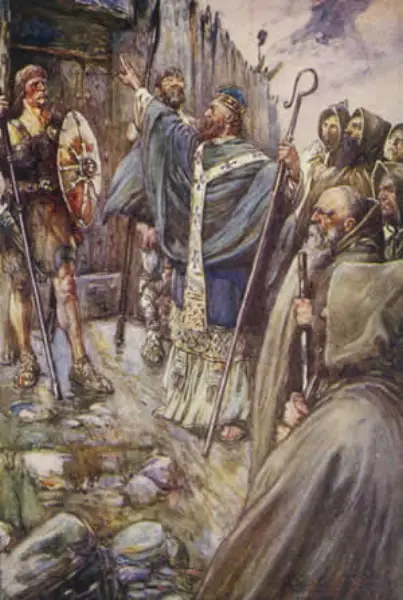
In 563 Columba and twelve fellow-monks, among them, it is said, Odran, crossed the sea in a currach of wicker and hide. Legend puts his first landfall on Kintyre near Southend, but Iona was granted to him by Conall mac Comgaill, his kinsman and the king of Dal Riata, who may have been the very man to invite him. In a real sense he had not left his own people, for Ulster Gaels had been settling the western seaboard of Scotland for two centuries. As guide of the district's single school of letters, and a man famed for holiness, he acted as diplomat among the tribes, visited the pagan King Bridei of Fortriu at his base in Inverness, and won the king's respect though not his conversion, speaking through an interpreter as Adomnan records. Many wonderstories gathered round the mission, the most famous being his banishment of a ferocious water beast into the depths of the River Ness in 565, after it had killed a Pict and menaced his disciple Lugne, a tale often connected with the Loch Ness legend. Besides founding churches through the Hebrides, he turned Iona itself into a school for missionaries and a repository of letters, credited with transcribing some three hundred books.
§ Scotland
Poet, Scribe and Warrior Saint
Two Latin poems attributed to Columba survive, Adiutor Laborantium and Altus Prosator, both abecedarian hymns composed at Iona. The shorter consists of twenty-seven eight-syllable lines that address God as helper, ruler, guard and defender of the good and as the enemy who will punish sinners. The longer, Altus Prosator, runs to twenty-three stanzas of sixteen syllables, each stanza beginning with a fresh letter of the alphabet, and tells the story of the world from the beginning of time through the history of creation to the apocalypse. Together with the three early-medieval Latin hymns attributed to him, they show a mind steeped in scripture and in the poetry of the liturgy. In later devotion Columba was revered as a warrior saint, often invoked for victory in battle; his relic-box, the Brecbennoch, was carried before Scottish armies, and legend tells that at Bannockburn in 1314 the greatly outnumbered Scots won the day through his intercession. Iona, honoured through his memory, became a place of pilgrimage for the whole of Europe. The severity of the hymns' form matches their themes: judgement, creation and the end of all things stand side by side with trust in God the helper.
§ Poetry
Death on Iona
Columba remained active in Irish affairs to the end, returning more than once to visit the communities he had planted; in 574 or 575, while home for the Synod of Drum Ceat, he established the monastery of Drumcliff in Cairbre, within present County Sligo,. Traditional sources place his death on Iona on Sunday, 9 June 597, at the age of seventy-five, and tell that his monks buried him in the abbey he had created. One modern scholar, Daniel P. Mc Carthy, disputes this chronology and assigns the death to 593. Whichever date is right, the island monastery stood at the summit of its influence when he died: a school of missionaries, a house of books and the spiritual capital of the Gaelic world on both sides of the sea. The grief of his monks found its monument in the Amra Coluim Chille, a poem of praise written almost certainly within a few years of his death and counted the earliest vernacular poem in European history. The anniversary on 9 June was long kept by both Churches and remains his feast to this day.
§ Scotland
Patron of Derry, Ireland and Scotland
In Ireland Columba ranks with Patrick and Brigid of Kildare among the nation's three patrons, and Derry claims him as its own patron, its Irish name, Doire Cholm Cille, entwining the city's oaks with his memory; its cathedral, its largest park and its college all bear his name. In Scotland the clans Malcolm and McCallum trace their name to him, and the Robertsons, the Dundas and perhaps the MacKinnons claim descent from his kindred, while innumerable parishes, schools and institutions throughout both countries are dedicated to him. Viking raids struck Iona in 795, 802, 806 and 825, and in 849 his relics were removed and divided between Alba and Ireland. His chief biography, the Vita Columbae by his successor Adomnan, together with the testimony of Bede, fixed his image for every later age. Books as splendid as the Book of Kells and the Book of Durrow are associated with his foundations, and in 1962 Benjamin Britten set one of the saint's own poems as A Hymn of St Columba for the fourteen-hundredth anniversary of his voyage. The Monymusk Reliquary, long identified with the Brecbennoch of St. Columba, preserves in metal and enamel the reverence later ages paid to his name.
§ Legacy
Timeline
- 7 Dec 521
Born at Gartan in Tyrconnell on 7 December, to Fedlimid and Eithne of the Cenel Conaill
§ Early life in Ireland
- 540
Founds a monastic settlement at Derry, on the site later linked with the city of that name
§ Ireland
- 544
A devastating pestilence scatters the monks of Glasnevin, and Columba returns to Ulster
§ Early life in Ireland
- 560
Quarrels with Finnian of Movilla over a psalter he has copied and wishes to keep
§ Early life in Ireland
- 560
Reputedly founds the town of Swords, County Dublin, one of several Irish monastic houses attributed to him
§ Ireland
- 561
The battle of Cul Dreimhne is fought in Sligo, traditionally linked to the psalter dispute
§ Early life in Ireland
- 563
Sails to Scotland with twelve companions and settles on Iona, granted by King Conall mac Comgaill
§ Scotland
- 565
Banishes the water beast into the depths of the River Ness while converting the Picts
§ Scotland
- 574
Founds the monastery of Drumcliff in Cairbre during his return for the Synod of Drum Ceat
§ Early life in Ireland
- 9 Jun 597
Dies on Iona on 9 June; his monks lay him to rest within his own abbey
§ Scotland
- 795
Vikings raid Iona for the first time, with further assaults in 802, 806 and 825
§ Scotland
- 849
His relics are removed and divided between Scotland and Ireland
§ Scotland
- 24 Jun 1314
The Brecbennoch reliquary is said to be carried before the Scots army at Bannockburn
§ Primary sources
In Their Own Words
Thou shalt go no further, nor touch the man; go back with all speed.
Where comes a cow, there follows a woman; and where comes a woman follows trouble.
The Record
- Major works
- Adiutor Laborantium (Latin hymn)·Altus Prosator (Latin hymn)·Iona Abbey (563)
- Patron of
- Derry·Against floods·Bookbinders·Poets·Ireland and Scotland
- Symbols
- Monk's robes·Celtic tonsure·Crosier
- Canonization
- Pre-congregation; venerated as a saint since his own lifetime and honoured by both Gaels and Picts
Prayer
Bibliography
Show 6 sources
- Edmonds, Columba (1913). "St. Columba, Abbot of Iona". Catholic Encyclopedia. Vol. 4
- Quiggin, Edmund Crosby (1911). "Columba, Saint". In Chisholm, Hugh (ed.). Encyclopaedia Britannica. Vol. 6 (11th ed.). Cambridge University Press. p. 737
- Adomnan of Iona (1995). Life of St Columba. Penguin Books. ISBN 978-0-14-190741-3
- Charles-Edwards, T. M. (2000). Early Christian Ireland. Cambridge University Press. ISBN 978-0-521-36395-2
- Sidwell, Keith (1995). Reading Medieval Latin. Cambridge University Press. ISBN 978-0-521-44747-8
- Mc Carthy, Daniel P., 'The Chronology of Saint Columba's Life', in Moran, P. & Warntjes, I. (eds), Early Medieval Ireland and Europe: Chronology, Contacts, Scholarship - Festschrift for Daibhi O Croinin, (Turnhout, Belgium: Brepols, 2015), pp. 3-32
Profile text adapted from the Wikipedia article, licensed CC BY-SA 4.0.
Pray with this saint every day
Save St. Columba to your favorites, read the full profile, and get feast-day reminders in the Saints app.
Get the Saints AppFree on the App Store for iPhone and iPad