
6th century·Feast November 11 (also November 15)
St. Columba of Cornwall
Virgin and Martyr of St Columb Major
Overview
Columba of Cornwall was a sixth-century virgin and martyr whom the Cornish parishes of St Columb Major and St Columb Minor honour as their patron. Tradition relates that she was born to pagan royalty, King Lodan and Queen Manigild, probably in Lothian in Scotland, but turned to Christ after a vision in which the Holy Spirit appeared to her in the form of a dove. Having vowed her virginity, she refused the pagan marriage her parents had arranged and suffered imprisonment, flight, capture and torture for it. Escaping by ship to Cornwall, she was overtaken at Ruthvoes in the centre of the county and beheaded at her pursuer's command; a spring was said to have gushed out along the path of her spilled blood. Almost everything known of her comes from local Cornish tradition, preserved in a manuscript compiled by Nicholas Roscarrock in the Elizabethan age. Her feast is kept in November, and her emblem in art is a maiden carrying a palm branch and a sword beneath a hovering dove.
The Complete Life
A Princess of the North
Columba was born in the sixth century, the daughter, so tradition runs, of the pagan royals King Lodan and Queen Manigild, and probably in Lothian in Scotland. The hagiographer David Nash Ford observes that the parents' names may be corrupted forms of those of King Lot and Queen Morgause of the Arthurian legends, which would place her childhood in the very heart of old British romance. She is said to have had as many as nine sisters, one of them named Wendon or Wedern. Beyond this outline, her story rests almost entirely on two witnesses: the Cornish parishes that took her as patron, and a manuscript in the University Library of Cambridge written by Nicholas Roscarrock, a Cornish Catholic scholar active under Elizabeth I, who gathered what local tradition still remembered. That so much detail survived at all is largely the work of the clergy of St Columb Major, one of the wealthiest churches in the county, whose well-developed traditions were written down in Cornish in the late sixteenth century. Of her childhood nothing else is recorded; the legend passes quickly from the northern court to the vision that changed her life.
§ Life
The Dove's Vision and the Vow
Columba became a Christian through a vision: she saw the Holy Spirit under the likeness of a dove, which pledged its love and blessing to her, and from that moment she belonged to Christ alone. She took a vow of virginity and refused even to enter the pagan temple with her parents. Her family answered with an arranged marriage to a pagan prince, and when she would not have it, her father and mother, as the tradition records, first tried kindness and then cruelty to turn her, and finally shut her in prison. An angel opened her way out and led her into the desert. Her vocation, in the shape the story gives it, is the classic witness of a consecrated virgin: a daughter of the old religion who chose the Christian God over her father's house, her people's temples and the marriage bed, and accepted imprisonment and violence rather than break the vow she had made. The dove of her vision remained her emblem for ever after. The story leaves no doubt that her choice, not her family's, defined her: the vision came first, and every suffering she endured followed from keeping faith with it.
§ Life
Flight, Capture and Martyrdom at Ruthvoes
Her second capture, in the wilderness, put her in the power of a king who found her beautiful and gracious; he offered marriage to his son on condition that she renounce her faith. her refusal earned her the wheel and the gallows, yet she survived the torments and was thrown into prison once more. An angel freed her a second time, and she fled to the coast, where a ship carried her across to Cornwall, landing at what is now Trevelgue Head, a name said to mean red dirt; the Cornish historian Nicholas Orme guesses this may describe the colour of the soil where her martyrdom took place. Her pursuer caught up with her at Ruthvoes in central Cornwall, south of St Columb Major, and beheaded her. She was buried at St Columb Major. Tradition adds that at the place of execution a spring gushed out along the path of her fallen blood, and the well that marked it was still traceable, with traces of a cemetery, at the opening of this century. The distance from the shore to Ruthvoes is short, a few miles inland, and tradition has always joined the landing place and the martyrdom in a single journey.
§ Life
Patron of Two Cornish Parishes
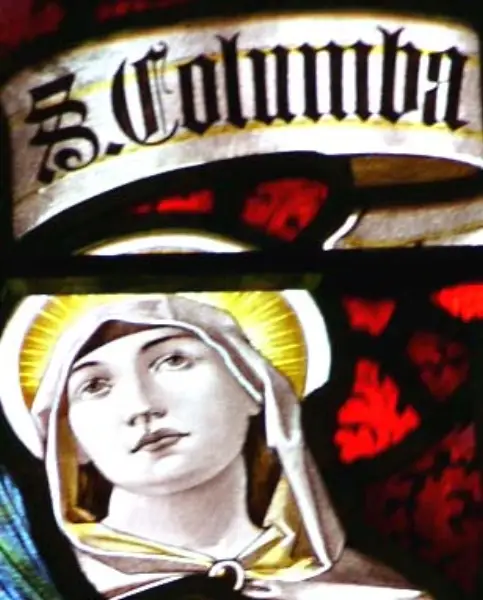
Whatever doubts learned men have raised, the people of Cornwall have kept Columba's memory for more than a thousand years. Sabine Baring-Gould suggested that the saint might have been a man, but nothing confirms the suggestion, and her womanhood is generally granted. The two churches of St Columb Major and St Columb Minor claim her as patron, the first recorded in about 1240, the second in 1284. St Columb Major ranked among the wealthiest churches of the county, staffed in the fifteenth and early sixteenth centuries by parish priests and seven chantry priests, which may explain how her traditions grew so full: a local physician wrote them down in Cornish late in the sixteenth century and sent them to Roscarrock, who described the poem to William Camden in 1607. The water of her well, one legend says, would never boil. Her feast has a complicated history, kept at different November dates in different places, sometimes moveable with the full moon, and two fairs came to St Columb Major each year, on 25 April and 24 June. A stained-glass window at the church of St Columb shows her carrying the palm and the sword beneath the hovering dove.
§ Legacy and veneration
Timeline
- 500
Born to King Lodan and Queen Manigild, pagan rulers probably of Lothian in Scotland
§ Life
- 500
Converted after a vision of the Holy Spirit in the form of a dove, and took a vow of virginity
§ Life
- 500
Imprisoned for refusing an arranged pagan marriage, tortured, and escaped by ship to Cornwall
§ Life
- 500
Beheaded at Ruthvoes in central Cornwall by the pursuing king and buried at St Columb Major
§ Life
- 1240
The church of St Columb Major is documented as dedicated to her
§ Legacy and veneration
- 1284
The church of St Columb Minor is documented under her patronage
§ Legacy and veneration
- 1599
Local traditions about her are recorded in a Cornish poem by a physician of the area
§ Legacy and veneration
- 1607
Nicholas Roscarrock describes the tradition-poem to his friend, the historian William Camden
§ Legacy and veneration
- 2000
Traces of the martyrdom well and a cemetery could still be seen at Ruthvoes
§ Legacy and veneration
In Their Own Words
dissuaded her first with kindness, then with cruelty
a spring gushed forth along the path of her fallen blood
The Record
- Patron of
- St Columb Major·St Columb Minor
- Symbols
- Palm branch·Sword·Dove hovering above
- Canonization
- Pre-congregation; ancient Cornish cult attested by her two patronal parishes
Prayer
Bibliography
Show 3 sources
- Nash Ford, David (2006). "St. Columba the Virgin". Early British Kingdoms. Archived from the original on 30 October 2006. Retrieved 4 September 2020
- Orme, Nicholas (2000). The Saints of Cornwall. Oxford: Oxford University Press. pp. 91-93. ISBN 1-280-44546-7
- Hutchison-Hall, John (Ellsworth) (2017). Orthodox Saints of the British Isles, Vol. 4. St. Eadfrith Press. pp. 145-146. ISBN 1542718228
Profile text adapted from the Wikipedia article, licensed CC BY-SA 4.0.
Pray with this saint every day
Save St. Columba of Cornwall to your favorites, read the full profile, and get feast-day reminders in the Saints app.
Get the Saints AppFree on the App Store for iPhone and iPad