
died 853·Feast September 17
St. Columba of Spain
Nun and Martyr of Cordoba
Overview
Columba of Spain, also called Columba of Cordoba, was a virgin and nun martyred at Cordoba on 17 September 853 during the persecution of Christians under the Muslim rulers of the city. Born the youngest of three children, she was drawn to the religious life by the example of her siblings, who founded a double monastery in the mountains of Tabanos to the north; after her widowed mother's hopes of marriage for her came to nothing, Columba entered the community as a nun. The record of her life comes from St. Eulogius of Cordoba, whose Memorial of the Saints describes the persecutions that began in 850. When the community was driven from Tabanos in 852 and sheltered in Cordoba, Columba defied the bishops' ruling against provoking the authorities, presented herself before the Muslim magistrate and denounced Mohammed and his law. Condemned to beheading, she became the sixth martyr executed under Mohammed I and one of the forty-eight Martyrs of Cordoba. Her recovered body was buried at the basilica of St. Eulalia at Fragellas, and her relics were later honoured at the abbey of Santa Maria de Najera and its priory.
The Complete Life
The Youngest of Three
Columba was born at Cordoba, the youngest of three children in a Christian family of the city. Her sister Elizabeth and her brother Martin gave themselves to the religious life: together with Elizabeth's husband they founded a double monastery amid the mountains of Tabanos, north of Cordoba, where Martin served as abbot of the men's house. Columba watched their example and resolved to follow them, but her plans were delayed. Her mother, a widow, had other designs and wished to see her daughter married. For a short time the old woman's opposition held; then, recognising that Columba would not be turned, she gave way, and died not long afterwards. Freed of the obstacle, Columba entered the monastery of Tabanos as a nun. Nearly everything known of her comes from the Memorial of the Saints, the account of the Spanish persecutions composed by St. Eulogius of Cordoba; even allowing for exaggeration, as the hagiographer Alban Butler observes, she enjoyed a high reputation for holiness. In the Cordoba of her youth a Christian family could still live openly, yet the authority of the emir hung over every church, and the memory of earlier persecutions was fresh.
§ Life
A Nun of Tabanos
Columba's sister and brother had already planted the church of Tabanos in the hill country north of Cordoba, and thither she followed them, taking the habit in the women's house. The ninth century in Moorish Spain offered consecrated Christians a fragile peace, and the community lived under a rule of prudence: the bishops of the province had determined that the faithful should do nothing to provoke the Muslim authorities into persecution. For a nun, the vocation of Tabanos meant enclosure, penance and prayer within walls built by her own family. It was in this setting that Columba's reputation for holiness grew. When the storm came, it came from outside: in 852, two years into the persecution that had begun in 850, the monastery was forced out of Tabanos, and the community took refuge in a house at Cordoba near the church of St. Cyprian. The move brought the young nun from the mountains into the city where the judges of the emir sat, and where her conscience would soon be tested. The memory of Tabanos, its mountain silence and its family founders, never left her; it was a community of her blood as well as of her vow.
§ Life
Witness Before the Magistrate
In the house at Cordoba Columba did what the bishops had forbidden: she left the refuge, presented herself before the city's Muslim magistrate, and denounced Mohammed and his law to his face. The magistrate condemned her to beheading, and the sentence was carried out on 17 September 853. her death made her the sixth of the victims put to death on Mohammed I's orders and placed her among the forty-eight Christians remembered as the Martyrs of Cordoba. Her executioners cast her body into the Guadalquivir marshes, but fellow Christians found it and laid her to rest in the basilica of St. Eulalia, at the place called Fragellas. Her relics were afterwards reported at two churches, the royal abbey of Santa Maria de Najera and its dependent priory, which was itself dedicated to St. Columba. The boldness of her self-surrender, defying the official policy of her own shepherds, has kept her among the most discussed figures of the Cordovan martyrs. Eulogius, who preserved her story, wrote to hearten the persecuted rather than to praise the prudent, and her defiance was exactly the witness his book set out to record.
§ Life
Patron Against Magic
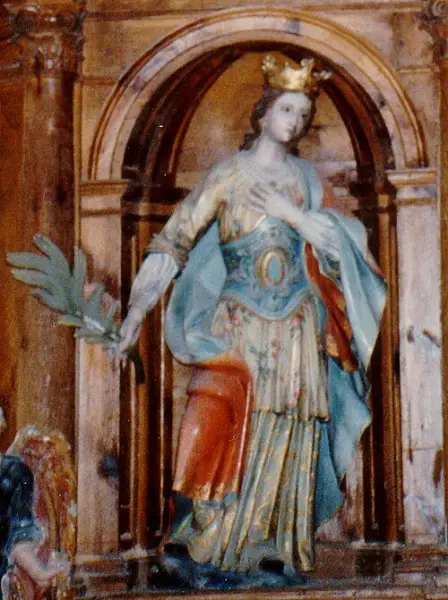
Devotion to Columba took root in Old Castile, where her shrine was honoured at the priory of St. Columba and at the royal abbey of Our Lady at Najera. The historian Allyson M. Poska contends that the devotion of two virgin martyrs actually fused, that of the Cordovan Columba and that of the third-century French martyr of Sens; a Visigothic church dedicated to St. Columba at Bande, near the Portuguese frontier, may show that devotion to the name had spread before the Muslim invasion, the fusion of the stories, she suggests, happened as colonists resettled Galicia once Muslim rule had ended there. Her patronage is unusual and telling: she is invoked against magic and honoured as the protector of magicians, wizards, witches and hags, those most entangled with the powers she renounced, and she is also patron of Andorra, Chevilly and Galicia. Her feast is kept on 17 September, the day of her martyrdom, when she is remembered as Santa Columba, the young nun who kept her vow at the cost of her head. In art she is remembered beside her sister martyr of Sens, and the two Columbas share the same emblems, the same feast-season legends and much of the same geography of devotion.
§ Life
Timeline
- 850
The persecution of Christians in Spain recorded by Eulogius of Cordoba begins
§ Life
- 852
Her community is driven from Tabanos and takes refuge in a Cordoba house near St. Cyprian's church
§ Life
- 17 Sep 853
Beheaded at Cordoba after denouncing Mohammed before the Muslim magistrate; sixth martyr under Mohammed I
§ Life
- Sep 853
Christians recover her body from the Guadalquivir marshes and bury it at the basilica of St. Eulalia
§ Life
The Record
- Patron of
- Against magic·Magicians, wizards, witches and hags·Andorra·Chevilly·Galicia
- Canonization
- Pre-congregation; venerated among the forty-eight Martyrs of Cordoba
Prayer
Bibliography
Show 4 sources
- Butler, Alban (1995). Butler's Lives of the Saints (9 ed.). Tunbridge Wells, Kent: Burns & Oates. p. 162. ISBN 0-8146-2377-8
- Wolf, Kenneth Baxter (1988). Christian Martyrs in Muslim Spain. Cambridge, United Kingdom: Cambridge University Press. ISBN 0-521-34416-6
- Capes, Florence Mary (1908). "St. Columba". Catholic Encyclopedia. Vol. 4
- Poska, Allyson M. (2005). Women and Authority in Early Modern Spain: The Peasants of Galicia. Oxford, England: Oxford University Press. ISBN 978-0-19-151474-6
Profile text adapted from the Wikipedia article, licensed CC BY-SA 4.0.
Pray with this saint every day
Save St. Columba of Spain to your favorites, read the full profile, and get feast-day reminders in the Saints app.
Get the Saints AppFree on the App Store for iPhone and iPad