
543 – 615·Feast November 23
St. Columbanus
Missionary abbot of Luxeuil and Bobbio
Overview
Columbanus, an Irish missionary whose name is simply the Latin dress given to Colmán, the little dove, first saw the light in Leinster in 543 and closed his eyes at Bobbio in Lombardy on 21 November 615. Educated first on an island of the River Erne under Abbot Sinell, under whom he composed a commentary on the Psalms, and afterwards at Bangor Abbey, where Abbot Comgall taught him Greek and Latin, he left Ireland around 590 with twelve companions and gave the rest of his life to founding monasteries on the continent. Welcomed by King Guntram of Burgundy, his band turned a ruined Roman fortress at Anegray into a school, then moved to Luxeuil and opened a second house at Fontaines. His adherence to the Irish reckoning of Easter provoked the Frankish episcopate, and his rebuke of King Theuderic II over a concubine drew the lasting enmity of Brunhilda, who brought about his expulsion. Driven out of Burgundy, he missioned along the Rhine and at Lake Constance before crossing the Alps, where King Agilulf and Queen Theodelinda received him; at Bobbio he raised his last monastery in 614. His ten-chapter Rule, with its penitential discipline of private confession and imposed penances, and his tireless evangelisation made him a prototype of Europe's missionaries.
The Complete Life
A Scholar of the Erne and of Bangor
Columbanus entered the world in 543 in the Kingdom of Leinster, and even before his birth legend marked him out: his mother was said to have been granted a vision of her child's remarkable genius. His name, the Latinised form of the Irish Colmán, means little dove. His first schooling came under Abbot Sinell of Cluaninis, whose monastery stood on an island of the River Erne in what is now County Fermanagh. There, under Sinell's direction, the young man composed a commentary on the Psalms, an early evidence both of his learning and of the literary habit that would make him one of the earliest identifiable Hiberno-Latin authors. From the Erne he moved to Bangor Abbey, the great school of the Irish north-east, where he prepared to become a teacher of the Bible. His education embraced grammar, rhetoric, geometry, and the Holy Scriptures, and Abbot Comgall himself instructed him in Greek and Latin, a training rare anywhere in the seventh-century West. He remained at Bangor until about 590, when Comgall, reluctantly, gave him permission to depart for the continent. Nearly three decades of formation thus preceded his departure: psalmody and Scripture on an island of the Erne, and the full secular and sacred curriculum at Comgall's side.
§ Biography and early life
Twelve Companions and the Schools of Burgundy
About 590 Columbanus set out on the enterprise that gave his life its shape, sailing with twelve companions whose names the record preserves: Attala, Columbanus the Younger, Gallus, Domgal, Cummain, Eogain, Eunan, Gurgano, Libran, Lua, Sigisbert, and Waldoleno. Their route ran through Cornwall, and they came ashore at Saint-Malo in Brittany before entering the Frankish kingdom of Burgundy. Jonas of Susa, his earliest biographer, describes the religious desolation they found: the faith, worn down by foreign enemies and careless bishops, had all but departed from the land, and penance was practised by only a few. Wherever he went, Jonas says, Columbanus preached the Gospel, and the people were pleased, because his teaching carried eloquence and the force of virtuous example. King Guntram of Burgundy welcomed the newcomers and granted them ground at Anegray, where they made a school out of a ruined Roman fortress. Though hidden deep in the Vosges Mountains, the house drew students in such numbers that a removal to Luxeuil became necessary, and a second school followed at Fontaines. All remained under Columbanus's authority, and their manner of life kept the Celtic tradition in which their master had been formed. As the communities grew and pilgrims multiplied, he hungered again for solitude, and often withdrew to a cave seven miles distant, keeping contact through a single companion who carried messages between them.
§ Frankish Gaul (c. 590 – 610)
Bishops, Queens, and the Road over the Alps
Conflict pursued Columbanus almost from the moment his schools began to flourish. In 603 he and his monks quarrelled with the Frankish bishops over the dating of Easter, for they kept the Irish reckoning, an eighty-four-year computus of the quartodeciman type, while the Franks followed the Victorian cycle of 532 years; the distinctive Irish tonsure gave further offence. The Gaulish councils had vested bishops with absolute authority over religious communities, and the prelates may well have feared the stranger's influence. Summoned to appear before their assembly in 602, he stayed away and answered instead with a letter, admonishing them to hold synods more often. When they persisted, he appealed to Pope Gregory I himself, begging the strong support of his authority; the letters went unanswered, most likely because Gregory died in 604, and a later appeal to Boniface IV fared no better before Columbanus moved beyond Frankish jurisdiction. His troubles with the throne proved sharper still. Having rebuked Theuderic II for keeping a concubine, he drew the hatred of Brunhilda, the king's grandmother and regent, who incited court and bishops against him. Confronted at Luxeuil, imprisoned at Besançon for execution, and then escaped, he was at last hunted toward Ireland by soldiers, separated from all but Irish-born monks. A storm drove his ship at Nantes back to shore, and the captain refused to carry him again. Freed, he found sanctuary with Chlothar II at Soissons, reached Metz in 611, and missioned up the Rhine to Lake Zurich and Bregenz, where Gallus preached in the local tongue and a monastery rose near the church of Aurelia of Strasbourg. With his pupils being slaughtered in the forests in 612, he resolved to lead them over the mountains into Lombardy.
§ Conflict with Brunhilda of Austrasia
The Rule and the Discipline of Penance
The Rule of Saint Columbanus embodied the customs of Bangor and the other Irish houses in which its author had been formed. Much shorter than Benedict's, it unfolds in ten brief chapters treating in turn of obedience, of silence, of food and poverty, then of humility, chastity, the choir offices, discretion, mortification, and last of all perfection. Obedience comes first and is absolute: seniors are to be heeded without reserve, after the pattern of the Son's own obedience unto death, and the mandate is enforced by hard labour that subdued the flesh and cleared the soil; the least breach brought corporal punishment or severe fasting. Silence is to be carefully kept, food to be poor and taken in the evening so as to avoid repletion, poverty so complete that greed is named a leprosy for monks, and chastity judged first in the thoughts. The seventh chapter instituted the laus perennis, a service of perpetual prayer in which choir followed choir both day and night. Discretion, mortification, and finally the penances of the tenth chapter complete the scheme, and it is in this penitential legislation that the Rule departs most sharply from Benedict's. The communal discipline required fasting every day until None, three in the afternoon, later relaxed to designated days, and a frugal table of beans and garden produce, of flour thinned with water, and of one modest loaf set out only at evening. The habit was a tunic of undyed wool with a cowl of the same cloth. Beyond the cloister, Columbanus taught penitential practice for those repenting of sin, urging that sin be confessed privately into a priest's ear, who then laid satisfactions upon the penitent to repair the wrong — a discipline that left its mark on the whole Western church. The Fourth Council of Mâcon approved his Rule in 627, and for centuries some great houses kept it alongside Benedict's.
§ Rule of Saint Columbanus
Lombardy, Bobbio, and a Quiet Death
Arriving in Milan in 612, Columbanus was received with honour by King Agilulf and Queen Theodelinda of the Lombards and at once turned to refuting Arianism, which still found acceptance in Italy; his treatise against it has been lost. At the king's request he took up the controversy of the Three Chapters, writings of Syrian bishops condemned as Nestorian in the fifth century, and addressed a letter to Pope Boniface IV that blends the most affectionate devotion to the Holy See with startling frankness, apologising that a foolish Scot should write for a Lombard king while entreating the pontiff to prove his orthodoxy by assembling a council. He styles the pontiff his lord and father in Christ, the watchman chosen for his post, the first of shepherds raised above all mortals, and insists that the Irish, dwellers at the world's edge, are bound to the Chair of Peter. In 614 Agilulf put at his disposal an estate named Bobbio, lying midway between Milan and Genoa by the river Trebbia and tucked into a gorge of the Apennines, with a ruined church and the empty lands of Ebovium. There, beside the little church dedicated to Peter the Apostle, he raised a monastery that would remain for centuries a stronghold of orthodoxy in northern Italy. In his final year Chlothar II, whose enemies were now dead, invited him back to Burgundy; he declined, asking only that the king protect his monks at Luxeuil. Preparing for death in his cave above the Trebbia, where tradition says he had dedicated an oratory to Our Lady. There, on 21 November 615, his long pilgrimage ended, and the abbey church became his resting place.
§ Lombardy (612–615)
Veneration at Bobbio and Beyond
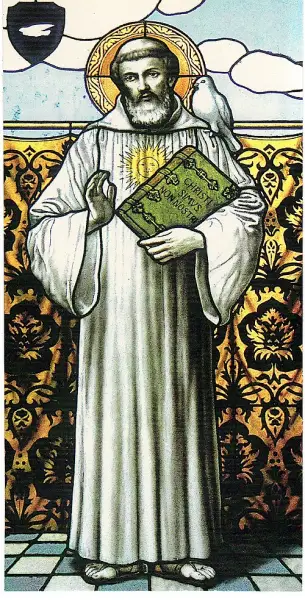
Columbanus never passed through a formal process of canonisation; he belongs to the company of saints recognised by the ancient tradition of the Church, and the Roman Martyrology enters him on 23 November, the date kept as his feast in Ireland, while the Benedictines observe 21 November, the day of his death. His bones lie in the crypt of Bobbio Abbey, the scene of wonders without number ascribed to his pleading; a fresh shrine was made for them in 1482 and set beneath that crypt's altar. The abbey's sacristy keeps a portion of the abbot's own skull alongside his knife, his wooden cup, his bell, and a venerable water vessel credited as a present from Pope Gregory the Great; a dozen of his teeth, lifted from the grave in the 1400s and housed in the treasury, have since vanished without trace. The catalogue of miracles attributed to him in the old sources ranges from practical charity to marvels of nature: food procured for a sick monk, a benefactor's wife cured, safety among wolves, a bear ordered out of a cave, a spring rising near his cell, the Luxeuil granary replenished, bread and beer multiplied, blindness lifted at Orleans, a cauldron of pagan beer destroyed by his breath, and a bear tamed and yoked to the plough. Jonas records that during a famine at Bregenz his fasting brought such flights of birds over the country that his people were fed for three days until grain arrived. In art he appears bearded and cowled, book and Irish satchel in hand, amid wolves or taming a bear, sometimes with sun-beams over his head.
§ Veneration
The First Voice of Europe
As a missionary Columbanus became the very pattern for Europe's evangelists, the forerunner of figures such as Kilian, Vergilius of Salzburg, Donatus of Fiesole, Wilfrid, Willibrord, Suitbert of Kaiserswerdt, Boniface, and Ursicinus of Saint-Ursanne. Luxeuil Abbey, which the Catholic Encyclopedia calls the nursery of saints and apostles, sent forth sixty-three apostles bearing both his discipline and the faith across France, Germany, Switzerland, and Italy, and the houses his followers planted are reckoned at more than a hundred; the canton and city of St. Gallen preserve the name of one of them, Gallus, who stayed behind at Lake Constance, where the Abbey of Saint Gall was later founded on the site of his cell. Bobbio grew into a renowned centre of learning that rivalled Monte Cassino in wealth and prestige, with Attala gathering texts for its library, and Italian towns from Milan to Genoa still bear the name San Colombano. His Latin pen was itself a monument: in a letter of about 600 to Gregory the Great he used the phrase totius Europae, the first known use of the expression all of Europe, and the historian Alexander O'Hara notes that he is the first Irishman we can read in a body of literary work and the first Irish person made the subject of a biography, Jonas of Bobbio's life written between 639 and 641. Modern honour has kept pace: the Annegray ruins were purchased and protected in 1959 by an international association, a congress at Luxeuil marked his 1,400th birthday in 1950, Pope Francis praised his service to European culture in 2024, and the Missionary Society of Saint Columban, founded in 1916, with its sisters' congregation of 1924, carries his name across the world.
§ Legacy
Timeline
- 543
Born in the Irish kingdom of Leinster; legend records his mother's prenatal vision foretelling the child's exceptional gifts
§ Biography and early life
- 590
Released by Abbot Comgall of Bangor, he sails with twelve companions, crosses via Cornwall, and lands at Saint-Malo in Brittany
§ Frankish Gaul (c. 590 – 610)
- 590
King Guntram grants land at Anegray, where the brothers convert a ruined Roman fortress into a school, later outgrowing it for Luxeuil and Fontaines
§ Frankish Gaul (c. 590 – 610)
- 602
Summoned before an assembly of Frankish bishops, he declines to appear and answers them instead with a letter defending his paschal practice
§ Conflict with Frankish Bishops
- 603
Quarrels openly with the Frankish bishops over the Celtic Easter date and Irish tonsure, then appeals in writing to Pope Gregory I
§ Conflict with Frankish Bishops
- 610
After rebuking King Theuderic II he is imprisoned at Besançon, escapes, and is deported toward Ireland, bidding Luxeuil farewell in a letter from Nantes
§ Conflict with Brunhilda of Austrasia
- 611
Received at Theudebert II's court in Metz, granted land at Bregenz, and missions up the Rhine to Lake Zurich and Lake Constance, founding Mehrerau Abbey
§ The Alps (611–612)
- 612
Arrives in Milan, where King Agilulf and Queen Theodelinda welcome him; he begins writing against Arianism, producing a treatise since lost
§ Lombardy (612–615)
- 614
Agilulf grants him Bobbio in the Apennine defile, where beside a ruined church of Saint Peter he erects a monastery
§ Lombardy (612–615)
- 21 Nov 615
Dies at Bobbio aged about seventy-two and is buried there, declining Chlothar II's invitation to return to Burgundy
§ Death
- 627
The Fourth Council of Mâcon approves his Rule, which the Rule of Saint Benedict gradually supersedes by the close of the century
§ Rule of Saint Columbanus
- 1482
His relics are placed in a new shrine beneath the altar of the Bobbio Abbey crypt, where they remain
§ Veneration
- 1916
The Missionary Society of Saint Columban is founded and dedicated to him
§ Legacy
- 1924
The Missionary Sisters of St. Columban are founded, likewise dedicated to him
§ Legacy
- 1947
A statue showing him denouncing King Theuderic II is unveiled at Luxeuil-les-Bains
§ Legacy
- 1950
A congress marking the 1,400th anniversary of his birth meets at Luxeuil, attended by Robert Schuman and the future Pope John XXIII
§ Legacy
- 1959
The Association Internationale des Amis de St Columban purchases and protects the ruins of his first monastery at Annegray
§ Legacy
- 2002
The Vatican, at Bishop John Oliver's suggestion, declares him patron of motorcyclists because of his extensive European travels
§ Veneration
- 2024
The XXV International Meeting of Columban Associations meets in Piacenza, with Pope Francis praising the Columban monks' renewal of European culture
§ Legacy
In Their Own Words
I am not the author of this divergence. I came as a poor stranger into these parts for the cause of Christ, Our Saviour. One thing alone I ask of you, holy Fathers, permit me to live in silence in these forests, near the bones of seventeen of my brethren now dead.
They come to tell me the ship is ready. The end of my parchment compels me to finish my letter. Love is not orderly; it is this which has made it confused. Farewell, dear hearts of mine; pray for me that I may live in God.
We Irish, though dwelling at the far ends of the earth, are all disciples of Saint Peter and Saint Paul ... we are bound to the Chair of Peter, and although Rome is great and renowned, through that Chair alone is she looked on as great and illustrious among us.
O Lord God, uproot, uproot from my soul all that the enemy has planted in you. Take away from my heart and lips all iniquity, give me intelligence and the habit of good, so that in works and truths I may not serve you alone: I may know how to do the precepts of Christ and seek you, O my God! Grant me memory, charity, faith.
God is everywhere; he is immense and everywhere present, according to what he said about himself: I am a God nearby and not a God far away
So let us not seek God as if he were far from us, because we can have him within us.
If, therefore, anyone wants to know what he must believe, he must realize that he will not be able to understand more by speaking about it than by believing.
The Record
- Major works
- Rule of Saint Columbanus, in ten chapters·Commentary on the Psalms, composed under Abbot Sinell·Treatise against Arianism, written in Lombardy and since lost·Letters to Frankish bishops and to Popes Gregory I and Boniface IV·Monasteries of Annegray, Luxeuil, Fontaines, Bregenz (Mehrerau), and Bobbio
- Patron of
- motorcyclists (patronage declared by the Vatican in 2002)
- Symbols
- bearded figure in the monastic cowl holding a book with an Irish satchel·standing amid wolves·taming a bear·sun-beams above his head
- Canonization
- Pre-congregation; his feast of 23 November is entered in the Roman Martyrology
Prayer
Bibliography
Show 10 sources
- Edmonds, Columba (1908). "St. Columbanus". The Catholic Encyclopedia. Vol. 4. New York: Robert Appleton Company.
- Walker, G. S. Murdoch, ed. (1957). Columbani Opera. Dublin: The Dublin Institute for Advanced Studies.
- Lapidge, Michael, ed. (1997). Columbanus: Studies on the Latin Writings. Woodbridge: Boydell Press.
- Munro, Dana C. "The Life of St. Columban, by the Monk Jonas, (7th Century)". Internet History Sourcebooks.
- O'Hara, Alexander (2018). Jonas of Bobbio and the Legacy of Columbanus. Oxford University Press.
- O'Hara, Alexander (2015). Saint Columbanus: Selected Writings. Dublin: Veritas.
- Ó Fiaich, Tomás (2012). Columbanus in His Own Words. Dublin: Veritas.
- Richter, Michael (2008). Bobbio in the Early Middle Ages: The Abiding Legacy of Columbanus. Dublin: Four Courts Press.
- Montalembert, Charles Forbes (1861). The Monks of the West. Vol. 2. London: William Blackwood.
- Jonas (2009). Life of St. Columban. Charleston: BiblioLife.
Profile text adapted from the Wikipedia article, licensed CC BY-SA 4.0.
Pray with this saint every day
Save St. Columbanus to your favorites, read the full profile, and get feast-day reminders in the Saints app.
Get the Saints AppFree on the App Store for iPhone and iPad