
died c. 175·Feast January 2
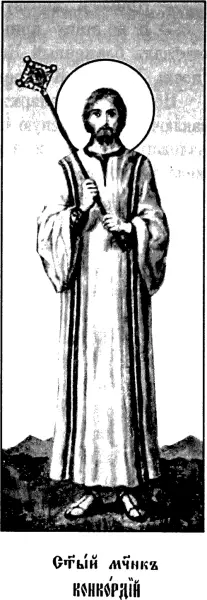
St. Concordius of Spoleto
Second-century Roman subdeacon and martyr
Overview
Concordius of Spoleto is a little-known martyr of the second century, remembered chiefly for the clarity with which he met his death. Born in Rome, he was the son of the presbyter Gordian and grew up within the household of a clerical father at a time when the Christian community of the imperial capital was still small and exposed. He was ordained a subdeacon by Pope Pius I in Rome, yet he does not seem to have sought a public career in the Church: the sources describe him as reclusive, a man who spent most of his time alone in prayer. That hidden life ended when the persecutions of the emperor Marcus Aurelius reached him. Arrested and brought to Spoleto in Umbria, he was tried before the provincial governor, who offered him freedom in exchange for a denial of his faith and an act of worship before the statue of Jupiter. His refusal earned him the rack; his praise of Christ under torture earned him a cell; and his final contempt for the idol, shown two days later, earned him the sword. He was beheaded about the year 175, and is venerated in both the Roman Catholic and Eastern Orthodox churches.
The Complete Life
A Presbyter's Son in Rome
Concordius came of Christian stock. His father, Gordian, was a presbyter of the Roman church, and the boy was raised in the faith his father served at a moment when that faith could still cost a believer everything. In due course he was ordained a subdeacon by Pope Pius I in Rome itself, taking a rank among the clergy of the city that placed him in the service of the liturgy and the care of the Christian community. The subdiaconate, in the ordering of the early Roman church, carried responsibilities in the practical and sacramental life of the congregations, and Concordius held it under the very eyes of the bishop of the city where the apostles Peter and Paul had died. Yet his temperament drew him away from visibility. The record describes him as reclusive: he spent most of his time alone and in prayer, a contemplative within a suffering church rather than a man of affairs. No preaching career, no journeys, no foundations are ascribed to him. His vocation, so far as the sources let us see it, was expressed in hiddenness, in the quiet fidelity of a clergyman's son who had become a clergyman himself and kept close to God in solitude.
§ Life
The Hidden Life of Prayer
Among the earliest things the tradition records about Concordius is his love of solitude. He was reclusive, devoting the better part of his days to being alone and to prayer, and this interior bent gives his later martyrdom its particular character. He had not been formed in controversy or in the cut and thrust of public disputation; he had been formed before God, in the silence that makes a believer incapable of the one betrayal that matters. The persecutions of Marcus Aurelius, which swept through the Christian communities of the empire in the years around his death, demanded of every believer exactly what his hidden life had been cultivating: the strength to stand alone before power with nothing but confession in his mouth. When arrest came, he was not a famous teacher whose trial would be argued over in the schools; he was a subdeacon of Rome tried in an Umbrian town, offered his life for a single gesture toward a statue. His solitary prayer had already decided the answer. In this the little that is known of Concordius illuminates a whole stratum of early Christian holiness, the unnamed faithful whose spirituality was ordinary, hidden, and persevering, and whose constancy under trial the church never forgot even when it failed to preserve their stories.
§ Life
Trial, Rack, and Sword at Spoleto
The trial of Concordius was conducted at Spoleto before the governor of Umbria, who oversaw and judged the proceedings. The terms offered were simple and public: freedom in exchange for a denunciation of his faith and an act of worship before the statue of the Roman god Jupiter. Concordius refused. The governor then ordered him beaten on the rack, and the torturers did their work; but the account preserves what the martyr did under it, for after the torture Concordius praised Jesus, turning the instrument of his agony into an occasion of confession. For this he was thrown into jail. Two days later the authorities tried once more: a second chance was offered, and the statue was brought before him. This time Concordius answered with his body as well as his words, spitting on the idol. There could be no further negotiation. The sentence of beheading was carried out at once, and the subdeacon of Rome died at Spoleto around the year 175, a victim of the persecutions of Marcus Aurelius. The sources note that he was canonised by the religious officials of his own time, though it is uncertain when or where that recognition took place; his feast is kept on 2 January in the Roman Catholic church and on 4 June in the East.
§ Trial
A Martyr of East and West
Concordius belongs to the earliest generation of recognised saints, honoured before any formal machinery of canonisation existed. The tradition records that the religious authorities of his era recognised him as a saint, while conceding that neither the moment nor the setting of that recognition can now be recovered, an obscurity typical of martyrs whose cult arose in the immediate aftermath of their deaths. His memory divided, as so many early Italian cults did, between the churches of East and West. The Roman Catholic church keeps his feast on 2 January, at the opening of the year, and lists him among the martyrs; the Eastern Orthodox church remembers him on 4 June, and also observes a commemoration on 1 January, so that his name recurs twice in the opening days and once in early summer across the two calendars. He is named in collections of the saints from the Orthodox Church in America's martyrology to Alban Butler's eighteenth-century lives and the Monks of Ramsgate's twentieth-century Book of Saints, witnesses to a cult that survived the silence of the sources. He is venerated in both the Roman Catholic and Eastern Orthodox communions, a shared inheritance from the age of the persecutions.
§ Veneration
A Little-Known Saint and a Namesake
Concordius of Spoleto is little known, and honesty requires that concession of any account of him. What has survived is the outline preserved above: a Roman birth, a presbyter's son, a subdeacon ordained by Pope Pius I, a life of solitary prayer interrupted by the persecutions of Marcus Aurelius, a trial at Spoleto, and a beheading around 175. Complicating the record further is the existence of another martyr of the same name who died in the fourth century, so that the stories of the two Concordii have travelled together through the martyrologies and are not always easy to disentangle. Yet the obscurity of the man has not extinguished his cult. His feast appears in the calendars of both East and West; his story was told by Sabine Baring-Gould in his Lives of the Saints of 1897 and by the Monks of Ramsgate in their 1921 Book of Saints, and it stands in the Orthodox Church in America's directory of martyrs. He belongs to the great company of second-century witnesses, and to that stratum of holiness in which the whole of the Christian life is compressed into a single refusal spoken before an idol.
§ Life
Timeline
- 175
Under Marcus Aurelius's persecution of Christians, the reclusive subdeacon is imprisoned and brought to trial at Spoleto in Umbria.
§ Life
- 175
Before the governor of Umbria he refuses to worship Jupiter's statue, endures the rack, praises Christ, and is thrown into jail.
§ Trial
- 175
Offered a second chance two days afterward, he spits upon the idol set before him and is beheaded at Spoleto.
§ Trial
The Record
- Canonization
- Pre-congregation; honoured as a saint by the religious authorities of his own age, though the date and place of his recognition are unknown
Prayer
Bibliography
Show 5 sources
- A Western Rite Orthodox Martyrology, p. 8.
- "Martyr Concordius of Spoleto", Orthodox Church in America.
- Baring-Gould, Sabine. "Saint Concord, Priest, Martyr". Lives of the Saints, 1897. CatholicSaints.Info, 23 December 2013.
- Monks of Ramsgate. "Concordius". Book of Saints, 1921. CatholicSaints.Info, 12 October 2012.
- Butler, Rev. Alban. "Saint Concordius, Martyr. January 2". The Lives of the Saints, Volume I: January, 1866.
Profile text adapted from the Wikipedia article, licensed CC BY-SA 4.0.
Pray with this saint every day
Save St. Concordius of Spoleto to your favorites, read the full profile, and get feast-day reminders in the Saints app.
Get the Saints AppFree on the App Store for iPhone and iPad