
c. 470 – 520·Feast November 27
St. Congar of Congresbury
Welsh abbot of Cadbury-Congresbury in Somerset
Overview
Congar, whose name appears also as Cumgar or Cungar, in Welsh as Cyngar, and in Latin as Concarius, was born around 470 at Llanwngar in Pembrokeshire and died on 27 November 520. He was a Welsh abbot and, by tradition, a bishop in Somerset, then part of the British kingdom of Dumnonia and now within England. Reared in Pembrokeshire, he crossed the Bristol Channel as an adult and founded a monastery identified with the hillfort site of Cadbury-Congresbury, a settlement that still carries his name, as does the parish church of Badgworth nearby. The monastery he planted is said to have become the centre of a bishopric that preceded the later Diocese of Bath and Wells. Legend attaches a living monument to his preaching: his staff, thrust into the ground, took root and grew into the yew tree that can be seen to this day. In his last years he returned to Wales, but set out on pilgrimage to Jerusalem and died on that journey. In the Middle Ages the parish of Congresbury claimed to hold his body, advertised the claim in pilgrim guides, and met with no rivals; a Winchester litany of about 1060 names him, and most medieval Somerset calendars record his feast of 27 November.
The Complete Life
A Boyhood in Pembrokeshire
Congar's story begins in the far south-west of Wales, at Llanwngar in Pembrokeshire, where he was born around the year 470 and where he grew up. His name is recorded in several shapes, a sign of the range of his later fame: the English forms Cumgar and Cungar, the Welsh Cyngar, and the Latinised Concarius used by scholarly writers. The Pembrokeshire of his childhood lay in the Welsh Christian world that had received the faith in the Roman era and kept it through the collapse of imperial rule, a landscape of kin-based churches, holy wells, and wandering ascetics. It was from this world, and presumably from one of its monastic schools, that he drew the formation that would carry him across the sea as a churchman. Nothing survives of his parents or his teachers, but the pattern of his life, a west Welsh upbringing followed by a mission to the British territories across the Bristol Channel, was a familiar one in the age after Rome, when saints from Wales and Cornwall planted churches among the Britons of the south-western peninsula. Almost everything else about his origins is lost, save that he belongs securely to the sixth-century generation of Welsh founders.
§ References
Across the Bristol Channel
As an adult Congar travelled across the Bristol Channel from his native Pembrokeshire into Somerset, then part of the British kingdom of Dumnonia, and there founded a monastery. The site is said to be Cadbury-Congresbury, the hillfort above the village that took his name: Congresbury means precisely the burh, or fortified place, of Congar. Here he established the monastic community that would be remembered as his principal work, and his name attached itself not only to the village but to the parish church at Badgworth in the neighbourhood. The settlement's importance endured long after him: Asser, biographer of King Alfred, writing of an earlier age, mentions Congresbury as a derelict Celtic monastery, almost certainly the one connected with the saint. Local tradition preserves a vivid emblem of his preaching. His staff, so the legend runs, struck root the moment he drove it into the earth, and the yew that sprang from it could still be seen in later centuries, a living witness in churchyard shade to the founder who had planted his authority in the soil of Somerset. To this day he is remembered as abbot of the house, and by reputation as a bishop in the land of his adoption.
§ References
Abbot and Bishop in Dumnonia
Congar is described as a Welsh abbot and a supposed bishop in Somerset, and the monastery he founded is said to have formed the seat of an early bishopric, older by centuries than the later see of Bath and Wells. If the tradition is right, his hilltop community was no isolated hermitage but the seat of ecclesiastical order for the British church of the region, an episcopal centre of the old Celtic kind, long before the Saxon diocesan map was drawn. The claim gives his otherwise quiet career a structural importance: the great medieval see of the west, under which Wells and Bath would flourish, looked back past its Norman founders to the age of Celtic saints, and Congar stood in that lineage. His cult spread along the western seaways. Churches dedicated to him are found in Brittany, the other great field of British missionary settlement, and in Cornwall, where Cornish memory remembers him living as a solitary at St Ingunger, within Lanivet parish. A saint honoured in Wales, Somerset, Cornwall, and Brittany belongs to the international world of the Celtic church, whose members moved by sea between the British kingdoms and the Armorican peninsula. His chief shrine remains archaeologically unknown, though tradition says it was at Cadbury-Congresbury itself.
§ References
Return to Wales and Death at Jerusalem
After his years of foundation in Somerset, Congar returned to Wales, the country of his birth and upbringing. How long this last Welsh period lasted, and where he settled, cannot now be said, but the return itself, after a lifetime of labour across the Channel, gives his career the shape of a ring: born in Pembrokeshire, he came back to Welsh ground for its closing chapters. He did not, however, end his days there. The old man set out on pilgrimage to Jerusalem, the supreme journey of medieval devotion, to kneel where Christ had walked, and he died on that pilgrimage on 27 November in the year 520, far from both his adopted Somerset and his native Wales. He died at Jerusalem itself. A founder who had planted a monastery and given his name to villages in the west thus finished his life in the most literal obedience to the pilgrim ideal, dying in the holy city with his work behind him. Where he was buried is unknown, though the medieval parish of Congresbury would afterwards claim possession of his body, a claim promoted in several pilgrim guides and one for which, notably, no rival claimants ever appeared.
§ References
A Minor Saint with an Enduring Name
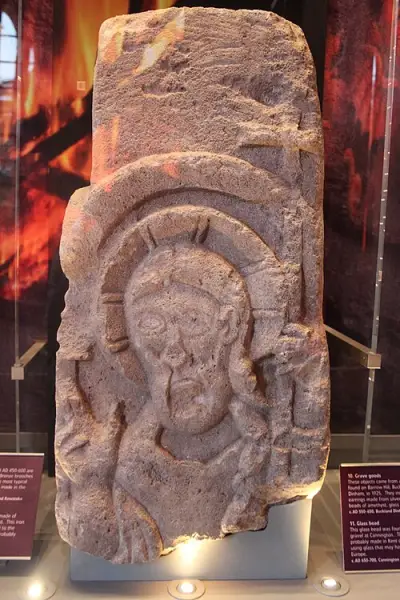
Congar is a minor saint, but his memory has proved surprisingly durable. The parish of Congresbury claimed during the Middle Ages to enshrine his body and advertised the claim in several pilgrim guides; no other church ever contested possession of his remains, an unusual unanimity among competing shrines. The place itself keeps his name and kept his memory: Asser's Life of Alfred, the earliest text to mention Congresbury, describes it as a derelict Celtic monastery, probably the saint's own foundation, so that his house remained identifiable three centuries and more after his death. His cult entered the liturgical records of the Anglo-Saxon church: a Winchester litany dating from around 1060 includes his name, and his feast day of 27 November was written into most of the medieval Somerset calendars, marking him as a regional patron of the county his monastery had served. Churches dedicated to him stand in Brittany and Cornwall, where Cornish memory remembers him living as a solitary at St Ingunger, within Lanivet parish. He is venerated today in the Catholic Church, the Eastern Orthodox Church, and the Anglican Communion, and a sculpture of St Congar of Congresbury, preserved at the Museum of Somerset, shows that his county still claims him.
§ References
Timeline
- 470
Born around this year at Llanwngar in Pembrokeshire, where he grew up before his missionary career.
§ Introduction
- 27 Nov 520
Died at Jerusalem while on pilgrimage, after returning to Wales from his monastery in Somerset.
§ Introduction
- 1060
His name appears in a litany of Winchester dating to about this year, an early witness to his cult.
§ Introduction
The Record
- Major works
- Monastery at Cadbury-Congresbury, Somerset·Parish church at Badgworth, which bears his name
- Symbols
- a staff that took root and became a yew tree
- Canonization
- Pre-congregation; venerated in the Catholic Church, the Eastern Orthodox Church, and the Anglican Communion
Prayer
Bibliography
Show 2 sources
- Farmer, David Hugh (1997). The Oxford Dictionary of Saints (4th ed.). Oxford: Oxford University Press. p. 113.
- Doble, G. H. (1970). The Saints of Cornwall: part 5. Truro: Dean and Chapter. pp. 3–29.
Profile text adapted from the Wikipedia article, licensed CC BY-SA 4.0.
Pray with this saint every day
Save St. Congar of Congresbury to your favorites, read the full profile, and get feast-day reminders in the Saints app.
Get the Saints AppFree on the App Store for iPhone and iPad