
c. 450 – 519·Feast May 4
St. Conleth
Hermit, metalworker, and first Bishop of Kildare
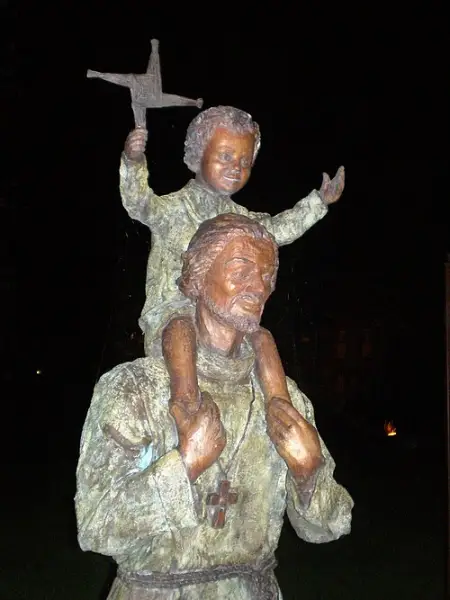
Overview
Conleth, known in Old Irish as Conláed and by many later spellings, was an Irish hermit and metalworker, remembered also as a copyist and a skilled illuminator of manuscripts. A native, by tradition, of the Wicklow country, he withdrew to a hermit's life at Old Connell beside the Liffey, on ground now occupied by Newbridge, remaining there as a solitary until Saint Brigid persuaded him to make sacred vessels for her convent. His craftsmanship soon made him famous: with Tassach of Elphin, Saint Patrick's craftsman, and Daigh, craftsman of Ciarán of Saigir, he was acclaimed one of the three chief artisans of Ireland. The Kildare school of metal-work and penmanship looked to him as its master, and the brotherhood he trained won renown alike for chalices and liturgical metalwork and for missals, gospels, and psalters decked out in ornament. Around 490, at Brigid's invitation, he became bishop of her double monastery at Kildare, erected its cathedral, and is counted the first bishop of the diocese. He died on 4 May 519, killed by wolves in the forests of Leinster while on pilgrimage to Rome, and was buried nearby. His relics were laid beside Brigid's in Kildare cathedral in 799 and moved to Connell in 835 for safekeeping against Danish raiders.
The Complete Life
From the Wicklow Hills to a Cell on the Liffey
The Wicklow country, the hill district south of Dublin where Irish Christianity had struck early roots, is thought to have been Conleth's home ground. His name survives in a remarkable variety of forms, Old Irish Conláed, Modern Irish Naomh Conlaodh, and the variants Conlaeth, Conlaid, Conlaith, Conlath, and Conlian, while one tradition renders him as Hugh the Wise. What the record chiefly preserves of his younger years is his choice of solitude: he made his hermitage at Old Connell beside the Liffey, on the spot within County Kildare where Newbridge stands today. There he lived in seclusion, and there he practised the two crafts that would make him famous, the working of metal and the copying and illumination of manuscripts, for a hermit in the early Irish church supported himself by his hands as well as his prayers. The place of his cell became so bound up with his memory that it is now a graveyard within the parish that bears his name, and the annual pilgrimage of his people still walks the two miles from Newbridge to the site where he once prayed alone.
§ Life
Brigid's Craftsman
The turning of Conleth's life came through the great abbess of Kildare. While he was living in seclusion at Old Connell, Saint Brigid persuaded him to make sacred vessels for her convent, and the quality of his work drew him out of his solitude into her service. His reputation grew with astonishing speed. Alongside Tassach of Elphin, who had been Saint Patrick's own craftsman, and Daigh, craftsman of Ciarán of Saigir, Conleth was acclaimed as one of the three chief artisans of Ireland in his period, a title that placed the hermit of the Liffey at the very summit of his trade. So relates Brigid's biographer Cogitosus: a brotherhood of monks formed itself around him, and under his direction it came to excel in two arts at once: the making of beautiful chalices and the other metal objects the church required, and the penning and decoration of missals, gospel-books, and psalters. Master of the Kildare house of craft in both metal and script, he made its products famous wherever the church they served was known. Of his individual pieces, the one singled out by name is the crozier he fashioned for Saint Finbarr of Termonbarry.
§ Life
First Bishop of Kildare
Conleth's artistry became the foundation of an institutional church. Around the year 490, the Diocese of Kildare appears to have been founded by Conleth himself, who raised the cathedral church with Brigid's help while she presided over the monastery, and took office as its first bishop. Cogitosus, in his Life of Brigid, tells the story as an invitation: Brigit's summons asked him to take up the bishop's office in the double monastery she ruled at Kildare, binding the craftsman of her convent to the see that would bear its name. The arrangement is a classic instance of the double monastery of early Ireland, where a community of monks and a community of nuns lived one ecclesial life under complementary leadership, the abbess commanding the reverence of the founders' memory and the bishop providing the sacramental office. In Conleth's hands Kildare acquired cathedral, clergy, and episcopal succession all at once, and his own monks, expert in chalices and in the ornamentation of the books of the altar, supplied the new see with the vessels and manuscripts its worship required. He stands first in the pre-Reformation lists of the bishops of Kildare, and the united diocese of Kildare and Leighlin reveres him as its patron to this day.
§ Life
The Sanctity of Made Things
Conleth's holiness expressed itself through material beauty, and the tradition has always seen his crafts as a form of prayer. A man who began as a hermit, praying alone at Old Connell, brought the recollection of the cloister into the workshop: the chalices his monks hammered into shape were destined for the hands of priests at the most solemn moments of the liturgy, and the missals, gospels, and psalters they copied and adorned were the words of Scripture given visible glory. The medieval Irish instinct that a sacred text deserved illumination as rich as any relic, and that the vessels of the altar should be as beautiful as the craftsman could make them, found one of its chief masters in Conleth, and Cogitosus praised the Kildare community's excellence in exactly these terms. His life joined the three estates of early Irish sanctity: the eremitical withdrawal of the solitary, the artistic service of the craftsman, and the pastoral office of the bishop. The crozier he made for Saint Finbarr of Termonbarry, the one surviving testimony to his hand by name, was itself a symbol of pastoral authority crafted by a bishop's own skill, a fitting emblem of a spirituality in which authority, art, and devotion were a single labour offered to God.
§ Life
Death on the Pilgrim Road
Conleth's life ended as it had begun, on the move and in the open country. In 519, already an old man of nearly seventy, he set out on pilgrimage to Rome, the goal of pilgrims from the far edge of the Christian world. In the forests of Leinster, before he could leave Ireland, he was attacked by wolves and killed on 4 May 519. He was buried nearby, in the district of his early solitude. The manner of his death, torn by wild beasts on the road to the apostles' tombs, gave the craftsman-bishop something of the martyrs' passing, and the date was fixed in the calendars as his feast. His body did not rest long in obscurity. A vellum fragment inscribed with his name, dating to about the year 700, shows his memory in written honour within two centuries of his death. When the year 799 came round, his bones were brought to Kildare to repose next to Brigid's in the great cathedral there, reuniting in death the bishop and the abbess whose partnership had built the diocese. When Danish raiders threatened in 835, his relics were moved once more, finally laid to rest at Connell to protect the inhabitants from the invaders, bringing the saint's remains back to the ground of his first cell.
§ Life
Veneration of the First Bishop
Conleth was never subject to a formal process of canonisation; he belongs to the saints recognised by the undivided tradition of the early Irish church, revered as first Bishop of Kildare from the generation of Brigid herself. He is venerated in Catholicism, in Anglicanism, and in the Eastern Orthodox Church, where his memory is kept on 4 May and additionally on the fourth Sunday of Pascha. His principal feast falls on 4 May, the day of his death, and the faith of his own countryside has kept it with unusual warmth. Newbridge and the district around it form the Roman Catholic parish of St Conleth, which honours him as its patron; Old Connell, the site of his original cell, now a graveyard, lies within the parish bounds. Each year, on the Sunday following his feast, the parishioners walk in pilgrimage from Newbridge's church out to Old Connell, some two miles beyond the town, joining the present people of Kildare to the ground where their first bishop once prayed in solitude. The Diocese of Kildare and Leighlin numbers him among its patrons, and his name opens the pre-Reformation roll of its bishops.
§ Veneration
Schools, Stadiums, and a Saint's Long Memory
Thirteen centuries after his death, Conleth's name remains attached to the life of Ireland in unexpected places. St. Conleth's College stands in Ballsbridge in Dublin, carrying the craftsman-bishop's name into education, while St. Conleth's Park in Newbridge, County Kildare, is the home stadium of the Kildare Gaelic Athletic Association teams, so that the first bishop of Kildare gives his name to the field where his county plays its games. The site of his hermitage continues to draw the faithful in the annual Sunday pilgrimage after his feast. His story also travelled beyond Ireland: Sabine Baring-Gould, in his Book of Cornwall, briefly describes Conleth's tale and community, spelling his name Conlaeth, a reminder that the fame of the Irish master-craftsman reached even the hagiography of Cornwall's saints. Among scholars his memory is maintained by the Dictionary of Irish Biography, where Aidan Breen treats Conláed, and by the older authorities such as Samuel Lewis's Topographical Dictionary of Ireland of 1837, which records the foundation of the diocese. The vellum fragment bearing his name from about 700 attests that the monks of Kildare were writing their founder's name within living memory of the schools of art he established, a fitting tribute to a saint whose trade was itself the making of beautiful books.
§ Legacy
Timeline
- 450
Born around this year, believed to be in the Wicklow area of Ireland.
§ Life
- 490
Founded the Diocese of Kildare around this year, erecting the cathedral and becoming its first bishop with Saint Brigid's assistance.
§ Life
- 4 May 519
Journeying toward Rome, he was set upon by wolves among the woods of Leinster and killed on 4 May, being buried close to where he fell.
§ Life
- 700
A vellum fragment inscribed with his name was produced around this time, the earliest surviving witness bearing it.
§ Life
- 799
His remains were carried in translation to Kildare and placed at Brigid's side within the cathedral church.
§ Life
- 835
His relics were moved to rest at Connell, to shield the inhabitants from invading Danes.
§ Life
The Record
- Major works
- Cathedral and diocese of Kildare, founded c. 490·Kildare school of metal-work and penmanship·Crozier fashioned for Saint Finbarr of Termonbarry·Sacred vessels, chalices, and liturgical metalwork for Brigid's convent·Illuminated missals, gospels, and psalters
- Patron of
- Diocese of Kildare and Leighlin·St Conleth's Parish, Newbridge, County Kildare
- Symbols
- bishop's crozier·smith's hammer and sacred vessels·illuminated manuscript
- Canonization
- Pre-congregation; honoured as a saint from the early Irish church as first Bishop of Kildare
Prayer
Bibliography
Show 6 sources
- "Churches of county Kildare". County Kildare Heritage.
- Duffy, Patrick. "St. Conleth". Caitlicigh Ar An Ngreasan.
- Lewis, Samuel. A Topographical Dictionary of Ireland. London: S. Lewis & Co., 1837.
- Breen, Aidan. "Conláed (Conleth)". Dictionary of Irish Biography, October 2009.
- Baring-Gould, S. A Book of Cornwall. Project Gutenberg.
- "St. Conleth's College".
Profile text adapted from the Wikipedia article, licensed CC BY-SA 4.0.
Pray with this saint every day
Save St. Conleth to your favorites, read the full profile, and get feast-day reminders in the Saints app.
Get the Saints AppFree on the App Store for iPhone and iPad