
c. 900 – 975·Feast November 26
St. Conrad of Constance
Tenth-century bishop and pilgrim of the Welf line
Overview
Conrad of Constance, a scion of the mighty Welf house, shepherded one of Germany's oldest dioceses through four decades of the turbulent tenth century and left behind a reputation for pastoral steadiness rather than political ambition. Born around 900 to Count Heinrich of Altdorf, he received his schooling at the cathedral school of Constance, served as provost of the cathedral, and in 934 was raised to the bishopric itself. Contemporaries reckoned it among his signal accomplishments that he kept his distance from the factional politics of the era and hoarded his strength for the work of his see. That reserve did not mean isolation: he stood close to Emperor Otto I and traveled with him to Italy in 962, the journey associated with Otto's imperial coronation. Conrad was a pilgrim by conviction, crossing to Jerusalem three times and visiting Rome repeatedly. On the estates of his diocese he raised new churches, and at Kreuzlingen he built a hospital placed under the protection of a relic of the True Cross he had carried home from the East. He died on 26 November 975, and in 1123 the First Lateran Council proclaimed him a saint.
The Complete Life
A Welf at the Cathedral School
Conrad entered the world around the year 900 as a member of the Welf family, one of the great dynasties of the medieval German lands, and his father was Count Heinrich of Altdorf. Birth placed him near the summit of a violent age, and education prepared him for a different kind of service. He was sent to the cathedral school of Constance, where the sons of the nobility received the learning of the Church — scripture, liturgy, and the administration of a great diocese. There his path diverged from that of many noble children: instead of returning to the affairs of his house, he remained within the life of the cathedral and rose to become its provost, the officer who governed its clergy and its daily worship. The sequence matters for understanding the man. Conrad never renounced his family or his rank, yet he directed every advantage of both toward the church he served. When the see of Constance fell vacant, the choice of the young provost in 934 must have seemed natural to clergy and magnates alike — a local man, of the blood of the Welfs, formed in the cathedral's own school, now made its bishop.
§ Life
Bishop Above Politics
The sources single out one achievement of Conrad's long episcopate: he refused to be swallowed by the politics of his day. Tenth-century Germany was a battlefield of dukes, kings, and churchmen, and bishops commonly spent as much energy at court and in war as in their dioceses. Conrad, by contrast, reserved his energies for episcopal duties — the ordering of worship, the care of clergy, the foundation and maintenance of churches across the vast estates of his see. His restraint won him a paradoxical prominence, for it made him a trusted figure at the highest level. Emperor Otto I valued him enough to take him along on the Italian expedition of 962, the campaign in the course of which Otto received the imperial crown. Conrad's primary devotion, however, ran on a different road: he made the pilgrimage to Jerusalem three times and visited Rome on many other occasions, journeys of enormous cost and danger that marked him as a man who measured his life against the holy places rather than the palace. The churches he built on his diocesan lands and the hospital he founded at Kreuzlingen were the concrete fruit of that pilgrim, pastoral spirit.
§ Life
The Chalice and the Spider
The image by which Conrad is recognized tells the story his admirers cherished most. In art he is shown with the chalice in his hand and a spider within it, or hovering just above the cup — a scene drawn from an episode of his sacramental life. One day, the tradition runs, as Conrad stood celebrating Mass, a spider dropped from above into the chalice and mingled with the wine. The science of the age held spiders to be lethally poisonous; to drink would seem to invite death. But the wine in that chalice was no longer mere wine. Believing in what the Mass had accomplished, Conrad drank the Blood of Christ together with the creature, entrusting his body to his Lord. The tale is remembered not as a marvel of survival but as a sermon on faith: the bishop valued the truth of the sacrament above the testimony of his senses and the fear of poison. It is a fitting emblem for a bishop whose whole ministry rested on the conviction that the things of God outrank the dangers of the world, whether a spider in a chalice or an empire at war.
§ Iconography
Remembered into Sainthood
Conrad died on 26 November 975, but the formal recognition of his holiness came slowly, and its history explains both his honor and the thinness of the record. The movement to keep his memory alive was championed more than a century after his death by Bishop Ulrich I of Dillingen, who led the diocese of Constance from 1111 to 1127 and held the old bishop up as a model of courage. Around 1120 a monk named Udalschalk of St. Ulrich's and St. Afra's Abbey in Augsburg — later the abbey's abbot — composed the Vita of Conrad. The biographer himself worked at a distance of nearly 150 years from his subject, and the lateness of the text doubtless accounts for its spareness: much had simply been forgotten. Nevertheless the cause advanced swiftly at the highest level of the Church. In 1123 the First Lateran Council, assembled under Pope Callixtus II, canonized Conrad among the saints, and his feast of 26 November entered the calendars of both the Roman Catholic and Eastern Orthodox churches. The act placed him among those bishops of the imperial church whose sanctity rested on settled reputation rather than paperwork; no process heard miracles or examined witnesses, only the Council's judgment that the old bishop of Constance had been a saint. For the diocese it meant a feast, an official cult, and the assurance that Ulrich's campaign of memory had not been made in vain.
§ Veneration
A Saint of the German Church
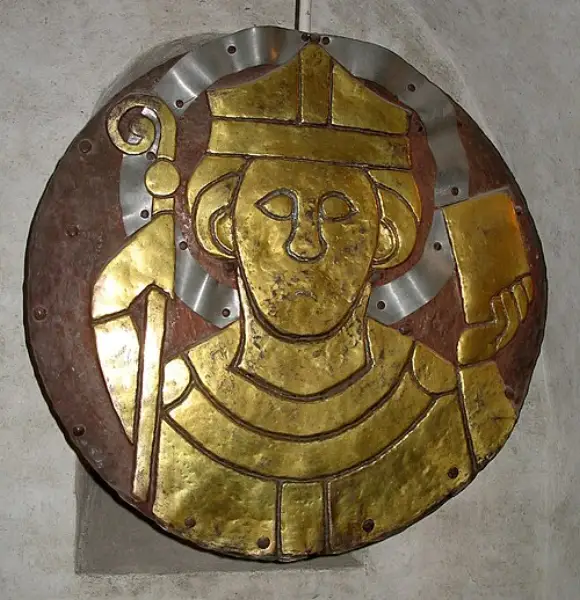
Conrad's afterlife in the devotion of the Church has been long and quietly persistent. Venerated in East and West alike, he stands among the early bishops of Constance as the diocese's own saint, remembered each 26 November. His iconography — the bishop with the chalice and the spider — kept his chief legend alive in the art of the region, and a copper plate depicting him was preserved in the crypt of the Cathedral of Konstanz as a token of that local attachment. His foundations outlived him in more material ways: the hospital at Kreuzlingen, dedicated under the relic of the True Cross he had brought from Jerusalem, endured as a monument of his charity long after the world of the tenth-century Welfs had passed away. Historians of the German Church remember him chiefly for the virtue the sources themselves found remarkable — a bishop of great family and high connection who refused to let politics consume his office. In an age when the line between prince and prelate was perpetually blurred, Conrad of Constance remained what he had trained to be at the cathedral school: a servant of the altar.
§ Veneration
Timeline
- 900
Born around this year into the Welf family, son of Count Heinrich of Altdorf
§ Life
- 934
After serving as provost of Constance Cathedral, made Bishop of Constance
§ Life
- 962
Accompanied Emperor Otto I on his expedition to Italy
§ Life
- 26 Nov 975
Died on 26 November, after more than forty years governing the see of Constance
§ Life
- 1120
Udalschalk, a monk of Augsburg's abbey of St. Ulrich and St. Afra, wrote the saint's Life (Vita)
§ Veneration
- 1123
Canonized at the First Lateran Council by Pope Callixtus II
§ Veneration
The Record
- Major works
- The hospital at Kreuzlingen, enshrining a relic of the True Cross·Churches founded on the episcopal estates of Constance
- Symbols
- Shown as a bishop holding a chalice with a spider in it or over it
- Canonization
- Canonized in 1123 at the First Lateran Council by Pope Callixtus II
Prayer
Bibliography
Show 4 sources
- Adriaan Breukelaar (1992). "Konrad von Konstanz". In Bautz, Traugott (ed.). Biographisch-Bibliographisches Kirchenlexikon (BBKL) (in German). Vol. 4. Herzberg: Bautz. cols. 416–417. ISBN 3-88309-038-7.
- St. Patrick's Church: Conrad of Constance
- "San Corrado di Costanza". Santiebeati.it (in Italian).
- "Saint Conrad of Constance". CatholicSaints.Info.
Profile text adapted from the Wikipedia article, licensed CC BY-SA 4.0.
Pray with this saint every day
Save St. Conrad of Constance to your favorites, read the full profile, and get feast-day reminders in the Saints app.
Get the Saints AppFree on the App Store for iPhone and iPad