
1818 – 1894·Feast April 21
St. Conrad of Parzham
Capuchin porter of Altötting and model of quiet charity
Overview
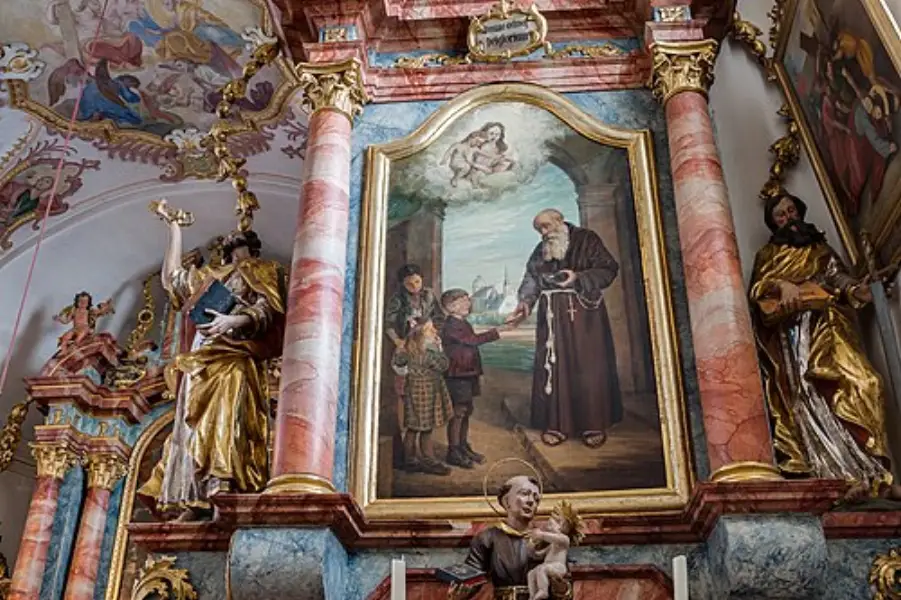
Conrad of Parzham, born Johann Birndorfer on 22 December 1818 on his family's farm in the Bavarian village of Parzham, became one of the most beloved religious figures of nineteenth-century Germany without ever holding an office beyond a friary doorway. The second youngest of twelve children, he lost his mother at fourteen and his father two years after, and worked the family land while nurturing a deep devotion to the Blessed Virgin and the rosary. At thirty-one, having given away his inheritance, he was received among the Capuchin lay brothers and in time stationed at the friary of St. Anna in Altötting, gateway to Bavaria's national Marian shrine. There, as porter, he admitted pilgrims, fed the poor, and counseled the troubled for more than forty years, saying little and loving much. He stole hours from the night for prayer before the Blessed Sacrament and was widely credited with reading hearts and foreseeing the future. He died at his post on 21 April 1894. Pope Pius XI declared him blessed in 1930 and a saint in 1934, and he is now patron of the Capuchins' Mid-America Province and, since 1984, of the diocese of Passau.
The Complete Life
A Farm Boy of Parzham
The boy who would become St. Conrad was born on 22 December 1818 on the family farm in Parzham, then in the Kingdom of Bavaria and now part of the town of Bad Griesbach, and was baptized Johann Evangelist, son of Bartholomäus Birndorfer and Gertrude Niedermayer. Of the couple's twelve children, five died in infancy; Johann was the second youngest of the survivors. His childhood was marked by loss — his mother died when he was fourteen, his father two years later — and by work, for the farm's care fell early on young shoulders. Yet the neighbors noticed something unusual in him. Sent to the village school at nearby Weng from the age of six, Johann showed a devotion conspicuous even among devout country children: he visited the church constantly, whatever the weather and however distant the road, and prayed there with unmistakable recollection. He nurtured a tender love of the Blessed Virgin, reciting the rosary daily, and on feast days would set out on foot for distant shrines of the Mother of God, praying along the way and often returning in the evening still fasting from the journey's beginning.
§ Early life
The Inheritance Given Away
For years after his parents' death, Johann continued to work the farm at Parzham, and the outward shape of his life changed little. Inwardly, the question of a religious vocation matured slowly. The turning point came in 1838, when he attended a parish mission and came away resolved to give himself wholly to God. Even then the step took time: he arranged his affairs, and only afterward, at the age of thirty-one, did he distribute his inheritance and ask for admission among the Capuchin friars as a lay brother. The delay was not hesitation but stewardship — he would enter religion owing nothing and holding nothing back. Received into the Order, he made his profession and was assigned at once to the friary of St. Anna at Altötting, attached to the great shrine of Our Lady of Altötting, the national sanctuary of Bavaria. There he was first given the task of assisting the porter. Later he left the town briefly, in 1851, to care for a dying priest at Burghausen, and that September entered the novitiate at Laufen, taking in religion the name Conrad after the hermit of Piacenza, before going back to Altötting as its porter for good.
§ Early life
The Door of Saint Anna's
The post of porter in a busy friary is humble in name and inexhaustible in fact, and at Altötting it was more demanding than most. The friary stood beside a shrine that drew pilgrims from across Bavaria, and every visitor, beggar, and traveler passed the brother at the door. Conrad filled the office for more than forty years, and the pattern of his service became proverbial in the town: diligent in his work, sparing of words, generous to the poor, and eager — even impatient — to receive and assist strangers. He was, in the description of those who recorded his life, the servant of the town's needs of body and soul: food for the hungry, a kind word for the grieving, counsel for the lost. People came to believe that the quiet brother could read the secrets of the hearts that stood before him, and that God had granted him a foreknowledge of things to come. He claimed no such gifts and sought none; he simply answered the door, and in answering it answered Christ. Nothing in the record suggests he ever asked for a different duty; when obedience moved him away, it brought him back to the same threshold.
§ Brother Porter
Silence, Adoration, and Little Sleep
Conrad's outer activity rested on an inner discipline of prayer so constant that observers concluded he never rested at all. He loved silence with a particular devotion, and in the scraps of time his duties left him he withdrew to a nook beside the door of the friary, where, without abandoning his post, he could keep his eyes on the Blessed Sacrament and adore it. Night brought no real repose. He deliberately shortened his sleep by several hours, devoting the stolen time to prayer in the friars' oratory or in the church, so that his days and nights formed one unbroken conversation with God. It was generally believed among those who knew him that he took no rest whatsoever, being continually occupied with work and the exercises of devotion. The Marian piety of his boyhood never left him: the porter of Altötting served the great shrine of the Blessed Mother and had spent his youth walking to her distant sanctuaries. His spirituality was that of the Capuchin lay brother at its purest — unlettered, Eucharistic, tireless, and hidden, with the doorbell as his psalter and the stranger as his liturgy.
§ Brother Porter
Dying at His Post
Conrad grew old at the same door he had opened for four decades, and in the end he did not leave it. On 21 April 1894 he died in the friary of St. Anna, the community he had served for forty-one years, still the brother of the porter's lodge. There was nothing dramatic about the ending, and that was fitting: he had spent his life insisting that holiness is built out of ordinary duties repeated with extraordinary love, and his death repeated the pattern. The town that had passed his doorway for two generations mourned him as its own, and reports of his virtues and of favors obtained through his intercession multiplied. The accounts of his reading of hearts and his prophetic intuitions, once whispered as gossip, now became testimony in a formal cause. He was buried among his brethren, and pilgrims began to make their way to the porter's friary as they had long made their way to the shrine next door. The community that buried him did not believe it was burying an ordinary religious; visitors began coming to his grave almost at once, and the stories they carried away became the first material of his cause.
§ Brother Porter
Raised to the Altars
The Church moved with unusual speed to confirm the verdict of the people. Conrad's reputation for heroic virtue and the miracles reported at his intercession brought him, in 1930, the distinction of beatification at the hands of Pope Pius XI, in a ceremony at Saint Peter's Basilica on 15 June. Four years later the same pope, having approved additional miracles worked through the humble porter's prayers, solemnly inscribed his name in the catalogue of the saints on 20 May 1934, likewise at Saint Peter's. The interval between his death and his canonization — exactly forty years — was short by any measure, and it testified to the strength of the devotion that had followed him from Altötting to Rome. His feast was fixed on 21 April, the anniversary of his death, and the Franciscans, whose order he had honored as a lay brother, took him as a particular glory of the Capuchin branch of the family. Few servants of God in the modern era have traveled from a friary deathbed to the highest honors of the Church so quickly, and the speed itself was a tribute: Rome does not hurry except where the people of God have already decided.
§ Beatification process
Patron of a Province and a Diocese
Conrad's patronage has attached itself to the communities that knew him best and the Church that reared him. The Capuchin friars of the Mid-America Province honor him as their patron saint, holding up to their own brothers the layman who showed that the order's humblest office could be a path to the altars. Since 1984 he has served likewise as patron of the diocese of Passau, the Bavarian diocese within whose borders he was born, worked, and died. Beyond these formal titles his influence persists in a quieter register: in the tradition of Altötting itself, where the shrine he served remains the spiritual heart of Bavaria, and in the enduring witness of a man who proved that a friary door can be a pulpit, a confessional, and a throne of charity all at once. He belongs to the long line of porter saints of religious orders, and perhaps stands first among them in modern memory — the brother who said little, prayed much, and was found, after his death, to have been tall in the sight of God. His feast of 21 April keeps him yearly before the faithful of Bavaria and of the whole Franciscan family.
§ Beatification process
Timeline
- 22 Dec 1818
Born 22 December on the family farm at Parzham, near Bad Griesbach in the Kingdom of Bavaria, and baptized Johann Evangelist Birndorfer.
§ Early life
- 1832
His mother died when he was fourteen years old.
§ Early life
- 1834
His father died two years after his mother, leaving the family farm in his charge.
§ Early life
- 1838
After attending a parish mission, he resolved to enter the religious life.
§ Early life
- 1839
The year after the mission, having given away what he owned, he was received among the Capuchins as a lay brother.
§ Early life
- 1842
Made profession as a Capuchin lay brother and was sent immediately to the friary of St. Anna in Altötting.
§ Brother Porter
- Mar 1851
Left Altötting in March to care for a dying priest at Burghausen.
§ Brother Porter
- Sep 1851
Entered the novitiate at Laufen that September and took the religious name Conrad, after the saintly hermit of Piacenza.
§ Brother Porter
- 21 Apr 1894
Died on 21 April in the friary at Altötting, where he had served for forty-one years.
§ Brother Porter
- 15 Jun 1930
Beatified by Pope Pius XI at Saint Peter's Basilica on 15 June.
§ Beatification process
- 20 May 1934
Canonized by Pope Pius XI on 20 May, after further approved miracles.
§ Beatification process
- 1984
Named patron saint of the diocese of Passau.
§ Beatification process
The Record
- Patron of
- Mid-America Province of Capuchin Friars·Diocese of Passau (since 1984)
- Canonization
- Beatified 15 June 1930 and canonized 20 May 1934 by Pope Pius XI at Saint Peter's Basilica
Prayer
Bibliography
Show 6 sources
- "Saint Conrad of Parzham", Franciscan Media. Archived from the original on 2020-10-08.
- Cargnoni, OFMCap, Costanzo. The Capuchin Way: Lives of Capuchins, v. 1, pt. 2, North American Capuchin Conference, 1996, pp. 180-206.
- "St. Conrad of Parzham", FaithND.
- "St. Conrad of Parzham", Capuchins, Mid-America Province (PDF). Archived from the original (PDF) on 2021-03-08.
- Farmer, David Hugh (1997). The Oxford Dictionary of Saints (4th ed.). Oxford University Press. pp. 114–115. ISBN 0-19-280058-2.
- Adriányi, Gabriel (1981). The Church in the Modern Age. Crossroad. p. 29. ISBN 978-0-8245-0013-9.
Profile text adapted from the Wikipedia article, licensed CC BY-SA 4.0.
Pray with this saint every day
Save St. Conrad of Parzham to your favorites, read the full profile, and get feast-day reminders in the Saints app.
Get the Saints AppFree on the App Store for iPhone and iPad