
1290 – 1351·Feast February 19
St. Conrad of Piacenza
Franciscan tertiary hermit and penitent nobleman
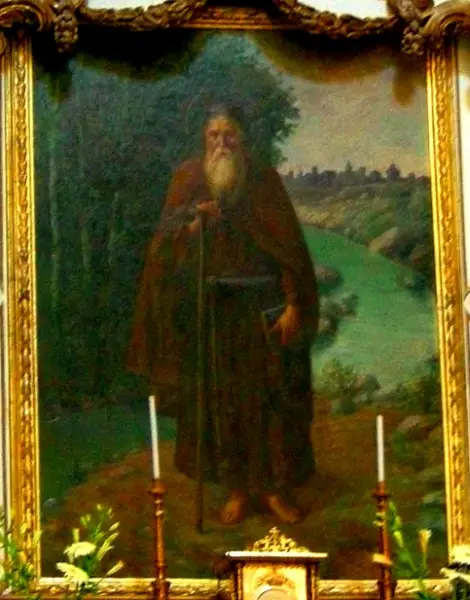
Overview
Conrad Confalonieri of Piacenza, born around 1290 into one of the foremost families of the Lombard city, traded a nobleman's life for a hermit's and became one of southern Italy's most beloved saints. The young Corrado married an aristocratic bride, Ephrosyne, but a hunting accident that led to an innocent man's condemnation broke his world open: he confessed his fault publicly, lost his goods in reparation, and with his wife's consent embraced a life of penance, she as a Poor Clare and he as a Franciscan tertiary hermit. After years of solitude near Calendasco, interrupted by crowds drawn by his holiness, he wandered as a pilgrim to Rome, the Holy Land, and Malta, before settling around 1340 in a grotto in the Sicilian Val di Noto. From 1343 he served the sick for two years at the hospital of Saint Martin in Netum, and his prayers were credited with ending the famine that followed the plague of 1348–49. He died kneeling before a crucifix on 19 February 1351, was buried at Netum, and later translated to the cathedral of Noto, where his incorrupt body remains enshrined.
The Complete Life
A Son of the Confalonieri
The records of Conrad's life are sparse, and what can be said of his beginnings rests on the outline the sources preserve. He was born Corrado Confalonieri around 1290 — some accounts say 1284 — into one of the leading families of Piacenza, in a stronghold of the family's own: Calendasco, a fiefdom they held, dominated by the Castle of Calendasco, where tradition places his birth. As a young man he married, as his station required, an aristocratic young woman named Ephrosyne. Of the couple's life together almost nothing is recorded, and the great turning point that reshaped it survives chiefly in the shape of legend, examined years later during his beatification process. What the solid record does establish is the fruit of that turning point: the new Roman Martyrology acknowledges that Conrad lived some forty years as a hermit, passed in prayer and acts of penance, and it is beyond dispute that he belonged to the Third Order of St. Francis. Whatever else the twentieth-century skeptics may trim from his story, the nobleman who became a tertiary hermit stands at the confirmed center of his life.
§ Biography
The Fire and the Gallows
The story that turned Conrad from nobleman to penitent is preserved as the founding legend of his life. Hunting, as was his custom, within the family domains, he ordered brushwood set alight to flush game from cover. The wind carried the flames beyond control, and fire spread across fields and forest alike. Soon afterward a peasant was found near the place where the blaze had begun, was accused of setting it, and under torture confessed to a crime he had not committed, and the court sentenced him to death. At the moment the doomed stranger was being taken out to die, Conrad's conscience conquered his safety. Before the Signoria of the city he publicly admitted that the fire was his. The court confiscated his entire estate as punishment and reparation — sparing his life only out of respect for his noble birth — and the rich Confalonieri heir was reduced to poverty. Conrad and his wife read the catastrophe differently: they saw the hand of God in the ruin, an appointed means of penance for his cowardice and a call to renunciation. In 1315 the marriage was dissolved by mutual consent for the sake of the religious life; Ephrosyne entered the Poor Clares in the city, and Conrad withdrew to a hermitage near Calendasco, joining a community of Franciscan tertiaries.
§ Legend
From Solitude to the Sick
Holiness drew crowds, and crowds destroyed the solitude Conrad sought. His reputation spread, visitors multiplied at his hermitage, and the would-be hermit resolved on the pilgrim's remedy: he departed, making his way to Rome, and from there across the sea to the Holy Land and Malta. Around 1340 the wandering brought him to Palermo, and from Palermo he was pointed toward a lonely spot in the Val di Noto, in southeastern Sicily. There he settled at last, in a grotto that still carries his name, adopting a life of the most austere and penitential solitude. Miracles were credited to him, and with them the gift of prophecy. But solitude gave way once more, in 1343, to service: Conrad felt called by God to the people of the region directly, and went to the town of Netum. For the next two years he nursed the sick at the Hospital of Saint Martin, dwelling in a hermitage beside the Church of the Crucified Christ, shared at the time with Blessed William Buccheri — formerly an equerry of King Frederick III of Sicily — who had likewise withdrawn into solitude and prayer. From time to time Conrad returned to his grotto for silent prayer, but his last active years belonged to the sufferers of Netum.
§ Legend
Bread from Angels
The famine that fixed Conrad's memory among the people of Sicily descended after the catastrophe of the bubonic plague of 1348–49, when hunger followed pestilence across the island. To the hermit's grotto came all who sought his help, and no one, the tradition insists, was turned away unfed: each petitioner received a loaf of bread still warm from the oven, though no oven was anywhere near, for the loaves were said to come from angels. The Miracle of the Bread became the defining story of his sanctity, told of him and eventually sworn to by witnesses in the canonization proceedings — Bishop Dalmazio Gabriele himself testified that he had seen it. Behind the marvel lay the man: a penitent nobleman who had learned that goods are held in trust, who had traded a castle for a cave, and who in a starving countryside became the channel of daily bread. His prayer was credited with ending the famine of 1348, when the Bishop of Syracuse came to his hermitage to beg his intercession. The spirituality that emerges is Franciscan to the core — poverty embraced, penance loved, and providence trusted for the next loaf and the last breath alike.
§ Legend
Death Before a Crucifix
Conrad is said to have foreseen his own death, and to have met it as he had met everything else — kneeling. On 19 February 1351 he died in prayer before a crucifix, in the solitude he had chosen thirty-five years before. He was buried in the principal church of Netum, the town he had served in its sickrooms. When earthquakes wrecked Netum in the 1690s and the survivors abandoned it in 1703 to found modern Noto, the saint's remains went with them: his body was translated to the Cathedral of St. Nicholas in Noto, where it remains the city's treasure. Before the translation, during the canonization proceedings begun in 1485, his grave had been opened and the body exhumed for examination; it was found incorrupt, and was placed in a silver casing for public veneration — a judgment of the Church on the body that had spent four decades in penance. Devotees had long credited him with cures, above all from hernia: an old friend and companion-in-arms, Antonio da Stessa of Daverio, was said to have been instantly relieved of the affliction after Conrad pitied him and prayed, and a tailor tormented by several hernias reported a similar cure.
§ Legend
From Cause to Canonization
The sheer number of miracles reported after Conrad's death moved the civic leadership to petition the Bishop of Syracuse, who oversaw Noto, to open the cause of his canonization. The machinery of the Church moved slowly, as canon law required: only in 1485, once the mandated interval had run, did Bishop Dalmazio Gabriele of the Order of Preachers formally initiate proceedings. The bishop proved to be a witness as well as a judge, for he testified that he had seen with his own eyes the Miracle of the Bread. In the course of the process Conrad's body was exhumed and found incorrupt, and was enshrined in silver for the veneration of the faithful. Papal recognition followed in stages. Pope Leo X beatified him on 12 July 1515 and sanctioned the keeping of his feast at Netum; on 30 October 1544 Pope Paul III extended that permission to the whole island of Sicily. Finally, on 2 June 1625, he was canonized, with a solemn ceremony at Piacenza Cathedral presided over by Cardinal Odoardo Farnese, Duke of Parma and Piacenza, at which his feast was declared obligatory; the Church's own records assign the canonization to Pope Urban VIII, who that same September allowed the Franciscans proper liturgical texts for the saint's Mass and Office.
§ Veneration
The Saint of Noto
Conrad's cult has proved as durable as the baroque city that grew from the ruins of Netum. In Noto he is the patron, and on his feast of 19 February the parish church of San Corrado keeps the custom of distributing blessed bread in his honor — an unbroken echo of the Miracle of the Bread that fed a famished island. His liturgical memory survives in a particular way among the Franciscan tertiaries, the branch of the order to which he belonged: after Pope Urban VIII granted the Franciscans dedicated propers for his feast in 1625, that liturgical form became the patrimony of the Third Order. His major shrine is the Cathedral of St. Nicholas in Noto, where his incorrupt body rests in silver. The sick continue to invoke him especially for the relief of hernia, the affliction his charity was said to have cured so strikingly in his lifetime. And his story keeps its old moral force: a man whose single act of carelessness might have been buried in silence chose confession instead, and let the loss of everything he owned become the door to everything worth having.
§ Veneration
Timeline
- 1290
Born at Calendasco, a fiefdom of his family near Piacenza; some sources give 1284.
§ Biography
- 1315
After the hunting-fire scandal and his public confession, he and his wife Ephrosyne separated; he withdrew to a hermitage near Calendasco and she entered the Poor Clares.
§ Legend
- 1340
Having wandered as a pilgrim to Rome, the Holy Land, and Malta, he reached Palermo and settled in an isolated grotto in the Val di Noto.
§ Legend
- 1343
Called to serve the local people, he moved to the town of Netum and for two years cared for the sick at the Hospital of Saint Martin.
§ Legend
- 1348
The Bishop of Syracuse, Giacomo Guidone de Franchis, visited his hermitage to ask his prayers for a famine afflicting Sicily.
§ Legend
- 19 Feb 1351
Died on 19 February, forewarned of his death, kneeling in prayer before a crucifix; buried in the principal church of Netum.
§ Legend
- 1485
After the required statutory wait, Bishop Dalmazio Gabriele of Syracuse initiated canonization proceedings; the exhumed body was found incorrupt.
§ Veneration
- 12 Jul 1515
Beatified by Pope Leo X on 12 July, with his feast sanctioned at Netum.
§ Veneration
- 30 Oct 1544
Pope Paul III extended permission for his feast to the whole island of Sicily on 30 October.
§ Veneration
- 2 Jun 1625
Canonized on 2 June at a solemn ceremony at Piacenza Cathedral, presided over by Cardinal Odoardo Farnese, Duke of Parma and Piacenza.
§ Veneration
- 12 Sep 1625
Pope Urban VIII granted the Franciscans special liturgical texts for Office and Mass on his feast day.
§ Veneration
The Record
- Patron of
- Invoked for the relief of hernia
- Canonization
- Beatified 12 July 1515 by Pope Leo X; canonized 2 June 1625 by Pope Urban VIII, with the ceremony at Piacenza Cathedral presided over by Cardinal Odoardo Farnese
Prayer
Bibliography
Show 4 sources
- "Il Patrono". Parocchia San Corrado. Archived from the original on 20 September 2010. Retrieved 19 February 2013.
- Donovan, Stephen. "St. Conrad of Piacenza." The Catholic Encyclopedia Vol. 4. New York: Robert Appleton Company, 1908.
- Farmer, D.H. (2011). Oxford Dictionary of Saints. 5th Ed. Revised. Oxford University Press, Oxford, UK. ISBN 978-0-19959660-7.
- "Bishop Dalmazio Gabrielli (Gabriele, Grazielli) [Catholic-Hierarchy]".
Profile text adapted from the Wikipedia article, licensed CC BY-SA 4.0.
Pray with this saint every day
Save St. Conrad of Piacenza to your favorites, read the full profile, and get feast-day reminders in the Saints app.
Get the Saints AppFree on the App Store for iPhone and iPad