
1654 – 1714·Feast August 16
St. Constantin Brâncoveanu
Martyr prince of Wallachia and great patron of culture
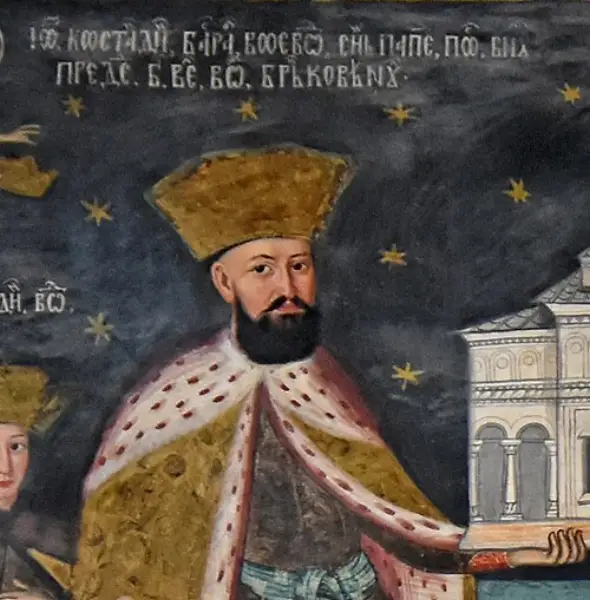
Overview
Constantin Brâncoveanu, Prince of Wallachia from 1688 until his martyrdom in 1714, was the greatest builder and cultural patron of the Romanian principalities and one of Orthodoxy's most honored martyrs of the modern age. Born on 15 August 1654 at Brâncoveni into the web of the Cantacuzino and Craiovești boyar families, he was raised in the house of his uncle, the stolnic Constantin Cantacuzino, and took the throne when his uncle, Prince Șerban Cantacuzino, died. His long reign balanced Ottoman suzerainty with careful negotiation toward the Habsburgs and Peter the Great's Russia, while at home a printing press established in Bucharest under Anthim the Iberian poured out books in six languages, the Royal Academy opened in 1694, and a whole architectural idiom — the Brâncovenesc style — took shape in monasteries and palaces, crowned by the UNESCO-listed Hurezi monastery. Deposed by Sultan Ahmed III, he was imprisoned at the fortress of Yedikule in Constantinople and tortured to reveal a fabled fortune. On 15 August 1714, his sixtieth birthday and the Feast of the Dormition, he refused to save his life by renouncing Christ and was beheaded together with his four sons and his friend Ianache Văcărescu. The Romanian Orthodox Church canonized the family as martyrs in 1992.
The Complete Life
Born Between Two Great Houses
Constantin Brâncoveanu was born on 15 August 1654 on the family estate at Brâncoveni, in Olt County, the son of Pope Brâncoveanu — also called Matthew — and of Stanca Cantacuzino. His ancestry ran through both of the great lineages of the Wallachian boyar class: through his mother he descended from the noble Greek family of the Cantacuzini, and through his father from the Craiovești boyars, inheriting from his grandfather Preda a considerable share of the fortune of the sixteenth-century prince Matei Basarab. Orphaned early of his father's guidance, he was raised in the house of his uncle, the stolnic Constantin Cantacuzino, one of the most powerful and cultivated men in the principality — an education in politics by immersion. His path to the throne opened in 1688 with the death of another uncle, Prince Șerban Cantacuzino. The young heir enjoyed at first the firm support of his maternal uncles, Constantin and Mihai Cantacuzino, the dominating figures of the realm; but over the course of his reign he grew steadily more independent of them. Constantin Cantacuzino withdrew in bitterness to his estates and began to advance the candidacy of his own son, Ștefan, sowing the family rivalry that would shadow and finally help undo the reign.
§ Ascension
Between the Sultan and the Tsar
Brâncoveanu's foreign policy walked a knife's edge between empires. From early in his reign he took steps toward anti-Ottoman understandings, he courted first the Habsburg monarchy and afterwards the empire of Tsar Peter. The test came in 1710, when Russian forces intervened in Moldavia and the regional rivalry sharpened into the Russo-Turkish war of 1710–11. The prince opened contact with Tsar Peter and accepted gifts from him, though his jealousy of Dimitrie Cantemir, the Moldavian prince and Russia's chief regional ally, kept him from any decisive commitment. He massed the Wallachian army at Urlați, near the Moldavian border, poised to welcome the tsar's troops into the country — and simultaneously prepared to join the Ottoman counter-offensive if the tide turned. When several of his own boyars deserted to the Russian camp, the risk of the gamble became unbearable: to remain half-committed was to make an enemy of his Ottoman suzerain. Brâncoveanu chose survival, swiftly returning the gifts Peter had sent. The maneuver saved the principality for the moment, but the flirting with Russia had been observed in Constantinople, and the denunciations that reached the Porte accumulated into the charge that would cost him his throne and his life.
§ Policies
None of Our Kind Has Lost the Faith
The martyrdom of the Brâncoveanu family is preserved in detail by the prince's own secretary, Anton Maria Del Chiaro, and in the sacred history of the Orthodox churches. Confronted with the loss of his fortune and the offer of life at the price of apostasy, the dying prince answered with the words that have become his memorial: all that he had possessed he had lost; his soul he would not lose. To his sons he said, 'Be brave and manly, my beloved! Ignore death,' holding before them the shameful death Christ had endured for their sake. The youngest, Matei, a child of eleven or twelve, broke at the sight of his brothers' blood and begged his father to let him save himself by converting. His father's reply — that no man of their blood had ever yielded the faith, that a thousand deaths were preferable to trading the religion of their fathers for a few more years of life — stilled the boy's tears, and Matei offered his head. After the execution the heads were impaled on javelins in a procession through the city; Christian fishermen later recovered the bodies from the waters of the Bosporus and buried them at the Halchi Monastery nearby. All Eastern Orthodox churches recognize the sanctity of the family thus put to the test and not found wanting.
§ Death and sanctification in Eastern Orthodoxy
Yedikule
The end came swiftly once the Porte resolved to strike. Sultan Ahmed III deposed Brâncoveanu and had him brought under arrest to Istanbul, where in 1714 he was confined in the fortress of Yedikule — the Seven Towers. The sultan's court believed the deposed prince had amassed an immense fortune, and torture was employed to force him to reveal where it lay. What his captors wanted, in the end, was not only gold. The date chosen was 15 August 1714: the Dormition feast and, by no coincidence, the prince's sixtieth birthday. Constantin, his four sons, and his faithful friend the grand treasurer Ianache Văcărescu were led into the sultan's presence, watched by envoys of Austria, Russia, France, and England. All of his fortune was seized, and a single offer was put to the family: renounce the Orthodox Christian faith, accept Islam, and live. The prince refused for himself and for his sons, and the beheadings began — the four boys dying one after another before their father's eyes, the youngest first frightened, then strengthened by his father's words, until Constantin himself bowed his head. The executioners paraded the heads on poles through Istanbul's streets, and the spectacle provoked an uproar among Muslims as well as Christians, after which the bodies were thrown into the Bosporus.
§ Arrest and execution
Martyrs of the Golden Cloaks
The Church's recognition of the Brâncoveanu martyrs came in the closing years of the twentieth century, but the devotion that preceded it was old and broad. In June 1992 the Holy Synod of the Romanian Orthodox Church proclaimed as saints the voivode, his four boys, and their counselor Ianache Văcărescu, honoring them as the Martyr Saints the Right-Believing Voivode and his companions; the canonization was celebrated on 20 June 1992 in Bucharest. Their relics rest at the New St. George Church in Bucharest, a church in the style the prince made his own, and in iconography the martyr family is shown together, wearing the golden cloaks that legend and art have given them. The veneration crossed national borders: on 7 March 2018 the Holy Synod of the Russian Orthodox Church added the Brâncoveanu martyrs to its own calendar, so that the family is now venerated in both the Romanian and Russian Orthodox churches. In 2020 Romania observed for the first time a national day of remembrance for the persecution of Christians throughout the world on 16 August — the day after the anniversary of the deaths — remembering the prince who died, as the Church teaches, for refusing to give up Christ for Islam.
§ Death and sanctification in Eastern Orthodoxy
The Brâncovenesc Century
Had he died in his bed, Brâncoveanu would still be remembered as the greatest cultural patron the Romanian lands produced before the modern era. Under his reign a printing press established in Bucharest, overseen by the typographer and hierarch Anthim the Iberian, issued texts in Romanian, Greek, Bulgarian, Arabic, Turkish and Georgian; the first Wallachian editions of fundamental works appeared in these years — Aristotle's Ethics; then the Flower of the Gifts together with the Philosophical Examples — these last two made over into Romanian by Antim Ivireanul. In 1694 he founded the Royal Academy of Bucharest, the principality's first institution of higher learning in the European mold. In architecture his reign created a style of its own — the Brâncovenesc — a harmonious fusion of local tradition, Byzantine inheritance, Renaissance ideas, and rich mural and sculptural decoration, whose best-preserved masterpiece is the monastery of Hurezi, inscribed on UNESCO's World Heritage list, where the prince meant to lie buried. Mogoșoaia Palace, Potlogi Palace, the Brâncoveanu Monastery, and the New St. George Church carry the same signature. The style proved fertile long after his death: through the architect Ion Mincu and his school it was reborn at the start of the twentieth century as the neo-Romanian national style, and again in the Romanian Revival of recent decades. His death added a final, greater work: the hero of Romanian folk ballads, featured in 2000–2005 on the 1000 lei circulation coin, and since 1992 a saint of the Orthodox Church.
§ Cultural contribution
Timeline
- 15 Aug 1654
Born on 15 August at Brâncoveni, in Wallachia, son of Pope Brâncoveanu and Stanca Cantacuzino.
§ Ascension
- Oct 1688
Ascended the throne of Wallachia in October after Prince Șerban Cantacuzino died; at first he was backed by his uncles Constantin and Mihai Cantacuzino.
§ Ascension
- 1694
Founded the Royal Academy of Bucharest.
§ Cultural contribution
- 1710
Upon the Russian intervention in Moldavia, contacted Tsar Peter the Great and gathered Wallachian troops at Urlați before being forced back toward the Ottoman side.
§ Policies
- 1714
Deposed by Sultan Ahmed III and brought under arrest to Constantinople, imprisoned and tortured in the fortress of Yedikule.
§ Arrest and execution
- 15 Aug 1714
Beheaded on 15 August, the Feast of the Dormition and his sixtieth birthday, together with his four sons and grand treasurer Ianache Văcărescu, after refusing to renounce Christianity.
§ Death and sanctification in Eastern Orthodoxy
- 20 Jun 1992
The Holy Synod of the Romanian Orthodox Church proclaimed as saints the voivode, his four sons, and their counselor Ianache Văcărescu on 20 June in Bucharest.
§ Legacy
- 7 Mar 2018
The Holy Synod of the Russian Orthodox Church added the Brâncoveanu martyrs to its calendar on 7 March.
§ Legacy
- 16 Aug 2020
Romania observed 16 August for the first time as a national day honoring the victims of anti-Christian persecution worldwide.
§ Legacy
In Their Own Words
Behold, all my fortunes and all I had, I have lost! Let us not lose our souls. Be brave and manly, my beloved! Ignore death. Look at how much Christ, our Savior, has endured for us and with what shameful death he died. Firmly believe in this and do not move, nor leave your faith for this life and this world.
Of our kind none have lost their faith. It is better to die a thousand times than to leave your ancient faith just to live few more years on earth.
The Record
- Major works
- Royal Academy of Bucharest (1694)·Hurezi Monastery, UNESCO World Heritage Site·Mogoșoaia Palace·Potlogi Palace·Brâncoveanu Monastery·Bucharest printing press overseen by Anthim the Iberian·New St. George Church, Bucharest
- Symbols
- Depicted together with his sons, wearing golden cloaks
- Canonization
- Canonized 20 June 1992 by the Holy Synod of the Romanian Orthodox Church in Bucharest, together with his four sons and counselor Ianache Văcărescu; added to the Russian Orthodox calendar on 7 March 2018
Prayer
Bibliography
Show 8 sources
- Berindei, Dan (1989), "Urmașii lui Constantin Brâncoveanu și locul lor în societatea românească. Genealogie și istorie", in Cernovodeanu, Paul și Constantiniu Florin (ed.), Constantin Brâncoveanu, București: Editura Academiei Republicii Socialiste România, pp. 275–285.
- Boia, Lucian (2001), History and Myth in Romanian Consciousness, translated by James Christian Brown, Budapest: Central European University Press.
- Del Chiaro Fiorentino, Anton-Maria (2005), Revoluțiile Valahiei, translation of the 1929 edition by S. Cris-Cristian, Iași: Editura Tehnopress.
- Chiriță, Ilie (September–December 1932), "Urmașii lui Brâncoveanu-Vodă", Arhivele Olteniei, anul XI (63–64): 303–318.
- Giurescu, Constantin C. (1946), Istoria Românilor. Volumul III, Bucharest.
- Iorga, N. (1914), Constantin Brîncoveanu (dramă în cinci acte), Vălenii de Munte: Tipogr. "Neamul Românesc".
- Xenopol, A. D. (1929), Istoria românilor din Dacia Traiană, Volumul VIII: Domnia lui C. Brancovanu (1689-1714), 3rd ed., Bucharest: Cartea Românească, pp. 7–76.
- "Romania celebrated first national day of remembrance of persecuted Christians". Evangelical Focus. 18 August 2020.
Profile text adapted from the Wikipedia article, licensed CC BY-SA 4.0.
Pray with this saint every day
Save St. Constantin Brâncoveanu to your favorites, read the full profile, and get feast-day reminders in the Saints app.
Get the Saints AppFree on the App Store for iPhone and iPad