
after 307 – 354·Feast February 18
St. Constantina
Imperial daughter of Constantine the Great venerated at Rome
Overview
Flavia Valeria Constantina, also called Constantia, was the eldest daughter of the emperor Constantine the Great and his second wife Fausta. Born after 307 and before 317, she grew up at the heart of the Constantinian dynasty alongside brothers who would themselves rule as emperors. In 335 she married her cousin Hannibalianus, whom her father had made ruler of the Pontic tribes; after Constantine's death the imperial purges of 337 cost Hannibalianus his life. Around 350 or 351 her brother Constantius II married her to another cousin, Constantius Gallus, newly raised to the rank of Caesar of the East, and the couple governed from Antioch in Syria. Ancient historians such as Ammianus Marcellinus remembered her as proud, ruthless, and politically formidable: she helped rally the general Vetranio against the usurper Magnentius in 350, and stood behind her husband's harsh regime. Summoned by Constantius in 354 to answer for Gallus, she set out to plead his cause and died of a sudden fever at Caeni Gallicani in Bithynia. Her body was returned to Rome and laid in the mausoleum her father had built for her by the Via Nomentana, later the church of Santa Costanza. A medieval legend, wildly unlike the historical record, recast her as a chaste princess healed at the tomb of Saint Agnes, and it is this figure who was honored as a saint.
The Complete Life
A Princess of the Constantinian House
Flavia Valeria Constantina entered the world sometime after 307 and before 317, the eldest daughter of the emperor Constantine the Great and his second wife Fausta, herself the daughter of the emperor Maximian. Her childhood unfolded within the most powerful family in the Roman world. Her brothers Constantine II, Constans, and Constantius II would each wear the purple in turn, and her sister Helena shared her parentage, while Crispus, her father's son by an earlier union, was her half-brother. An inscription preserves her full name, a rare certainty in a life otherwise wrapped in partisan testimony. In 335 her father arranged her marriage to her cousin Hannibalianus, son of Flavius Dalmatius, whom Constantine had elevated with the grand eastern title of King of Kings and Ruler of the Pontic Tribes. Through this union Constantina may have borne a daughter, Constantia, who in later years married the aristocrat Memmius Vitrasius Orfitus and became mother of Rusticiana, wife of the senator Quintus Aurelius Symmachus. The idyll of dynastic favor did not last. When Constantine died in 337, a bloody purge swept through the imperial house, and Hannibalianus was among those put to death. Constantina, still a young woman, was left a widow amid the wreckage of her family's new order.
§ Life
Augusta and Player of Parties
Constantina's vocation, if it can be called that, was the pursuit of power within an imperial family that consumed its own. Her father is said to have granted her the title of Augusta upon her first marriage, though only the late writer Philostorgius records this and scholars have questioned it. After Hannibalianus fell in the purges of 337 she vanished from the imperial record for over a decade, reappearing dramatically in 350 when Magnentius revolted against her brother Constantius II. Seizing the moment, she used her status and political network to proclaim Vetranio as Caesar, encouraging the veteran general to stand against the usurper and thereby shield her own interests and preserve her influence. The usurper himself sought her hand as part of a proposed peace, offering to marry her while Constantius took his daughter; the emperor refused. Early in 351 Constantius instead gave her in marriage to her half cousin Gallus, whom he created Caesar of the East under the name Constantius Gallus. Some ancient accounts frame the match as a device to bind Gallus's loyalty; others suggest Constantina may even have proposed it herself, both to escape the perilous west and to supervise the young and untried Caesar, an aim she shared with her brother.
§ Political role
Mistress of Antioch
Sent from Rome to Antioch in Syria, Constantina shared with her second husband the government of the eastern provinces, whose chief charge was holding the frontier against the Sassanid Persians. Gallus proved an arbitrary and merciless ruler who alienated his own subjects, and Constantina supported him throughout. Writing of these years, Ammianus Marcellinus describes a woman who operated largely hidden from public view yet was sinister, brutal, and controlling. When Gallus was questioned about people killed on his orders, he managed only to answer that most had been massacred at his wife's insistence. Even a necklace, ancient writers claim, was her price for consenting to a nobleman's death. Ancient sources in general remember her as cruel and violent yet politically dynamic, a woman who wielded the tools of imperial power with a freedom few Roman matrons enjoyed. Whether Ammianus's venom reflects the whole truth is uncertain, for his history drips with hostility toward her, and later historians like Edward Gibbon simply amplified the portrait, likening her to one of the infernal furies. What is clear is that she was no idle consort: in Antioch she became politically active in the manner of imperial Roman women, exercising real influence over life and death.
§ Political role
The Legend of the Chaste Princess
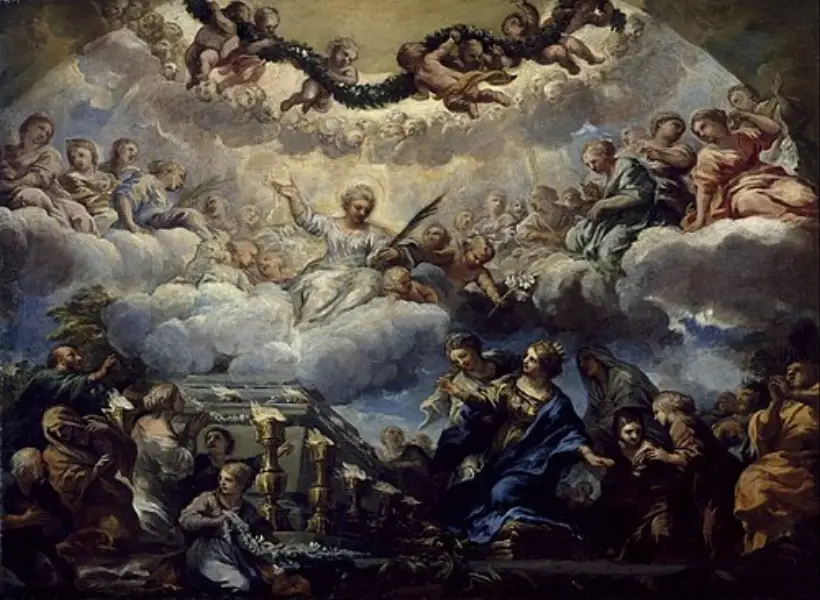
The woman the Middle Ages remembered bore little resemblance to the formidable widow of Antioch. In medieval legend, elaborated in the Golden Legend and tied to the cult of Saint Agnes of Rome, Constantina was a princess who contracted leprosy and journeyed to pray at Agnes's tomb, beside which her father had built a great basilica over the catacomb where the Roman martyr lay. There she was miraculously cured. She then took a vow of chastity, converted her betrothed Gallicanus to the Christian faith, and bequeathed her fortune to the servants John and Paul, charging them to devote it to Christian causes. The tale grew elaborate embellishments as it passed through various literary forms; as a companion figure in the life of Saint Agnes, Constantina appears on the enamelled scenes of the late fourteenth-century Royal Gold Cup now in the British Museum. An Ethiopian tradition preserves a different cure story, describing how Constantine sent his sick daughter to Abu Mena in Egypt, where she was healed and credited with discovering the body of Saint Menas, prompting her father to build a church on the spot. The origins of these legends are obscure, but their anchor is real: her burial beside the shrine of Agnes.
§ Medieval legend
The Last Journey to Bithynia
The experiment in joint rule at Antioch ended badly. Complaints from the people of the city reached Constantius II, and the emperor summoned both Gallus and Constantina to answer for their conduct. According to Ammianus, Constantina made one final play with the political skill that had defined her life: she journeyed ahead of her husband, hoping that as the emperor's sister she could soften him and pacify his quarrel with Gallus. She never arrived. At Caeni Gallicani in Bithynia, in Asia Minor, she died in 354 of a sudden high fever whose cause was unknown. She had not returned to Rome since leaving it for Syria. Her body was sent back to the city of her father and entombed in the mausoleum Constantine had begun building for her beside the Via Nomentana, adjoining the basilica of Sant'Agnese fuori le mura. There her porphyry sarcophagus, sculpted with vine scrolls around the year 340, was laid to rest; it now stands in the Museo Pio-Clementino in the Vatican. Her death spared her the sight of her husband's fall, for Gallus was soon afterward arrested and executed by the brother she had tried to appease.
§ Life
From Imperial Tomb to Saint's Shrine
Constantina was never formally canonized; her cult arose from the holiness people came to associate with her place of burial. The mausoleum her father built for her by the Via Nomentana, attached to the Constantinian basilica over the catacomb of Saint Agnes, survived the centuries largely intact even as the great basilica crumbled, and it came to be known as the church of Santa Costanza once she was venerated as a saint. Pope Alexander IV placed her relics beneath a new altar, giving papal recognition to a devotion already alive among the faithful. Her porphyry sarcophagus was eventually removed to the Vatican Museums, where it remains one of the great surviving monuments of Constantinian funerary art, while an arm reliquary of the saint is preserved at Santa Maria della Scala in Siena. In the sixteenth century her name, together with those of Attica and Artemia, was recorded for the first time in the martyrologies, fixing her feast in the western calendars. Her feast day is kept on 18 February; Attica and Artemia are honored additionally on 28 January and 17 February, and the three are commemorated together on 25 February and 25 June.
§ Cult and veneration
Two Women, One Memory
Constantina's legacy is a strange double image. The historical figure whom Ammianus Marcellinus painted as proud, bloodthirsty, and inexhaustible in fueling her husband's rage, and whom Edward Gibbon in the eighteenth century recast as one of the infernal furies tormented by an insatiable thirst for human blood, stands at one pole. At the other stands Saint Constance of the Golden Legend: the leprous princess healed at Agnes's tomb, the virgin who converted Gallicanus and endowed the servants John and Paul, whose story would later be woven into the narrative of those martyrs' own passio. Historians observe that the medieval legend stands at hopeless odds with the record of her character, yet the very distance between the two testifies to how deeply her burial site shaped Christian imagination. As a patron buried beside Agnes, her name travelled onto the enamelled scenes of the Royal Gold Cup, into martyrologies, and into parish dedications such as the church of Saint Constance that claims her as patron. Modern scholarship, from the Prosopography of the Later Roman Empire to Julia Hillner's studies, continues to sift the partisan testimony, recovering her as one of the most politically active imperial women of the fourth century.
§ Character assessment
Timeline
- 335
Married her cousin Hannibalianus, whom Constantine I had styled King of Kings and ruler of the Pontic tribes.
§ Life
- 337
Her husband Hannibalianus was executed in the purges of the imperial family that followed Constantine's death.
§ Life
- 350
Amid Magnentius's revolt, used her Augusta standing to promote Vetranio as Caesar against the usurper.
§ Political role
- 350
Magnentius proposed a marriage alliance with her; her brother Constantius II refused the offer.
§ Political role
- 351
Married Constantius Gallus, newly created Caesar of the East, and moved with him to Antioch in Syria.
§ Political role
- 354
Sent ahead by Gallus to soften Constantius II, she died of a sudden high fever at Caeni Gallicani in Bithynia.
§ Political role
- 354
Her body was returned to Rome and entombed in the mausoleum her father had begun for her near the Via Nomentana.
§ Life
In Their Own Words
her pride was swollen beyond measure; she was a Fury in mortal form, incessantly adding fuel to her husband's rage, and as thirsty for human blood as he
Gallus...had just enough strength to reply that most of them had been massacred at the insistence of his wife Constantina
The Record
- Major works
- Mausoleum of Santa Costanza at Rome, built for her by Constantine I
- Canonization
- Pre-congregation veneration; relics enshrined under a new altar by Pope Alexander IV
Prayer
Bibliography
Show 9 sources
- Ammianus Marcellinus. Res Gestae Libri XXXI.
- Ammianus Marcellinus (1986). Walter Hamilton (ed.). The later Roman Empire (A.D. 354-378). Harmondsworth: Penguin Books. ISBN 978-0-14-044406-3.
- Crawford, Peter (2016). Constantius II: Usurpers, Eunuchs, and the Antichrist. Pen & Sword. ISBN 978-1-78340-055-3.
- DiMaio, Michael (15 November 1996). "Constantina (daughter of Constantine I)". De Imperatoribus Romanis.
- Gibbon, Edward (1854). The History Of The Decline And Fall Of The Roman Empire. London: John Murray.
- Kleinhenz, Christopher (2004). "Constantina". Medieval Italy an encyclopedia. New York: Routledge. ISBN 978-0-415-93929-4.
- Jones, A. H. M.; Martindale, J. R.; Morris, J. (1971). The Prosopography of the Later Roman Empire. Cambridge University Press. p. 222. ISBN 0-521-07233-6.
- Webb, Matilda (2001). The Churches and Catacombs of Early Christian Rome. Brighton: Sussex Academic Press. p. 41. ISBN 1-902210-57-3.
- Hillner, Julia (24 May 2018). "Constantina, daughter of Constantine, wife of Gallus Caesar, and patron of St. Agnes at Rome".
Profile text adapted from the Wikipedia article, licensed CC BY-SA 4.0.
Pray with this saint every day
Save St. Constantina to your favorites, read the full profile, and get feast-day reminders in the Saints app.
Get the Saints AppFree on the App Store for iPhone and iPad