
c. 650 – 685·Feast September 3
St. Constantine IV
Byzantine emperor who defended Constantinople and healed the Church
Overview
Constantine IV, called the Younger, was Byzantine emperor from 668 to 685 and is honored as a saint in the Eastern Orthodox Church. The firstborn child of Emperor Constans II and the empress Fausta, herself a daughter of the patrician Valentinus, he was crowned co-emperor beside his father on 13 April 654 while still a child. He became sole senior emperor in September 668, when news reached Constantinople that his father had been assassinated in Syracuse, where Constans had moved his residence years before. His first task was crushing the revolt of Mizizios, the officer the Sicilian conspirators had acclaimed, which he accomplished within seven months with the support of Pope Vitalian. His reign then met the gravest threat of his age: Arab armies and fleets under the Umayyad caliph Muawiyah I converged on the capital in the war traditionally known as the First Arab Siege of Constantinople. Disease and famine broke the attackers, and Byzantium inflicted the first serious check on nearly fifty years of unbroken Arab expansion. In 680 Constantine convened the Sixth Ecumenical Council at Constantinople, presiding in person over its formal sessions, and the council's closure in September 681 ended the long monothelite controversy in the empire. For this service to orthodoxy he is venerated as a saint, with his feast on 3 September. He died of dysentery on 10 July 685 and was buried in the Church of the Holy Apostles.
The Complete Life
Born to the Purple
Constantine IV was born around 650 in Constantinople, the eldest son of Emperor Constans II and Empress Fausta, daughter of the patrician Valentinus. His exact birth year is unknown to history, but the traditional dating places it near 650. Imperial childhoods were short on privacy and long on ceremony: on 13 April 654, almost certainly at Easter, the boy was crowned co-emperor beside his father, joining the long Heraclian line that had ruled the Roman east since the days of Heraclius himself. He grew up as the empire reeled from catastrophe. Egypt, the Levant, and much of the old Roman Middle East had fallen to the Rashidun Caliphate, and Arab raiders were pressing deep into Anatolia. In 663 his father made the fateful decision to relocate the imperial residence to Syracuse in Sicily, transferring a significant portion of the army and the treasury with him and leaving the capital under Constantine's authority. This weakening of Constantinople's defenses invited the attacks that would define the son's reign. When Constans was assassinated in Syracuse on 15 July 668, reportedly by members of his own entourage, the young co-emperor inherited not only the throne but an empire besieged, a treasury drained to Sicily, and a revolt in progress.
§ Early career
The Usurper in Syracuse
The news of the Arab withdrawal from Constantinople never reached Sicily, blocked in part by a continuing naval blockade, and rumors spread that the capital had fallen. In the confusion that followed the assassination of Constans II on 15 July 668, the conspirators raised Mizizios, a senior officer stationed on the island, to the purple. The usurpation, however, never gathered real force. Mizizios won support only among parts of the local army; Pope Vitalian refused to recognize his rule; and the imperial navy under the officer Severus stayed loyal to Constantine, soon sailing back to Constantinople and restoring naval control to the legitimate emperor. By the end of 668 Constantine had reasserted his authority in the capital. With the fleet in loyal hands he could shield the capital and blunt any fresh Arab movement at sea. To secure the west, he dispatched his younger brothers and fellow emperors to Sicily with additional forces, sharing military responsibility among them. Mu'awiyah ibn Hudayj al-Kindi, the governor of Egypt, tried to exploit the succession crisis with an expedition against Sicily, raiding briefly; but when Constantine's fleet arrived, reportedly some six hundred ships strong, the Arabs withdrew without a battle. Constantine came ashore at Syracuse, took Mizizios prisoner, and had him put to death, while the surviving rebels were carried to Constantinople in chains.
§ Succession Crisis and the usurpation of Mizizios (668)
Saving Constantinople
The defining mission of Constantine's reign was the survival of his capital. As early as 668 the caliph Muawiyah I had answered an appeal from Saborios, who commanded the forces of Armenia, to assist in toppling the emperor, and despatched an army under his son Yazid that reached Chalcedon and seized Amorion. In the summer of 667 a fresh army under Fadalah ibn Ubayd al-Ansari had marched toward Constantinople while Yazid's fleet advanced by sea, the two forces blockading the city through the winter of 667 without a major assault. By spring of 668 the siege intensified and lasted into early summer, but hunger and an epidemic — smallpox by report — cut the Arab force to pieces, and Yazid drew off. A remnant held a base at Cyzicus until around 669 or 670. The assault continued by other means: Cyzicus fell in 670, Smyrna and other coastal cities in 672, and in that same year the Arabs sent a great fleet against Constantinople by sea. While the emperor was occupied, Slavic forces laid siege to Thessalonica. Modern scholarship has even re-dated the traditional First Arab Siege of 674-678 to the years 667-669, but whichever chronology holds, the outcome is the same: the Arab advance was checked, and Byzantium gradually regained the initiative, launching counteroffensives into Egypt and Syria that ended fifteen years of continuous raids.
§ The First Arab Siege of Constantinople (667–669)
Emperor of Unity
With the Arab threat temporarily broken, Constantine turned to the Church, which stood torn between the Monothelite teaching and Chalcedonian orthodoxy. In November 680 he convened the Sixth Ecumenical Council, known also as the Third Council of Constantinople. The emperor presided in person over the formal aspects of the proceedings, attending the first eleven sittings and later the eighteenth, surrounded by his court officials, yet he deliberately took no part in the theological debates themselves, leaving the bishops to their work. The assembled fathers restated the Chalcedonian teaching confirmed in 451, and with their closing the long monothelite quarrel in the Byzantine Empire was finished. Politics abetted theology: most of the remaining monothelites now lived under Umayyad rule, outside imperial borders. The council closed in September 681. For this act of gathering and guarding the Church's unity, the Orthodox Church remembers Constantine as a saint, commemorating him in the Synaxarion on 3 September under the name Constantine the New. His Chalcedonian faith was personal as well as political; his reign is a standing reminder that a ruler's highest work may be not conquest but convocation, the patient assembling of the Church to hear the truth in peace.
§ Later reign
Bulgars, Brothers, and a Weary Emperor
The final years of Constantine's reign were darker. War with the Arabs through the 670s had obliged him to make terms in the west with the Lombards, who by then held Brindisi and Taranto. In 680 the Bulgars under Khan Asparukh crossed the Danube into imperial territory and began subjugating the local communities and Slavic tribes. Constantine mounted a joint assault by land and water and pressed their stockaded camp in Dobruja under siege, but suffering from bad health he had to leave the army; the troops panicked and were routed. In 681 he had to recognize a Bulgar realm in Moesia and buy peace with tribute to spare Byzantine Thrace, responding by creating the Theme of Thrace. His brothers Heraclius and Tiberius had shared the rank of augustus with him from their father's reign, a dignity the populace itself had demanded, but in late 681 Constantine had their noses slit, a mutilation that barred them forever from the throne. Some historians argue he then associated his son Justinian II with the throne, though contemporary evidence indicates the boy succeeded only at his father's death. Dysentery carried off Constantine IV on 10 July 685, when he was about thirty-five; he was laid to rest in the Church of the Holy Apostles, the mausoleum of Byzantine emperors. By his wife Anastasia he left at least two sons, Justinian II, who succeeded at sixteen, and Heraclius, remembered through the tale of the locks of both boys' hair that their father dispatched to Pope Benedict II.
§ Later reign
The New Constantine Remembered
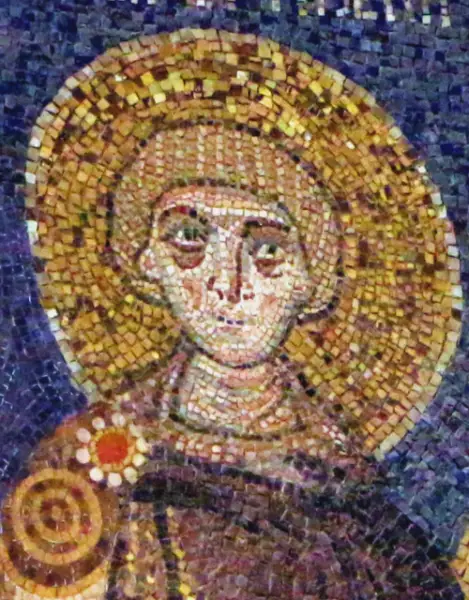
Constantine IV's afterlife in memory has been both honored and confused. Orthodoxy venerates him as Constantine the New, the Holy and Right-Believing Emperor, his feast kept on 3 September; scholars such as Venance Grumel have even examined which emperor commemorated in the Synaxarion on that day the memory belongs to, a question bound up with the tangle of Heraclian names. His own epithet drifted in the chronicles of Symeon Logothete, Kedrenos, and Zonaras, which called him the Bearded, a nickname modern scholarship following E. W. Brooks has shown to be a mistake born of confusion with his father; even the learned Constantine VII applied Pogonatus to both men on different occasions. His reign is remembered as the turning of the tide, the first serious check to nearly fifty years of uninterrupted Arab expansion and the temporary stabilization of the empire after decades of war, defeat, and civil strife. In modern popular culture he has appeared on screen and in song: the Bulgarian actor Iossif Surchadzhiev portrayed him in the 1981 film Aszparuh directed by Ludmil Staikov, and the Bulgarian heavy metal band Epizod released the song Imperator about him on their 2012 album Moyata molitva. The mosaic of him at Sant'Apollinare in Classe in Ravenna still shows the emperor standing with his family in imperial dress.
§ In art and popular culture
Timeline
- 13 Apr 654
Crowned co-emperor alongside his father Constans II, almost certainly at Easter on 13 April.
§ Early career
- 668
Arab land and sea forces under Muawiyah I reached Chalcedon and blockaded Constantinople through the winter.
§ The First Arab Siege of Constantinople (667–669)
- Sep 668
Became emperor in September after the assassination of Constans II in Syracuse; the conspirators proclaimed Mizizios emperor.
§ Succession Crisis and the usurpation of Mizizios (668)
- 669
Suppressed the Sicilian revolt within seven months of accession, executing Mizizios at Syracuse with Pope Vitalian's support.
§ Consolidation of Constantine IV's rule
- 669
His son Justinian II was born; the emperor deliberately linked the child to the legacy of the Justinian dynasty.
§ Monetary reforms and imperial propaganda
- 670
Arab forces captured Cyzicus and made it a staging point for deeper strikes against the empire's interior.
§ Early career
- 672
Smyrna and other coastal towns fell to them, and a great fleet was launched against Constantinople from the sea.
§ Early career
- 680
Led a combined land and sea campaign against the Bulgar invaders in Dobruja but fell ill and had to leave the army, which was defeated.
§ Later reign
- Nov 680
Convened the Sixth Ecumenical Council in November, presiding in person over its formal sessions.
§ Later reign
- 681
Acknowledged the Bulgar state in Moesia and paid tribute, creating the Theme of Thrace; in late 681 had his brothers Heraclius and Tiberius mutilated.
§ Later reign
- Sep 681
The Sixth Ecumenical Council closed in September, reaffirming Chalcedon and ending the monothelite controversy.
§ Later reign
- 10 Jul 685
Died of dysentery on 10 July in Constantinople and was buried in the Church of the Holy Apostles.
§ Later reign
The Record
- Major works
- Convening of the Sixth Ecumenical Council (Third Council of Constantinople), 680-681·Restoration of the heavy copper follis of Justinian I, quadrupling its weight
- Symbols
- Imperial attire
- Canonization
- Venerated in Eastern Orthodoxy as Constantine the New, Holy and Right-Believing Emperor; commemorated in the Synaxarion on 3 September
Prayer
Bibliography
Show 10 sources
- Bury, John Bagnell (1889). A History of the Later Roman Empire from Arcadius to Irene (395 A.D. to 800 A.D.). Vol. II. Macmillan and Co.
- Grierson, Philip (1962). "The Tombs and Obits of the Byzantine Emperors". Dumbarton Oaks Papers. 16. doi:10.2307/1291157.
- Grierson, Philip (1968). Catalogue of the Byzantine Coins in the Dumbarton Oaks Collection. Vol. 2. Dumbarton Oaks. ISBN 9780884020240.
- Grumel, Venance (1968). "Quel est l'empereur Constantin le nouveau commemore dans le Synaxaire au 3 septembre?". Analecta Bollandiana. 84 (1-2): 254-260. doi:10.1484/J.ABOL.4.02605.
- Jankowiak, Marek (2013). "The First Arab Siege of Constantinople". Travaux et Memoires. 17: 237-322.
- Kazhdan, Alexander, ed. (1991). Oxford Dictionary of Byzantium. Oxford University Press. ISBN 978-0-19-504652-6.
- Norwich, John Julius (1990). Byzantium: The Early Centuries. Penguin. ISBN 0-14-011447-5.
- Ostrogorsky, George (1956). History of the Byzantine State. Oxford: Basil Blackwell.
- Theophanes (1997) [c. 820]. Chronographia. Translated by Mango, Cyril. Oxford University Press. ISBN 9780198225683.
- Zuckerman, C. (1995). "A Gothia in the Hellespont in the Early Eighth Century". Byzantine and Modern Greek Studies. 19 (1): 234-242. doi:10.1179/030701395790836649.
Profile text adapted from the Wikipedia article, licensed CC BY-SA 4.0.
Pray with this saint every day
Save St. Constantine IV to your favorites, read the full profile, and get feast-day reminders in the Saints app.
Get the Saints AppFree on the App Store for iPhone and iPad