
c. 570 – 636·Feast March 11
St. Constantine of Strathclyde
Legendary king of Alt Clut who became a monk and missionary
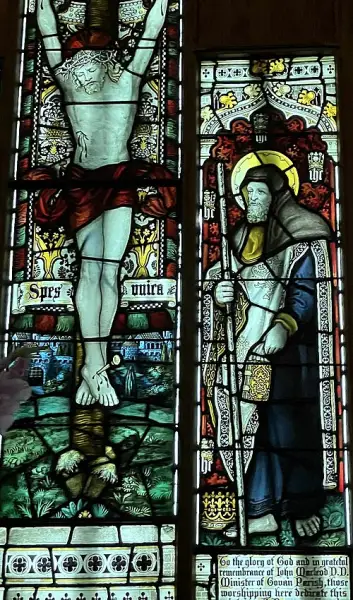
Overview
Constantine of Strathclyde is a shadowy saint-king of the early British church, reputedly the son and successor of King Riderch Hael of Alt Clut, the Brittonic kingdom later known as Strathclyde, whose stronghold stood at modern Dumbarton Rock. Jocelyn of Furness's Life of St. Kentigern makes him the son born to Riderch and his queen Languoreth; he took up his great father's kingship in turn, only to lay it down later for the clergy, and so is joined to the various dim saints of that name honored in different corners of Britain. The Great Synaxaristes of the Orthodox Church, which gives his feast as 11 March, adds that Columba brought him to the faith, that he served as a herald of the gospel through England and Ireland, and that he died near 640. No writer besides Jocelyn knows a Constantine among Riderch's sons: the Harleian genealogies and the Bonedd Gwyr y Gogledd pass him over, the pedigrees of the northern British kings, and scholars suspect the king of Jocelyn's narrative may be a literary invention devised to give a story to an early saint of the Glasgow region whose own biography had been forgotten. Yet devotion is anchored in place: the early church at Govan near Glasgow was dedicated to him, a sarcophagus there is traditionally believed to have housed his relics, and he remains recognized by the Greek Orthodox Church as Constantine of Strathclyde and Govan.
The Complete Life
Son of Riderch Hael
By the testimony of Jocelyn of Furness, writing his Life of St. Kentigern in the twelfth century, Constantine was born into the royal house of Alt Clut around the year 570, the son of King Riderch Hael and his queen Languoreth. Riderch was one of the most celebrated figures of the old north, the king of the Brittonic stronghold on Dumbarton Rock whose court figures in the early Welsh tradition of the Men of the North. To succeed such a father was a daunting inheritance, and Jocelyn's narrative has Constantine do exactly that, assuming the kingship of the kingdom later known as Strathclyde upon Riderch's death. History, however, keeps an awkward silence: no source other than Jocelyn mentions a son of Riderch named Constantine, and the prince is absent from the Harleian genealogies and from the Bonedd Gwyr y Gogledd, the medieval collections of descent for the northern British kings. Whether the Constantine of the Life is genuine royal blood or a pious fiction woven around an older cult, his legendary childhood places him at the meeting of royal power and Christian faith in sixth-century Britain, the world of Kentigern and Columba, whose disciple the later tradition declares him to have been.
§ Saint Constantine of Strathclyde
The King Who Stepped Down
The heart of Constantine's legend is a renunciation. According to the narrative tradition, he succeeded his illustrious father as king but later stepped down from the throne to become a clergyman. The Greek Orthodox accounts preserve a date: it is said that he laid down the kingship of Strathclyde in 612, embracing first the monastic habit and then the priesthood. The same tradition relates that he was guided to Christianity by Saint Columba, the great Irish abbot of Iona whose mission shaped the Christianity of the western Britons and Picts in those decades. A king turned monk was a figure the early British church honored, and Constantine of Strathclyde belongs to a wider family of obscure saints bearing the same name venerated throughout Britain, all of whom Jocelyn's story implicitly connects. The chronology is at least plausible: 612 falls within the span of Christian life at the Govan churchyard, where excavation has shown worship and burial reaching back to the fifth and sixth centuries. Whatever the truth of the abdication, the memory it preserved was of a ruler who measured kingship as a stage on the way to holiness rather than its end, and who chose the discipline of the cloister over the throne of the Britons.
§ Saint Constantine of Strathclyde
Missionary Among the Britons
The Great Synaxaristes, the great compilation of hagiographies of the Orthodox Church, includes Saint Constantine of Strathclyde with his feast day on 11 March and carries the story beyond the cloister. It states that once Columba had won him to Christ he carried the gospel through England and Ireland, spending his later years carrying the gospel that had claimed him, and that he died around 640. A missionary career among the Irish and the English would have placed him in the dense network of monastic travelers that bound Iona, Ireland, and the British kingdoms together in the seventh century, the world in which Columba's disciples moved constantly between coasts. The sources will not let us say more. Scholarly opinion is divided even about his identity: there is a Cornish Saint Constantine associated with the Dark Age kingdom of Dumnonia, a realm strikingly similar in culture and origin to the Strathclyde region, once known as the land of the Damnonii, and historians debate whether Constantine of the British kingdoms was one figure, several men popularly given the same name at birth, or a single legend fabricated in emulation of the other. Further scholarship and archaeological work would be needed to establish firmer conclusions about the missionary king.
§ Saint Constantine of Strathclyde
The Saint of Govan
Whatever the historians conclude, Constantine's cult left durable marks on the Glasgow countryside where much of Jocelyn's story is set. From early ages a Saint Constantine was honored in that region, and the old church in the burgh of Govan bore his dedication, tying his memory to the Clyde. Within Govan's ancient churchyard, where Christian use has been confirmed from the fifth and sixth centuries, stands a richly carved sarcophagus in stone, honored as the resting place of his relics, though its carving points to the ninth or tenth century. That gap does not exclude the older saint beneath it, for creating a new shrine well after a saint's death to receive his remains, or part of them, was common practice across Christendom in the medieval age of relic cults. By the twelfth century the saint's own biography had grown so obscure that Jocelyn of Furness may well have invented the story of the king of Strathclyde to give narrative flesh to the shadowy early figure. Nevertheless, St Constantine of Strathclyde and Govan is recognized by the Greek Orthodox Church, listed with his feast on 11 March, and honored alongside the many other early British saints whose lives survive only as devotion, place names, and carved stone.
§ Saint Constantine of Strathclyde
Timeline
- 570
Reputedly born around this time, son of King Riderch Hael and Queen Languoreth of Alt Clut
§ Saint Constantine of Strathclyde
- 612
Legend has him lay down the Strathclyde kingship for the monastic habit, later receiving priest's orders
§ Saint Constantine of Strathclyde
- 636
Died at Govan near Glasgow; the Great Synaxaristes instead places his death around 640
§ Saint Constantine of Strathclyde
- 900
Govan sarcophagus linked with his relics carved, its style falling between the ninth and tenth centuries
§ Saint Constantine of Strathclyde
The Record
- Canonization
- Pre-congregation; venerated in the Eastern Orthodox and Roman Catholic churches
Prayer
Bibliography
Show 3 sources
- Clarkson, Tim (Winter 1999). "Rhydderch Hael". The Heroic Age. 1 (2).
- Great Synaxaristes: "Ho Hagios Konstantinos ho basileus". 11 Martiou. Mega Synaxaristes (in Greek).
- "Icon of St. Constantine of Strathclyde, King, Monk (7th c.)". All Merciful Savior Orthodox Mission.
Profile text adapted from the Wikipedia article, licensed CC BY-SA 4.0.
Pray with this saint every day
Save St. Constantine of Strathclyde to your favorites, read the full profile, and get feast-day reminders in the Saints app.
Get the Saints AppFree on the App Store for iPhone and iPad