
272 – 337·Feast May 21
St. Constantine the Great
First Christian Roman emperor, Equal-to-the-Apostles
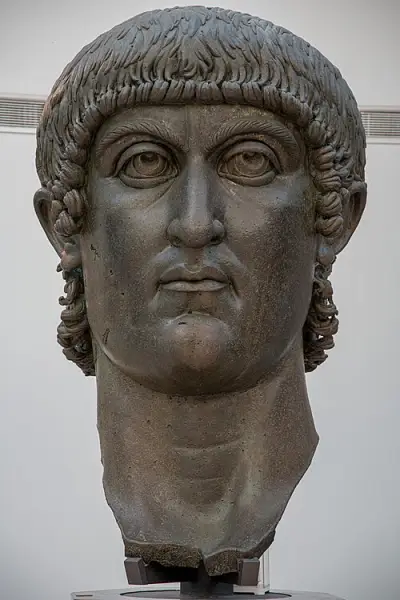
Overview
Constantine I, called the Great, reigned as Roman emperor from 306 to 337 and became the first of Rome's emperors to embrace Christianity. A native of Naissus in Moesia Superior, he was son of the officer Constantius Chlorus and of Helena, a Greek of humble origins, and was raised partly as a hostage at the court of Diocletian, where he witnessed the outbreak of the Great Persecution. Proclaimed augustus by his army at Eboracum (York) after his father's death in 306, he fought his way through the civil wars of the Tetrarchy, defeating Maxentius at the Battle of the Milvian Bridge in 312 after a vision of the cross, and Licinius at Chrysopolis in 324, becoming sole ruler of the empire. With the Edict of Milan of 313 he ended the persecution of Christians; he financed basilicas, granted privileges to the clergy, made Sunday a day of rest, and summoned the First Council of Nicaea in 325, which produced the Nicene Creed. He founded Constantinople on the site of Byzantium, dedicated in 330, which served as imperial capital for over a thousand years, and built the Church of the Holy Sepulchre in Jerusalem. A complex and ruthless ruler, he introduced the gold solidus, reformed the government and army, and died in 337 shortly after baptism at the hands of the Arian bishop Eusebius of Nicomedia. Eastern Christianity venerates him as an equal of the Apostles.
The Complete Life
The Officer's Son from Naissus
Constantine was born on 27 February 272 in the city of Naissus, in Dardania within the province of Moesia Superior, modern Niš in Serbia. His father was Flavius Constantius, an Illyrian army officer who had served in Emperor Aurelian's imperial bodyguard and rose to the governorship of Dalmatia; Helena, his mother, was a Greek of humble standing, perhaps a native of Drepanum in Bithynia, and her union with Constantius may never have been lawful. Constantius abandoned Helena around 288 or 289 to marry Theodora, stepdaughter of the emperor Maximian, and in 293 Diocletian appointed Constantius caesar in the Tetrarchy. Constantine then went to the court of Diocletian at Nicomedia, formally a hostage ensuring his father's good behavior, in practice the heir presumptive of the system. There he received an education in Latin literature, Greek, and philosophy, and mixed with intellectuals pagan and Christian, perhaps even hearing the lectures of Lactantius. He served with distinction: campaigning against barbarians on the Danube in 296, against the Persians in Syria in 297, and in Mesopotamia in 298-299, rising by some accounts to tribune of the first order. In the spring of 303 he was back at Nicomedia in time to watch the beginnings of the Great Persecution, the fiercest assault on Christians in Roman history, which his later writings insisted he had opposed but which he did nothing effectively to stop.
§ Early life
From Hostage to Augustus
When Diocletian and Maximian resigned on 1 May 305, Galerius outmaneuvered expectations: Constantius and Galerius became augusti, while Constantine and Maxentius were passed over entirely. Ancient sources tell of Galerius plotting Constantine's death, sending him into a suicidal cavalry charge through a Danube swamp, forcing him into single combat with a lion, and stalking him in hunts and wars; whatever the truth of such tales, Constantine recognized the danger of remaining a virtual hostage. In late spring 305 Constantius obtained leave for his son to join him in Britain, and Constantine fled east-west across the empire at famous speed, riding through the night and hamstringing every horse at the post-houses behind him. He joined his father at Bononia and crossed to Britain, spending a year campaigning against the Picts beyond Hadrian's Wall. When Constantius died at Eboracum on 25 July 306, he declared his support for his son's elevation, and the Alamannic king Chrocus proclaimed Constantine augustus, with the troops acclaiming him in turn. Galerius raged at the news but had to compromise, sending Constantine the traditional purple robes with the lesser title of caesar. Constantine accepted, spending his early reign securing Britain and Gaul, driving back the Franks, and building lavishly at Trier, while fashioning himself, as Eusebius put it, a renewal of his father's life and reign.
§ Emperor (306–337)
In This Sign, Conquer
The turning point of Constantine's life came in the war against Maxentius. Declaring war in 311 and vowing to avenge his father's death, Maxentius was nonetheless a hated ruler whose support was crumbling in Rome and Carthage. Constantine crossed the Cottian Alps early in the spring of 312 with about 40,000 men, ignoring the cautions of his advisers and the unfavorable omens of his soothsayers, took Segusium without looting it, shattered Maxentian cavalry at Turin, and broke the army of Ruricius Pompeianus at Verona. Rome itself he approached along the Via Flaminia as Maxentius's popularity collapsed. In Lactantius's telling, a dream bade Constantine paint the heavenly sign upon the shields of his men, the cipher of Christ, the Chi-Rho; Eusebius tells of a midday vision of a cross of light above the sun bearing the inscription In hoc signo vinces, and of Christ appearing in a dream to command a standard in the form of the labarum. On 28 October 312, at the Milvian Bridge over the Tiber, Constantine's cavalry broke Maxentius's lines; driven back against the river, Maxentius drowned in the Tiber among his fleeing men. Constantine entered Rome the next day, refused to sacrifice at the Temple of Jupiter, pardoned Maxentius's supporters, and disbanded the Praetorian Guard, while a statue of him holding the labarum proclaimed that by this sign he had freed the city from tyranny.
§ Milvian Bridge
The Emperor and the Church
Constantine's religious policy transformed the world. In February 313 he and Licinius met at Milan and agreed on the Edict of Milan, removing the penalties for professing Christianity, restoring confiscated churches and property, and protecting every religion from persecution. As sole emperor he wrote circular letters urging his subjects to become Christians, poured money into the Church, freed the clergy from a number of taxes, raised Christians to the highest offices, and raised the great basilicas: the Church of the Holy Sepulchre at the claimed tomb of Jesus in Jerusalem, and Old St. Peter's, raised over the apostle's resting place in a construction that took more than thirty years. In 321 he made venerable Sunday a day of rest, and in 323 he banned Christians from participating in state sacrifices. Disliking the instability that theological dispute brought, he summoned the First Council of Nicaea in 325, which confronted Arianism and produced the Nicene Creed, and he ruled against the Donatists in North Africa. His own conversion remained gradual and debated by scholars: over forty when he declared himself a Christian, he retained the title pontifex maximus, allowed pagan imagery on the Arch of Constantine, and waited until his deathbed for baptism, believing it would cleanse the sins his rule had entailed. His reign set the enduring precedent of imperial authority in the Church's councils.
§ Religion and religious policy
Baptism and Death
The last years of Constantine's reign joined triumph and darkness. In 326 he had his eldest son Crispus seized and killed by cold poison at Pola, and in July of that year his wife Fausta was killed in an overheated bath; their names were erased from inscriptions and Eusebius excised praise of Crispus from his works, leaving motives forever obscure, though contemporaries whispered of adultery and later writers drew on the Hippolytus-Phaedra legend. He made his sons caesars in a hereditary pattern alien to the Tetrarchy. On the frontiers he pressed eastward: his bridge at Sucidava opened the hope of reconquering Dacia, the wars of 332 against the Goths and of 334 against the Sarmatians widened Rome's reach, and by 336 he had retaken most of the long-lost province, taking the title Dacicus maximus. Planning a war against Persia that he treated as a Christian crusade, complete with bishops and a tent shaped like a church, he had asserted his patronage over Persia's Christians in a letter to King Shapur and hoped to be baptized in the Jordan before crossing the frontier. In the spring of 337 he fell ill. Making his way to the hot baths near Helenopolis, praying in the church he had built for Lucian the Martyr, he summoned the bishops to Nicomedia and received baptism from the Arian bishop Eusebius of Nicomedia, professing his desire to live united with the people of God. He died at the villa Achyron on 22 May 337, the last day of Pentecost, and was buried in the Church of the Holy Apostles in Constantinople.
§ Illness and death
Equal to the Apostles
It is above all the Eastern Christian churches that keep Constantine's memory year by year as a saint. The autocephalous Eastern Orthodox Churches and the Eastern Catholic Churches venerate him as isapostolos, an equal of the Apostles, honoring him together with his mother Saint Helena on 21 May, with liturgical propers composed for the Horologion and the Divine Liturgy; several Orthodox monasteries and shrines claim first-class relics of the emperor. The Coptic Orthodox Church keeps his memory on 28 Parmouti, the Maronite Catholic Church commemorates him with Saint Helena on 21 May, and the Armenian Apostolic Church recalls Constantine and Helena on the Tuesday following the fourth week after Pentecost, with the Armenian Catholic Church marking both on 1 July. The Lutheran churches, among them the Lutheran Church-Missouri Synod, commemorate emperor and mother as saints on 21 May as well. In the Latin Church of Catholicism Constantine has never been formally canonized, though editions of the Martyrologium Romanum up to 1956 referred to him as piissimi Imperatoris, the most pious emperor. His major shrine was the Church of the Holy Apostles in Constantinople, where his porphyry sarcophagus stood, described by Constantine VII in the tenth century; his remains survived the sack of 1204 but were destroyed at some point afterward, though a fragment of the sarcophagus survives in Istanbul.
§ Veneration as a saint
The Thirteenth Apostle's Long Shadow
Constantine's age stands as an epoch of its own, the hinge on which the classical world turned toward the Middle Ages. By replacing Diocletian's Tetrarchy with dynastic succession, leaving the empire to his sons, he reshaped Roman rulership; by founding Constantinople he gave the East a capital that stood for over a millennium. His military record was formidable: victories over the Franks and Alemanni, the Goths in 332, the Sarmatians in 334, and the reconquest of most of Dacia. Later rulers claimed his mantle constantly: ten Byzantine emperors bore the name Constantine, the Holy Roman Empire reckoned him among its venerable figures, and Charlemagne, the Habsburgs, and the Stuarts all claimed descent from him, while Geoffrey of Monmouth attached even King Arthur to his line. His reception as a saint spread through the Byzantine world in the wars against Persia and Islam of the sixth and seventh centuries. Historians have quarreled over him ever since: Julian the Apostate mocked him, Zosimus blamed him for weakening the empire, Eusebius deified him in prose, Gibbon saw a hero degenerating into a despot, Burckhardt a scheming secularist, and modern scholars from Baynes to Barnes have argued him a sincere Christian convert. In his birthplace of Niš an airport bears his name and a memorial was raised in 2012; the commemoration of the Edict of Milan was held there in 2013.
§ Assessment and legacy
Timeline
- 27 Feb 272
Born on 27 February at Naissus in Moesia Superior, son of Flavius Constantius and Helena
§ Early life
- 293
His father was named caesar in the Tetrarchy, and Constantine went to Diocletian's court at Nicomedia
§ Early life
- 303
Witnessed the opening of Diocletian's Great Persecution of Christians at Nicomedia
§ In the East
- 305
Joined his father in Gaul and Britain, campaigning with him against the Picts beyond Hadrian's Wall
§ In the West
- 25 Jul 306
Proclaimed augustus by the army at Eboracum (York) on 25 July after Constantius died; Galerius allowed him only the title caesar
§ In the West
- 307
Married Fausta, daughter of Maximian, at Trier
§ Maxentius's rebellion
- Jul 310
Crushed Maximian's rebellion at Massilia; the elder emperor hanged himself in July
§ Maximian's rebellion
- 28 Oct 312
Defeated Maxentius at the Battle of the Milvian Bridge on 28 October after a vision of the cross
§ Milvian Bridge
- Feb 313
Met Licinius at Milan and issued the Edict of Milan, granting tolerance to Christianity and restoring confiscated property
§ Religion and religious policy
- 317
Settled with Licinius after the battles of Cibalae and Mardia; their sons were named caesars
§ Religion and religious policy
- 321
Ordered that Sunday, the venerable day of the sun, be kept as a day of rest throughout the empire
§ Religion and religious policy
- 18 Sep 324
Defeated Licinius at Adrianople, the Hellespont, and Chrysopolis on 18 September, becoming sole ruler
§ Wars against Licinius
- 325
Summoned the First Council of Nicaea, which produced the Nicene Creed and condemned Arianism
§ Religion and religious policy
- 326
Ordered the execution of his eldest son Crispus at Pola and of his wife Fausta
§ Executions of Crispus and Fausta
- 11 May 330
Dedicated Constantinople, the New Rome, on 11 May, issuing commemorative coins for the founding
§ Foundation of Constantinople
- 332
Campaigned with the Sarmatians against the Goths, who submitted to Rome
§ Later campaigns
- 334
Campaigned against the Sarmatians once their common people had deposed their rulers; victorious, he widened his authority over the region
§ Later campaigns
- 337
Baptised on his deathbed by Eusebius of Nicomedia
§ Illness and death
- 22 May 337
Died at the villa Achyron near Nicomedia on the last day of Pentecost
§ Illness and death
In Their Own Words
In hoc signo vinces
it was proper that the Christians and all others should have liberty to follow that mode of religion which to each of them appeared best
This is certainly the Will of the Supreme God, who is the Author of this world and its Father, ... that the whole human race should agree together and be joined in a certain affectionate union by, as it were, a mutual embrace
By keeping the Divine faith, I am made a partaker of the light of truth: guided by the light of truth, I advance in the knowledge of the Divine faith.
I cannot, then, my brother believe that I err in acknowledging this one God, the author and parent of all things
The Record
- Major works
- Edict of Milan (313), with Licinius·First Council of Nicaea (325)·Founding of Constantinople (330)·Church of the Holy Sepulchre, Jerusalem·Old St. Peter's Basilica, Rome·Introduction of the gold solidus
- Symbols
- Labarum·Chi-Rho·Imperial robes with model of Constantinople
- Canonization
- Venerated as Equal-to-the-Apostles in Eastern Christianity; feast of 21 May kept with St. Helena; not formally canonized in the Latin Church
Prayer
Bibliography
Show 8 sources
- Barnes, Timothy D. Constantine and Eusebius (1981).
- Baynes, Norman H. Constantine the Great and the Christian Church (1929).
- Burckhardt, Jacob. The Age of Constantine the Great (1853, revised 1880).
- Elliott, T. G. The Christianity of Constantine the Great (1996).
- Eusebius. Vita Constantini (Life of Constantine), written between 335 and 339.
- Lactantius. De mortibus persecutorum.
- Odahl, Charles Matson. Constantine and the Christian Empire (2004).
- Veyne, Paul. Quand notre monde est devenu chretien (2007).
Profile text adapted from the Wikipedia article, licensed CC BY-SA 4.0.
Pray with this saint every day
Save St. Constantine the Great to your favorites, read the full profile, and get feast-day reminders in the Saints app.
Get the Saints AppFree on the App Store for iPhone and iPad