
died c. 170·Feast January 29
St. Constantius of Perugia
Martyr and First Bishop of Perugia
Overview
Constantius of Perugia, honored as one of the patron saints of Perugia, was a martyr of the Antonine persecutions who died around the year 170. His legend survives in four versions, all of which agree that he was arrested for the faith, whipped, and forced into a burning stove with his companions, from which all emerged unharmed. Jailed afterward, he converted his own guards, who set him free; he took refuge in the house of a Christian named Anastasius, was arrested again, tortured in the prisons of Assisi and Spello, and finally beheaded near Foligno. Local tradition remembers him as the first bishop of Perugia, consecrated at the age of thirty, an active evangelist and a protector of the poor. His cult spread well beyond Umbria, and his name appears in the Martyrologium Hieronymianum under January 29. Tradition says the faithful brought his body home and laid it to rest close to where the cathedral of Perugia stands today; in 1825 his remains were transferred amid solemn rites to the church of San Costanzo, where they remain the focus of the city's devotion on his feast day.
The Complete Life
A Young Leader in a Persecuted City
The historical record on Constantius is thin, and what Perugia knows of him comes chiefly from legend. Four versions of his passio existed, and from them a portrait emerges of a young Christian leader in the city during the reign of Antoninus - some sources say Marcus Aurelius - when professing the faith carried a death sentence. Local tradition goes further and claims him as the first bishop of Perugia, stating that he accepted the office at the age of thirty. Whether or not the episcopal claim can be verified, the same tradition describes the shape of his ministry: he was active in evangelism, preaching the Christian message in a city still steeped in older worship, and he was known for his care of the poor, making the charity of the church concrete for its most vulnerable members. By these accounts Constantius was not a passive victim who happened to be arrested but a recognized leader whose preaching and service had made him conspicuous. It was precisely this visibility, the legends imply, that brought him to the attention of the authorities when the persecutions reached Umbria.
§ Legend
Fire, Prison, and the Sword
The account of his martyrdom, consistent across the four versions of his legend, reads as a chain of interventions that death could not close. Arrested during the persecutions, Constantius was first whipped, then forced into a stove together with his companions; all of them came out unharmed, a deliverance his narrators attributed to divine protection. Thrown into prison, he did not wait passively for the end: he preached to his own guards and converted them to Christianity, and they set him free. He found shelter in the house of a Christian named Anastasius, but the reprieve was brief. Arrested a second time, together with Anastasius, he was subjected to torture in the prisons of Assisi and of Spello, and was finally decapitated near Foligno. All four versions of the legend agree on the place of his death, which gave Foligno a lasting connection with the saint. The narrative then follows his body: the faithful brought it home to Perugia and interred it close to where the cathedral now stands, so that the man who had led the city's church in life was laid to rest at its heart in death.
§ Legend
Patron of a City
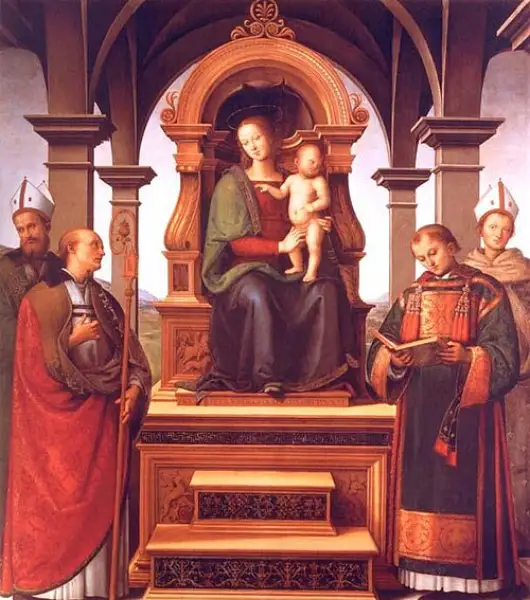
Constantius remained one of the principal holy figures of Perugia, remembered alongside Herculanus as a patron of the city. His cult was diffused beyond Umbria at an early date, and the Martyrologium Hieronymianum listed him under the feast day of January 29, which remains his feast. A church stood in his honor in Perugia until it was demolished in 1527. The most tangible expression of his cult is the translation of his relics: in 1825 they were moved with great solemnity to a new altar in the present-day church of San Costanzo, where they are venerated still. The feast has a taste as well as a liturgy. On January 29 the people of Perugia eat torcolo, a ring-shaped cake made with pine nuts, raisins, and dried fruit, a custom that binds the saint to the domestic calendar of the city. Art has kept his image in circulation as well: Pietro Perugino placed him among the saints flanking the Virgin and Child in a work of 1497, and he is generally represented as a bishop in mitre and robe bearing a crozier, frequently in the company of Sant'Ercolano, Perugia's other patron.
§ Veneration
Timeline
- 170
Beheaded near Foligno during the persecutions under Antoninus, or Marcus Aurelius in some sources, after torture at Assisi and Spello
§ Legend
- 1497
Pietro Perugino portrayed Constantius among the saints flanking the Virgin and Child
§ Introduction
- 1527
The Perugian church dedicated to Constantius was demolished
§ Veneration
- 1825
His relics were translated with great solemnity to a new altar in the church of San Costanzo
§ Veneration
The Record
- Patron of
- Perugia
- Symbols
- episcopal attire
- Canonization
- Pre-congregation martyr; listed in the Martyrologium Hieronymianum under January 29
Prayer
Bibliography
Show 5 sources
- Patron Saints at Catholic-Forum.com
- The Book of Saints: A dictionary of persons canonized or beatified by the Catholic Church. Benedictine Monks of St. Augustine Abbey, Ramsgate. NY: Thomas Y. Crowell, 1966
- Solberg, Gail E. "A Reconstruction of Taddeo di Bartolo's Altarpiece for San Francesco al Prato, Perugia". The Burlington Magazine, Vol. 134, No. 1075 (October 1992), pp. 646-656
- Umbria Best Gastronomy
- "San Costanzo di Perugia" (in Italian)
Profile text adapted from the Wikipedia article, licensed CC BY-SA 4.0.
Pray with this saint every day
Save St. Constantius of Perugia to your favorites, read the full profile, and get feast-day reminders in the Saints app.
Get the Saints AppFree on the App Store for iPhone and iPad