
died c. 286·Feast September 18
St. Constantius of the Theban Legion
Legendary Theban soldier-martyr and patron of Villar San Costanzo
Overview
Constantius, known in Italian as San Costanzo, receives veneration as one of the fabled Theban Legion, the wholly Christian corps said to have been martyred in the Alpine passes at the end of the third century. According to tradition he was of Egyptian birth and survived the decimation of his legion, fleeing with other survivors into the Val Maira in what is now the province of Cuneo, Italy. His fellow survivors — Constantine and Dalmatius, Desiderius and Isidore, Magnus, Olympius and Pontius, Theodore, lastly Victor — gave themselves to preaching the Christian faith, and the Roman power soon killed them all; Constantius alone remained, and it fell to him to bury his fellow martyrs. The local landscape preserved the memory of his flight in stone: the strange erosion columns called the Ciciu del Villar were explained as the troops Rome had dispatched for his execution, turned to stone by a miracle before they could do him harm. Constantius was eventually beheaded, by tradition on Monte San Bernardo, where a sanctuary in his honor, San Costanzo al Monte, was built, probably in Lombard times, its stone church completed in 1190. His cult became popular, drawing an annual pilgrimage to Villar, and in 1516 the bishop of Saluzzo declared Constantius co-patron of the diocese alongside Chiaffredo. His Egyptian origin, inherited from the Theban legend, brought him veneration in the Coptic Church as well.
The Complete Life
A Soldier of the Theban Legion
Constantius belongs to the great cycle of Alpine soldier-saints gathered around the legend of the Theban Legion, the corps of Christian soldiers from Egypt said to have been executed for refusing to persecute the church. Like Chiaffredo at Crissolo, Bessus in Val Soana, Tegulus at Ivrea, Magnus of Castelmagno and Dalmatius of Borgo San Dalmazzo, Constantius was joined to the Legion's story so that age might be lent to a local holy man of whom almost nothing was remembered; students of these cults describe the mechanism without embarrassment, and Constantius's Egyptian birth derives entirely from his supposed membership in the Theban Legion. Whatever the history, the tradition gives him a vivid story. By it, Constantius was a soldier of the Legion who survived the decimation, the execution by lots that destroyed his comrades, and fled with other survivors into the Val Maira, the valley that today lies in the province of Cuneo in the Italian Alps. His name in Italian, San Costanzo, is fixed in the very landscape of the valley, in the village of Villar San Costanzo and the mountain sanctuary that still keeps his feast on 18 September.
§ Saint Constantius and Companions
Preacher and Gravedigger of Martyrs
In the Val Maira, tradition says, Constantius and his fellow survivors took up a new mission: they set themselves to proclaiming the Christian faith through the valleys of the western Alps. In their number went Constantine and Dalmatius, Desiderius and Isidore, Magnus, Olympius and Pontius, Theodore, lastly Victor — names that echo across the dedications of the Alpine churches. The mission was short and bloody. Every one of them but Constantius was soon put to death by the Roman power, and Constantius was left alone, the last of the Theban band in the valley. It was he who buried his companions, and the act defines his legend: the soldier who escaped the sword of the empire only to take up the spade and give his comrades honorable graves. The landscape of Villar San Costanzo still tells the story in stone. The geologic formation known as the Ciciu del Villar, columns formed by natural erosion, was bound to Constantius's legend by local devotion: the pillars are, in the tale, the very soldiers Rome sent against the saint, frozen into rock by miracle before they could touch him. Earth, in this tale, refused to lend itself to the martyr's executioners, and the valley's strange pillars became a standing monument to the failed persecution.
§ Saint Constantius and Companions
Martyrdom on Monte San Bernardo
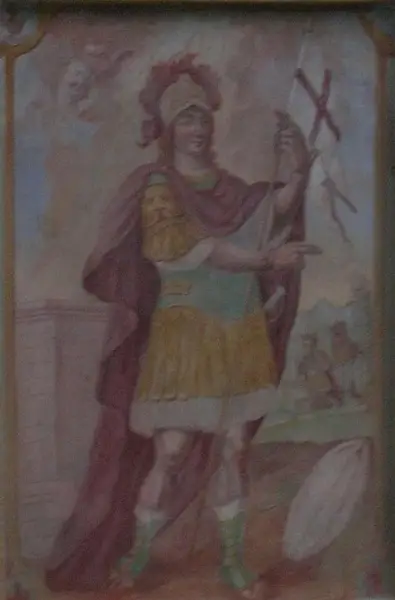
Tradition relates that the blade finally fell on Monte San Bernardo, the hill rising above Villar San Costanzo where his pursuers at last ran down the Legion's last survivor. There his sanctuary was raised, the church called San Costanzo al Monte, whose facade of the twelfth century still shows the soldier-saint. The sanctuary probably dates to Lombard times, and some eighth-century sculptures remain from its earliest fabric; later generations rebuilt and reshaped it; the stone church reached completion in 1190, and a Baroque facade came still later. Villar's other church, the Benedictine abbey of Santi Vittore e Costanzo, keeps notable archaeological remains, among them a marble slab marked with vermilion symbols, polished smooth where the hands of pilgrims have touched it across the centuries. In art Constantius appears as a soldier whose banner carries the Mauritian Cross beside the martyr's palm, and, recalling his final service to his companions, a spade. The date of his heavenly birthday is kept as 18 September, the day of his feast in the diocese whose patron he became.
§ Saint Constantius and Companions
Patron of the Val Maira and the Coptic Church
Constantius's cult became popular in the valley of his martyrdom, and a pilgrimage of the faithful to Villar takes place every year, keeping alive a devotion that has outlived the empire that killed him. In 1516, at a synod of his diocese, Bishop Tornabuoni of Saluzzo named Chiaffredo its patron and gave Constantius the standing of co-patron, formally binding the two Theban saints to the ecclesiastical life of the region; the cathedral altar at Saluzzo holds statues of the two saints together. His tie to the Theban Legion gives him an Egyptian birthplace in the tradition, and on that account the Coptic Church numbers him among those it venerates, which numbers him among its martyrs alongside Maurice and the rest of the Legion. He belongs to a family of Alpine cults, with Chiaffredo, Bessus, Tegulus, Magnus, and Dalmatius, that grew up around the Theban legend to give the valleys of Piedmont their own soldiers of Christ, saints whose antiquity was borrowed but whose hold on local devotion was entirely real. The sanctuary of San Costanzo al Monte, with its eighth-century sculptures, its 1190 stone church, and its Baroque facade, remains the center of his feast on 18 September.
§ Saint Constantius and Companions
Timeline
- 286
Tradition has him beheaded on Monte San Bernardo after surviving the decimation of the Theban Legion and burying his companions
§ Saint Constantius and Companions
- 700
Sanctuary of San Costanzo al Monte probably founded in Lombard times; eighth-century sculptures survive
§ Saint Constantius and Companions
- 1190
Stone church of the sanctuary completed; a Baroque facade followed in later centuries
§ Saint Constantius and Companions
- 1516
Bishop Tornabuoni of Saluzzo named Chiaffredo diocesan patron at a synod, with Constantius as co-patron
§ Saint Constantius and Companions
The Record
- Major works
- Burial of his companion martyrs in the Val Maira·Preaching of the Christian faith among the Alpine valleys
- Patron of
- Patron of Villar San Costanzo·Patron of the diocese of Saluzzo (with Chiaffredo)
- Symbols
- Soldier bearing a banner with the Mauritian Cross·Palm of martyrdom·Spade
- Canonization
- Pre-congregation; venerated from antiquity in the Roman Catholic and Coptic churches
Prayer
Bibliography
Show 3 sources
- Arduino, Fabio (October 27, 2005). "San Costanzo e compagni". Santi e Beati. Retrieved December 28, 2008.
- Pomi, Damiano (July 16, 2004). "San Magno". Santi e Beati. Retrieved December 28, 2008.
- "San Chiaffredo di Saluzzo su santiebeati.it". Santiebeati.it. Retrieved 2018-03-17.
Profile text adapted from the Wikipedia article, licensed CC BY-SA 4.0.
Pray with this saint every day
Save St. Constantius of the Theban Legion to your favorites, read the full profile, and get feast-day reminders in the Saints app.
Get the Saints AppFree on the App Store for iPhone and iPad