
c. 480 - died 513·Feast January 19
St. Contentius
Sixth-Century Bishop of Bayeux and Hermit of Blay
Overview
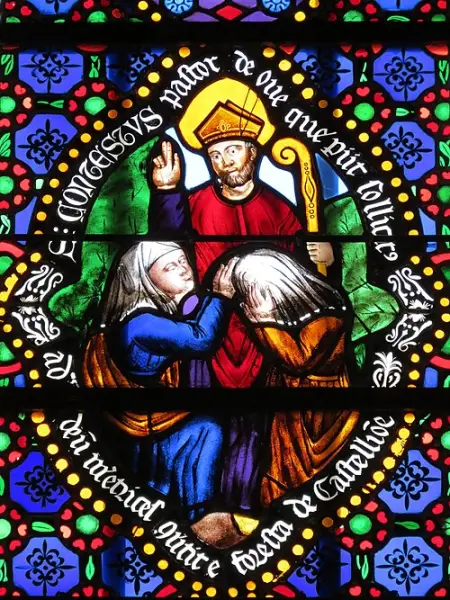
Contentius led the diocese of Bayeux from 480 until he died, and is venerated as a saint in both the Catholic and Orthodox churches. A native of the Bayeux region according to Father Elie, he first served God as a hermit at Blay, near the city, where his reputation for holiness drew a steady stream of pilgrims seeking spiritual comfort. The inhabitants of the area pressed him into a wider sphere, arranging his election as bishop to succeed Saint Manvieu. As bishop he campaigned against the idolatry that still persisted in the countryside and against the nobles who profited from it, and several miracles were attributed to him, among them the bringing of water from dry ground at Athis-de-l'Orne to refresh his companions on the way to Sees. He died in 513. His remains, first buried in the church of Saint-Exupere, were translated to the Benedictine abbey of Fécamp in 1162, were later moved on to Argentan, and in 1896 his right femur was installed with great ceremony in the church of Saint-Contest, whose name still marks the map of Normandy.
The Complete Life
The Hermit of Blay
The earliest biographical notice about Contentius comes from Father Elie, who records that he was Bayeusain - a native of the Bayeux country - and that his first formal commitment to God took the shape of the eremitical life. His hermitage stood at Blay, close to Bayeux, in the countryside of Normandy that had only recently and imperfectly been Christianized. There he lived a life of prayer and austerity that gradually became publicly known. His reputation for holiness acted like a magnet: pilgrims began to arrive at Blay in numbers, seeking spiritual comfort, counsel, and intercession from the solitary. For a hermit such attention was a trial as much as an honor, since the eremitical vocation depends on withdrawal, while holiness inevitably draws the world toward the man who embodies it. The sources do not record his family, his education, or the year of his birth; what they preserve is the impression he made on those who came to him. By the time the episcopal see of Bayeux fell vacant, Contentius was already recognized across the region as a man of God whose word could be trusted and whose prayers were sought by the ordinary faithful.
§ Biography
Chosen to Succeed Manvieu
Contentius did not seek the episcopate; the Christians of the region sought it for him. When the see of Bayeux became vacant on the death of Saint Manvieu, the inhabitants prevailed upon Contentius to accept election as Manvieu's successor, transferring the holy hermit of Blay from the wilderness to the cathedral city. The choice joined two streams of Normandy's Christian beginnings: the ascetic witness of the hermits and the ordered ministry of the diocesan bishop. As bishop, Contentius took up the unfinished work of converting the countryside. The tradition records that as bishop he battled the idolatry that endured in the region, and no less the nobles who traded in it - a phrase that suggests the old cults were not merely lingering but were being sustained by powerful interests that profited from them. A bishop who confronted idolatry in general might be tolerated; a bishop who confronted the aristocrats who sponsored it made enemies of the strong. Contentius's episcopate thus took the shape of a long, unglamorous campaign to complete, community by community, the Christianization of his diocese, armed with the authority of his office and the credibility of his ascetic reputation.
§ Biography
Water from Dry Ground
The tradition attributes several miracles to Contentius, of which the most beloved took place on the road. Journeying toward Sees, the bishop and his companions found themselves at Athis-de-l'Orne without water, and Contentius brought water out of the ground to quench their thirst - an act that linked him to the long line of desert saints whose prayer opened springs in dry places, and that localized the miracle in the landscape of Normandy. A bishop refreshing his traveling companions echoed the Gospel promise that whoever gives a cup of water to the thirsty serves Christ himself, and it made the saint a familiar figure to a rural people for whom wells, springs, and fountains marked the geography of daily life. Beyond the miraculous, his missionary record is the one the sources stress under his episcopal office: the patient suppression of idolatry in a region where the old religion still had adherents, and the confrontation with those nobles who drew profit from maintaining it. Such work demanded persistence as much as charisma - instruction, confrontation, and example - but the tradition remembers it as spiritual combat, and the spring at Athis-de-l'Orne became the sign that God stood with the combatant.
§ Biography
A Name on the Map of Normandy
Contentius died in 513, after some three decades governing the see of Bayeux. He was first buried in the church of Saint-Exupere, but his cult grew with the centuries, and his remains became part of Normandy's sacred geography. In 1162 they were translated to the Benedictine abbey of Fécamp, one of the great monasteries of the duchy. Later they were transported to Argentan, where they escaped destruction at the hands of the Huguenots in 1562, a survival that the devout read as providential. Devotion continued into the modern era: in 1896 the translation of the saint's right femur to the church of Saint-Contest was carried out with a great ceremony, nearly fourteen centuries after his death. His name remains fixed in the map of Normandy. One municipality of the Caen urban area bears the name Saint-Contest, while the town of Contest in Mayenne carries it as well - rare and tangible evidence that the memory of a sixth-century bishop of Bayeux stayed alive in the very places where he had lived, fought idolatry, and been honored after his death, sustained by parish life, pilgrimage, and the quiet persistence of local devotion.
§ Biography
Timeline
- 480
Leaves his hermitage at Blay to take up the bishopric of Bayeux as successor of Saint Manvieu.
§ Biography
- 513
Dies after decades shepherding Bayeux, and is laid to rest in the church of Saint-Exupere.
§ Biography
- 1162
His remains are translated to the Benedictine abbey of Fécamp, one of the great monasteries of Normandy.
§ Biography
- 1562
His relics, kept at Argentan by then, escape destruction at Huguenot hands.
§ Biography
- 1896
His right femur is installed in the church of Saint-Contest amid a great ceremony.
§ Biography
The Record
- Canonization
- Pre-congregation; venerated as a saint in the Catholic and Orthodox churches
Prayer
Bibliography
Show 5 sources
- Patron Saints Index: Saint Contentius (archived 2008-10-14 at the Wayback Machine)
- Bunson, Matthew and Stephen. Our Sunday Visitor's Encyclopedia of Saints (2003), p. 223
- Latin Saints of the Orthodox Patriarchate of Rome
- Histoire de la paroisse de saint Contest (1895)
- Miquel-Regnauld, Manoelle. Les saints normands. Éditions Charles Corlet, 2003. ISBN 2-84706-017-0
Profile text adapted from the Wikipedia article, licensed CC BY-SA 4.0.
Pray with this saint every day
Save St. Contentius to your favorites, read the full profile, and get feast-day reminders in the Saints app.
Get the Saints AppFree on the App Store for iPhone and iPad