
late 12th century – first half of the 13th century·Feast June 3
St. Conus
Benedictine monk of Cadossa, patron of Teggiano
Overview
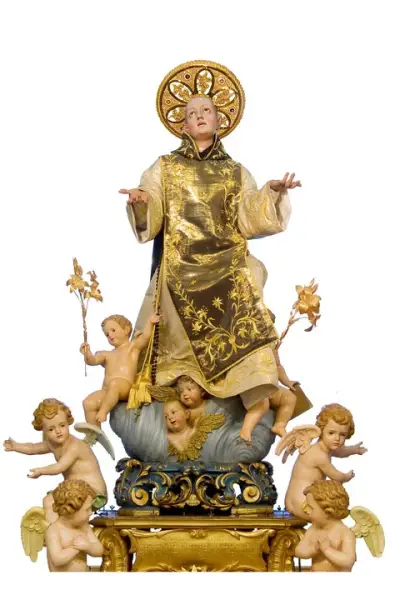
Conus, known in Italian as San Cono, was a Benedictine monk of the late twelfth and early thirteenth centuries, born at Diano in southern Italy and dead before middle age, whose short life left a cult that has spread across two continents. He entered the Benedictine monastery of Santa Maria di Cadossa, near Montesano sulla Marcellana, the house whose site is now occupied by the sanctuary of St. Cono, and there he pursued the ordinary, demanding discipline of Benedictine life. Death overtook him while he was still young, in the first years of the thirteenth century, yet his reputation for holiness already stood fixed among his brethren and neighbors. When the Cadossa monastery was closed, his relics were brought back in 1261 to Diano, his native city, which had already claimed him as its patron and where his veneration has continued unbroken. The church confirmed what the people had long held when Pope Pius IX canonized him on April 27, 1871, fixing his feast on June 3. As patron of Teggiano, he is honored with celebrations not only in his native Campania but among migrant communities in Florida in Uruguay, Buenos Aires, Brooklyn, San Mauro Pascoli, and San Cono di Cessaniti.
The Complete Life
The Young Monk of Santa Maria di Cadossa
Conus was born at Diano, a town in the mountains of southern Italy's Campania, at the end of the twelfth century, and while still a young man he left the world for the Benedictine cloister. The house that received him was the monastery of Santa Maria di Cadossa, set near Montesano sulla Marcellana in the high country above the Diano valley. There he took up the round of prayer, work, and obedience that Benedict's rule prescribes, and there, without leaving the cloister, he accomplished everything for which the church would later honor him. He died very young, in the first half of the thirteenth century, and it was precisely the brevity of his life that made his sanctity conspicuous: a monk who had scarcely reached manhood, and who had held no office, founded nothing, and written nothing, was acknowledged by all who knew him to have possessed the holiness that the rest of Christendom spends a lifetime pursuing. The monastery where he had lived was eventually closed, but the site of Santa Maria di Cadossa was not forgotten; it became the sanctuary of St. Cono, and pilgrims from the Vallo di Diano still climb to it in memory of the young religious who died there in the odor of sanctity.
§ Saint Conus
Patron of Teggiano and of a Scattered People
When the Cadossa monastery was suppressed, the monk's body was not left in the abandoned hills: in 1261 his relics were translated to Diano, his birthplace, and the city received him as its own. There his cult took root and has never ceased, and the neighboring town of Teggiano likewise honors him as its principal patron. The veneration of the local saint proved so durable that the Apostolic See confirmed it formally: on April 27, 1871, Pope Pius IX canonized Conus, and his feast was assigned to June 3. The celebration of his memory has since traveled farther than any medieval devotion could have foreseen. Emigrants from the Vallo di Diano carried the cult of San Cono across the Atlantic, and in honor of him festivities are held in Florida, a town in Uruguay; in Buenos Aires; in Brooklyn; in San Mauro Pascoli; and at San Cono di Cessaniti in Sicily, whose very name proclaims its devotion. The young monk who never left his cloister thus finds himself venerated on two continents, the patron of a scattered people who remember in him the valley and the faith they carried with them across the sea.
§ Saint Conus
Timeline
- 1261
After the Cadossa monastery was closed, Conus' relics were returned to his native Diano, where he was venerated as patron.
§ Saint Conus
- 27 Apr 1871
Pope Pius IX canonized Conus, confirming the ancient veneration of the monk of Cadossa.
§ Saint Conus
The Record
- Major works
- the sanctuary of St. Cono on the site of the Cadossa monastery
- Patron of
- patron of Teggiano, Italy·patron of Diano
- Symbols
- Benedictine habit
- Canonization
- Canonized on April 27, 1871 by Pope Pius IX
Prayer
Bibliography
Show 1 sources
- "Saint Cono yearly celebration", Italia.it
Profile text adapted from the Wikipedia article, licensed CC BY-SA 4.0.
Pray with this saint every day
Save St. Conus to your favorites, read the full profile, and get feast-day reminders in the Saints app.
Get the Saints AppFree on the App Store for iPhone and iPad