
c. 570 – c. 630·Feast September 28
St. Conval
Irish Missionary of Strathclyde and the Inchinnan Stone
Overview
Conval, whose name survives in Scotland as Conwall, was an Irish-born missionary of the late sixth and early seventh centuries who labored in the British kingdom of Strathclyde. Tradition, preserved in the Aberdeen Breviary, tells that while he prayed on a seashore asking to be carried across the waters, the very stone beneath his feet bore him miraculously over the Irish Sea to Inchinnan, the Renfrewshire settlement that became the heart of his cult. In Scotland he is remembered as a church-founder: foundations at Inchinnan, Pollokshaws, and Fereneze near Barrhead carry his memory, and holy wells bearing his name flowed at Barrhead and Thornliebank. A medieval tradition made him a disciple of Saint Kentigern in Glasgow, though modern historians suspect that link was crafted by twelfth-century bishops seeking authority over the Inchinnan church. His relics rested in a carved sarcophagus at Inchinnan, where a church stood under his patronage from the age of David I until modern times. He died around 630, and his feast is kept on 28 September.
The Complete Life
A Stone Across the Sea
The story of Conval's crossing from Ireland to Scotland is one of the strangest and most beloved wonders in the Aberdeen Breviary's collection. As the account tells it, the young missionary stood on the shore of his native land and poured out a single petition: that he might be carried, by whatever means God chose, to the lands waiting beyond the sea. In answer, the stone on which he stood lifted from the beach and bore him across the Irish Sea, setting him down at Inchinnan in Renfrewshire. Whatever the historical kernel of the tale, it bound the saint's name forever to that crossing place, and the stone itself became an object of devotion. A later tradition, recorded in the same Breviary, made Conval a disciple of Saint Kentigern at Glasgow, numbering him among the holy men who surrounded the apostle of the Britons. The historian Tim Clarkson cautions that this connection may have been an invention of twelfth-century churchmen, who wished to draw the flourishing church at Inchinnan under the jurisdiction of the Glasgow bishops. If so, the claim says as much about the power of Conval's cult as it does about medieval politics: a church worth claiming was a church whose founder was remembered.
§ Saint Conval
Churches and Wells of Renfrewshire
Conval worked as a missionary in the kingdom of Strathclyde, in the country now known as East Renfrewshire, and the landscape itself preserved the memory of his passage. Three churches were believed to rest on foundations he laid: the church at Inchinnan on the banks of the Clyde, a church at Pollokshaws, and another at Fereneze near Barrhead. Springs dedicated to him rose at Barrhead and Thornliebank, the so-called Conval wells, which kept his name in the speech of local people long after the circumstances of his ministry had faded. In an age when holy men planted the faith less by written word than by presence, settlement, and prayer, such a network of foundations and wells marks Conval as a genuine worker in the Strathclyde mission field. He belonged to the generation that carried Christianity through the British-speaking realms between Ireland and the Pictish north, and his choice of Inchinnan, a place of meeting between Irish sea-routes and the Clyde, gave his communities a lasting importance. When he died, around the year 630, his people did not let him go: his bones were gathered with honor and laid in a sarcophagus of impressive craftsmanship at the Inchinnan church, where they remained the center of his cult for centuries.
§ Saint Conval
The Chariot Stone and the Vanished Church
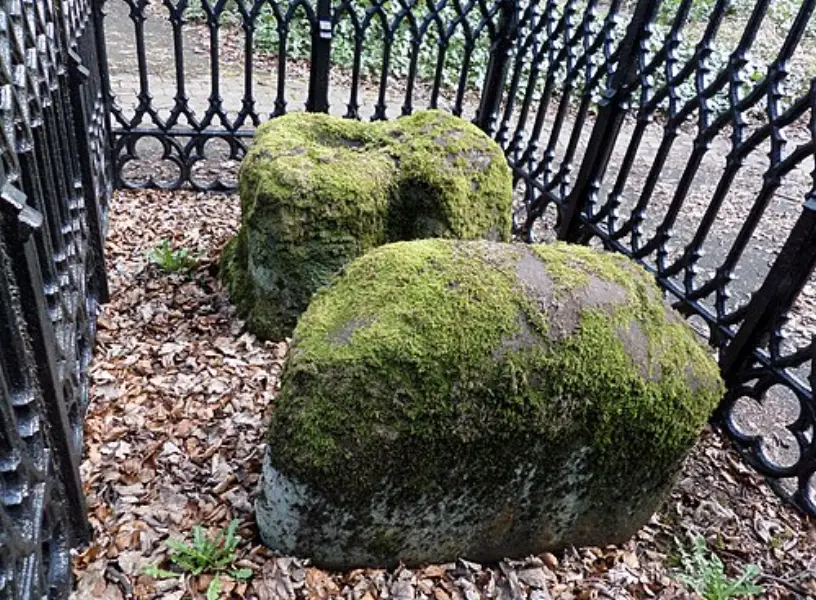
Conval's cult at Inchinnan proved durable enough to attract royal patronage. In the twelfth century King David I of Scotland granted the Knights Templar a church at Inchinnan dedicated to the saint, and a church stood on or near the site through the following centuries, until it was replaced by Hallows Church in 1900 and that in turn was demolished in 1965, when the runway extensions of Abbotsinch airfield swallowed the ground to make Glasgow Airport. Yet the oldest memorial survived the endings. Near the bridge at Inchinnan, sheltered by a cast-iron enclosure, stands a stone believed to be the footing of an early Christian cross, called for centuries St Conval's Chariot: the very stone, tradition says, that carried the saint from Ireland. Pilgrims once drank water gathered in a hollow of its surface, trusting in its healing power, and a neighboring stone was reckoned the pediment of the cross it once supported. Behind it lies the Argyll Stone, another fragment of the sacred geography that grew up around the crossing legend. Whatever the future of the airfield around them, these stones keep alive the memory of a missionary whose whole journey began with a prayer on a distant shore.
§ Saint Conval
Timeline
- 570
Born in Ireland around this year.
§ Saint Conval
- 630
Died in Scotland at about sixty years of age; traditionally buried at Inchinnan.
§ Saint Conval
- 1900
The medieval church of Inchinnan dedicated to him was replaced by Hallows Church.
§ Saint Conval
- 1965
Hallows Church was demolished to allow Abbotsinch airfield to be extended into Glasgow Airport.
§ Saint Conval
In Their Own Words
to be borne, by whatsoever means, to the regions beyond the sea
The Record
- Major works
- Church at Inchinnan·Church at Pollokshaws·Church at Fereneze, near Barrhead
- Symbols
- St Conval's Chariot, the stone of his sea-crossing
- Canonization
- Pre-congregation canonization; venerated in the Catholic Church and the Eastern Orthodox Church
Prayer
Bibliography
Show 5 sources
- The Legends and Commemorative Celebrations of St. Kentigern, His Friends and Disciples. Translated from the Aberdeen Breviary and the Arbuthnot Missal. Translated by W. Stevenson. Thomas George Stevenson, 1874, p. 28.
- Tim Clarkson, The Men of the North: The Britons of Southern Scotland.
- Historic Environment Scotland, "Inchinnan, Old Parish Church And Graveyard" (Site no. NS46NE 11), retrieved 4 July 2025.
- "A Wildlife Walk Along The Erskine Shore". Clydeside Images.co.uk, 2018.
- Argyll Stones, Renfrewshire Council, retrieved 28 February 2018.
Profile text adapted from the Wikipedia article, licensed CC BY-SA 4.0.
Pray with this saint every day
Save St. Conval to your favorites, read the full profile, and get feast-day reminders in the Saints app.
Get the Saints AppFree on the App Store for iPhone and iPad