
c. 670 - 730·Feast September 8
St. Corbinian
Frankish Bishop and Apostle of the Bavarians
Overview
Corbinian was a Frankish bishop who became one of the great missionaries of Bavaria and is honored as the apostle of the Bavarians. Born around 670 at Châtres, near Melun in Neustria, and originally named Waldegiso after his father, he was renamed Corbinian by his mother Corbiniana. After fourteen years as a hermit near Chartres he made a pilgrimage to Rome, where Pope Gregory II, recognizing his gifts, sent him to evangelize Bavaria; he may already have been a bishop, or he received consecration from Gregory himself. Probably arriving in 724, he ministered to Duke Grimoald, founded a monastery and school on a mountain near Freising, and made the city the center of his apostolate. His blunt denunciation of Grimoald's marriage to his brother's widow provoked the anger of Grimoald and the vindictive hostility of Biltrudis, who branded him a foreign interloper and arranged to have him murdered; he fled until Grimoald was killed in 725, then returned at the invitation of the new duke, Huebert, and labored at Freising until his death on 8 September, around 730. Buried at Merano, his body was translated to Freising in 769, and the legend of the bear that carried his luggage made his memory unforgettable.
The Complete Life
The Hermit Who Changed His Name
Corbinian began life under another name. He was born and baptized Waldegiso at Châtres, near Melun, in Frankish territory, bearing his father's name; the father probably died while the child was still small, and soon afterward his mother, Corbiniana, gave the boy her own name, Corbinian - the first of the strong figures who shaped his story, and the source of the name history remembers. Of his childhood nothing else is known. The earliest and principal source for his life is the Vita Corbiniani written by Bishop Arbeo of Freising, a text of broader significance because its Latin counts among the few surviving specimens of the language as Bavaria wrote it before the Carolingian reforms reshaped prose. Arbeo tells us that the young man withdrew to Châtres, on the road to Orléans, and lived there fourteen years as a hermit alongside a church honoring Saint Germain. Students gathered around his reputation, and their company drew him away from the solitude he sought. That growing circle of disciples became the seed of his later mission: when he resolved to travel to Rome out of devotion to Saint Peter the Apostle, some of them went with him on the road.
§ Life
Sent by the Pope to Bavaria
The pilgrimage to Rome changed Corbinian's vocation from solitude to mission. He set out for the city of the Apostles with several of his disciples, moved by devotion to Saint Peter, and there he came before Pope Gregory II. The pope admonished him to put his talents to work in the evangelization of Bavaria - a commission that turned a Frankish hermit into a missionary bishop. The sources leave Corbinian's exact status open: he may already have been a bishop when he arrived in Rome, or he may have been consecrated by Gregory himself. Either way, he was sent to minister to Grimoald, the Frankish duke of Bavaria, and he probably reached his new field in 724. The pastoral charge was formidable: Bavaria was still being gathered into Christian order, and it lacked the diocesan structure that Boniface would later impose. Into that world came a man formed by fourteen years of eremitical discipline, carrying the authority of a Roman commission and, according to his legend, the unforgettable image of a bear that had slain his pack animal on the Rome road and then shouldered his baggage in its stead.
§ Life
Foundations and Confrontations
Corbinian's work in Bavaria joined foundation and confrontation. On a mountain near Freising, where a sanctuary already stood, he erected a monastery and a school - institutions that after his death came under the governance of his brother Erembert, were dedicated first to Saint Vitus and later to Saint Stephen, and eventually grew into Weihenstephan Abbey in the eleventh century. Education and monastic prayer thus took root at Freising through Corbinian's initiative, giving the Bavarian church a durable base. Yet the same bluntness that made him an effective founder made him a dangerous courtier. Soon after settling, he denounced Grimoald's marriage to Biltrudis, his brother's widow - a union the duke had, the sources note, already repented of, though not abandoned. Grimoald reacted with anger, and Biltrudis with vindictive contempt: she excoriated Corbinian, denouncing him as a foreign intruder, and in the end plotted his murder. Corbinian escaped from Freising. Only when the storm had broken over his enemies' heads did he come back - Grimoald had fallen, and Biltrudis had been seized by raiders in 725 - and then at the invitation of Grimoald's successor, Huebert. Back at Freising he resumed the apostolic labors that the interruption had cut short, teaching the people and building up the young church.
§ Life
Death and the Return of His Body
Corbinian's last years at Freising were years of unbroken pastoral work. Restored to the scene of his mission after the exile forced on him by Biltrudis's enmity, and secured by the goodwill of Duke Huebert, he continued his apostolic labors until his death in 730, on a September 8 that the church later fixed as his feast day. He died on the mountain he had made his own, near the monastery and school that would outlive every political convulsion of the duchy. His brother Erembert, who took over the community after his death, was chosen in 738 as the first Bishop of Freising when Saint Boniface regulated the ecclesial structure of the duchy by creating four dioceses under the archbishop of Mainz - an arrangement that turned Corbinian's missionary station into an episcopal see. Corbinian himself had been buried at Merano, far from Freising, but in 769 Bishop Arbeo - the same man who wrote his vita - translated the body to Freising, where it is now entombed in the cathedral. The commemoration of that translation is kept on November 20. The man who had arrived as a foreign missionary ended, by his tomb, as the father of the diocese.
§ Life
The Saddled Bear
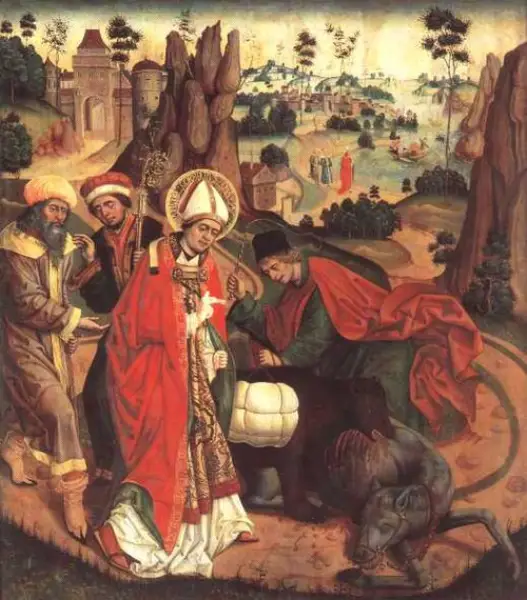
No early medieval missionary is remembered by a more striking emblem than Corbinian's harnessed bear. His hagiography relates that a bear slew the saint's pack animal on the Rome road, and Corbinian ordered the creature to shoulder his load instead; once there he set it free, and it trundled off to its home woods. The image proved inexhaustible. One interpretation sees the bear, tamed by God's grace, as the Bishop of Freising himself, and the pack saddle as the burden of his episcopate; another reads the animal's submission as Christianity's taming of the ferocity of paganism, setting down a base on which a great civilization could rise in the Bavarian duchy. The legend entered both civic and ecclesiastical heraldry as the symbol of Freising and appeared on the arms of Pope Benedict XVI, who adopted it when appointed Archbishop of Freising-Munich in March 1977, kept it as cardinal that June, and retained it on his papal coat of arms at his election in 2005. Benedict said the bear recalled Corbinian, founder of his diocese, and represented himself as "tamed by God" to bear the burdens of ministry. Artists followed the legend too, from Jan Polack's Miracle of the Bear of 1489 to Cosmas Damian Asam's painting of about 1725 and the narrative panels in the crypt of Freising Cathedral.
§ Corbinian's bear
Timeline
- 670
Born at Châtres near Melun in Neustria and baptized Waldegiso, bearing his father's name.
§ Life
- 724
Probably reaches Bavaria, commissioned by Pope Gregory II to minister to Duke Grimoald.
§ Life
- 725
Grimoald is slain and Biltrudis carried off by invaders; Corbinian, who had fled her wrath, returns at Duke Huebert's invitation.
§ Life
- 8 Sep 730
Dies at Freising on 8 September after resumed apostolic labor; the date later becomes his feast.
§ Life
- 738
Boniface reorganizes the Bavarian church into four dioceses; Erembert, Corbinian's brother, becomes first Bishop of Freising.
§ Life
- 769
Bishop Arbeo, his biographer, translates his remains from Merano to Freising cathedral.
§ Life
- Mar 1977
Joseph Ratzinger, newly appointed Archbishop of Freising-Munich, adopts Corbinian's bear for his arms.
§ In Catholic iconography
- Jun 1977
Made a cardinal this month, Ratzinger keeps the bear on his reworked heraldic arms.
§ In Catholic iconography
- 2005
The saddled bear appears on Benedict XVI's papal arms upon his election.
§ In Catholic iconography
The Record
- Major works
- Monastery and school near Freising, later Weihenstephan Abbey
- Patron of
- Freising, Germany·Archdiocese of Munich and Freising, Germany
- Symbols
- bear·bishop making a bear carry his luggage·bishop with a bear and mule in the background
- Canonization
- Pre-congregation; venerated in the Roman Catholic and Eastern Orthodox Churches
Prayer
Bibliography
Show 7 sources
- Jones, Terry. "Saint Corbinian". Patron Saints Index (archived 17 February 2007)
- Staley, Tony (3 September 2004). "From recluse to missionary". The Compass
- "Freising". Encyclopædia Britannica (2007)
- "Munich-Freising". Catholic Encyclopedia, Vol. 10. Robert Appleton Company (1911)
- "St. Corbinian". Catholic Encyclopedia, Vol. 4. Robert Appleton Company (1908)
- "The bear and the scallop-shell - a unique papal coat of arms". Catholic World News (27 April 2005)
- Ratzinger, Joseph. Milestones: Memoirs 1927-1977. Ignatius Press (1998). ISBN 0898707021
Profile text adapted from the Wikipedia article, licensed CC BY-SA 4.0.
Pray with this saint every day
Save St. Corbinian to your favorites, read the full profile, and get feast-day reminders in the Saints app.
Get the Saints AppFree on the App Store for iPhone and iPad